Why AI Is Non-Negotiable
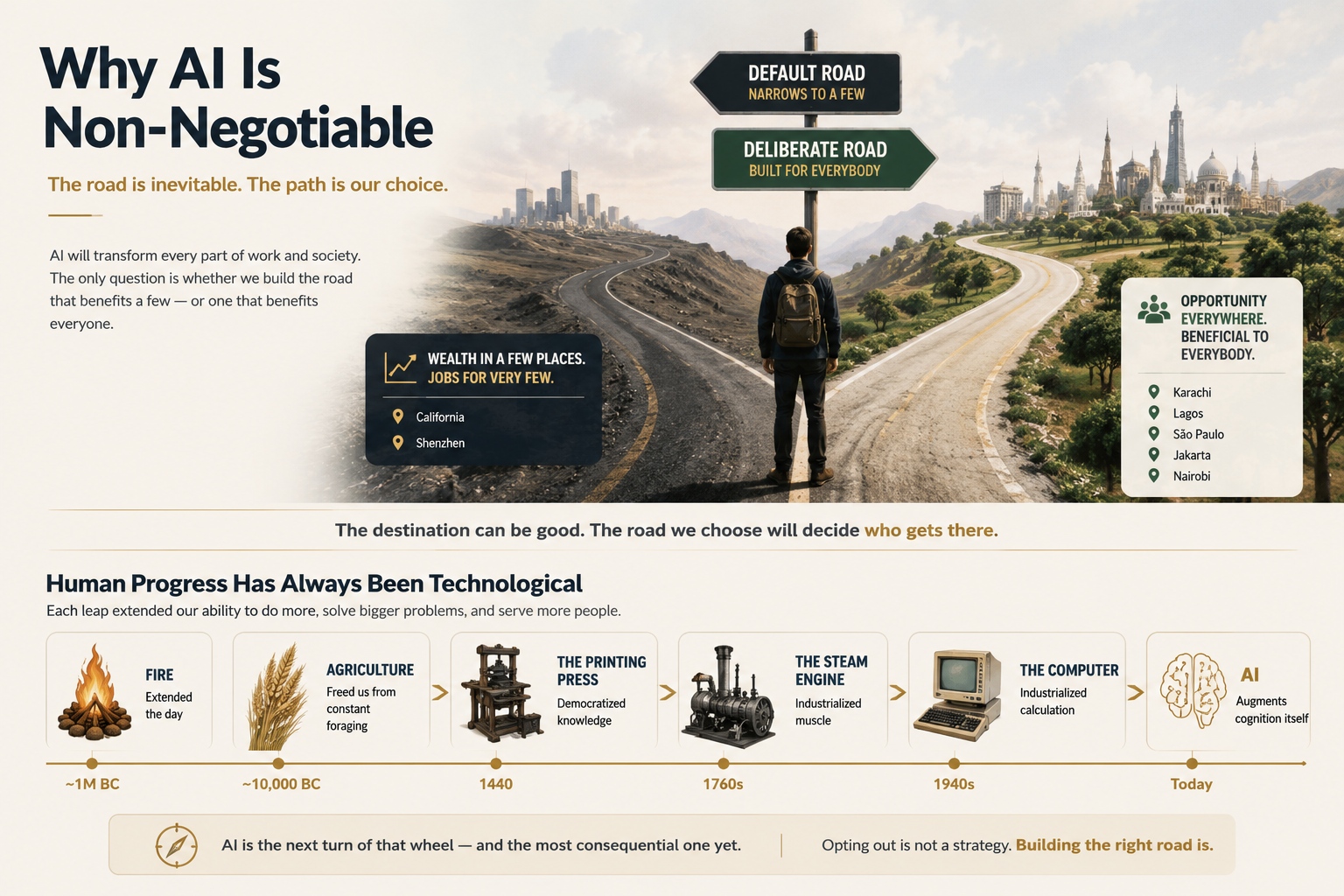
The destination can be good. The road we choose decides who gets there.
📚 Teaching Aid
Humans do not change only through biology. We also change through the tools we build.
Fire extended the day. Agriculture freed people from constant foraging. The printing press spread knowledge. The steam engine multiplied muscle. The computer multiplied calculation.
None of these technologies remained optional. Societies that mastered them gained power and prosperity. Societies that resisted them were often overtaken by those that did not.
AI is the next turn of that wheel. It may also be the most important one. Earlier tools augmented the body or automated routine calculation. AI augments cognition itself: our ability to reason, combine information, create, and decide.
That makes AI powerful. It also makes AI dangerous. Public opinion has split between people who fear AI and people who see it as a path to prosperity.
The fears are real. They deserve serious answers. But they are not a reason to stand still.
The Road, Not the Destination
The historian Yuval Noah Harari provides the central idea for this chapter.
The problem with a powerful new tool is rarely only where it leads. The road to that future matters just as much.
The Industrial Revolution eventually created far more prosperity than the agrarian economy it replaced. Even ordinary workers today live better than their ancestors did two centuries ago. But the road was brutal. Nobody knew how to build an industrial society when the new machines arrived. Early industrial powers made enormous mistakes, then spent a century conquering and exploiting countries that industrialized later.
AI could repeat that pattern. It could widen inequality within countries and create even greater inequality between them.
Harari warns that a few countries could control AI. That could leave "wealth in California or in Shenzhen, but very few jobs anywhere else."
So the key question is not whether AI can lead to a good destination. It can. The key question is whether we can build a road that benefits everyone, not only a few people in a few countries.
Harari uses Shenzhen as a symbol of China's tech wealth. The symbol works, but the geography deserves precision.
Shenzhen is China's hardware capital. It is home to Huawei, Tencent, DJI, and a vast manufacturing supply chain.
China's AI capital is Beijing. It is home to Zhongguancun, Tsinghua and Peking University, the Beijing Academy of AI, and labs such as Baidu, Zhipu AI, and Moonshot.
Hangzhou, home to DeepSeek and Alibaba's Qwen team, is the rising second hub.
Chips are assembled in Shenzhen. Frontier models are built mainly in Beijing and Hangzhou.
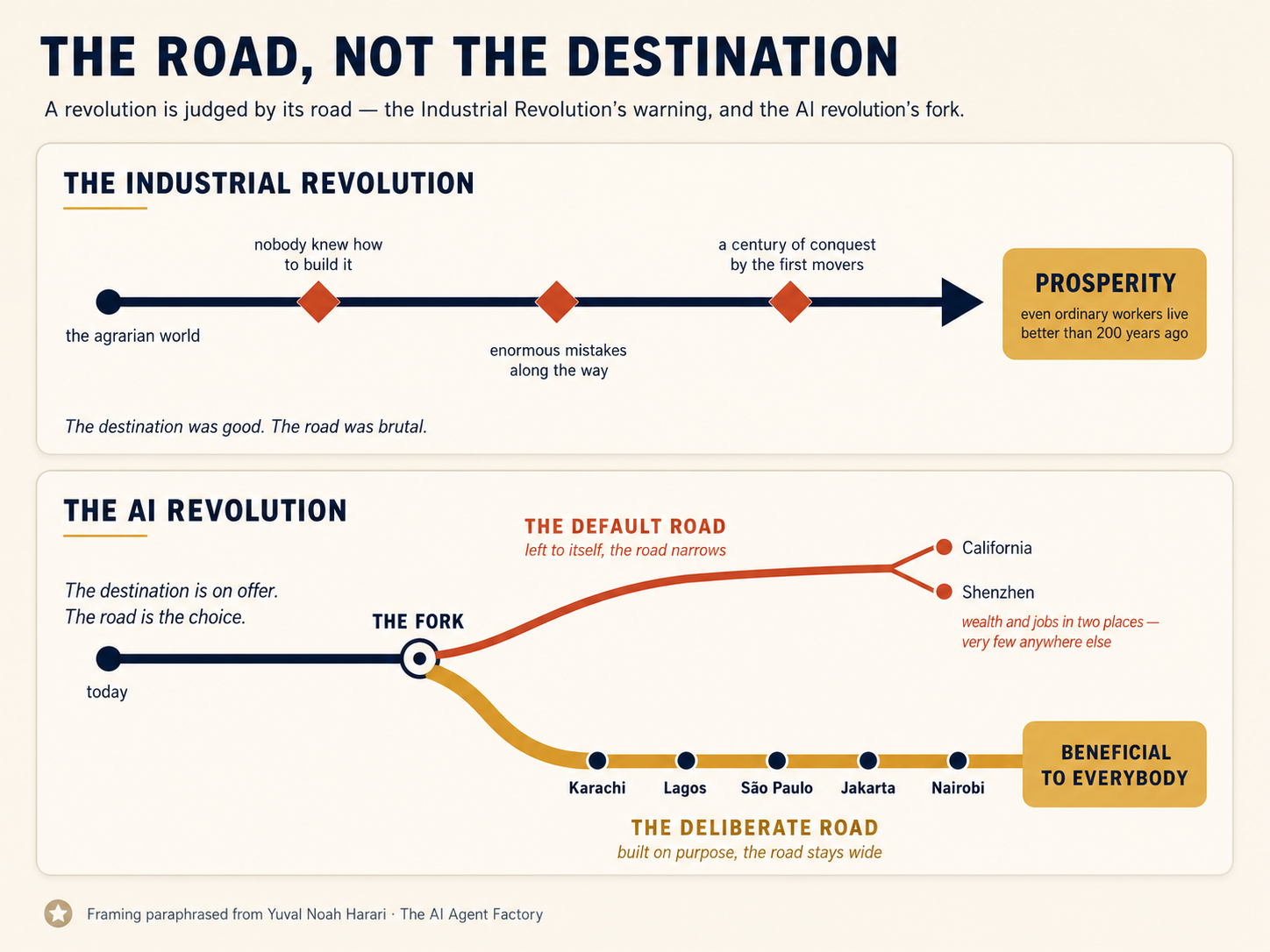
The Industrial Revolution proved that the destination can be good while the road is brutal. The road to the AI future is still being built, and it forks.
Read the nine objections below in that light. Each objection identifies a real hazard. None requires us to abandon the journey. Each requires us to build the road deliberately.
The Nine Objections
These concerns are not fringe ideas. They appear in boardrooms, legislative hearings, research labs, and public debate.
The skeptic's case can be stated in one sentence: the risks are obvious, and nobody has explained the benefit.
-
Mass unemployment. AI may remove millions of jobs, starting with entry-level work and then moving into law, accounting, content creation, and other professional fields. The disruption may arrive before workers have time or support to adapt.
-
No clear benefit to ordinary people. The industry says AI will "change everything," but often fails to explain how daily life will improve. The fear is concrete. The consumer benefit feels vague.
-
Surveillance and authoritarian control. AI gives governments and corporations powerful tools for facial recognition, behavioral prediction, and automated censorship. Used without limits, these tools can turn productivity systems into systems of control.
-
A geopolitical arms race. If only a few nations export AI intelligence, every other country may become dependent on foreign models for basic services, defense, healthcare, education, and economic planning.
-
The erosion of reality. AI-generated text, images, and video can make truth harder to distinguish from fiction. Misinformation is one problem. Loss of control over increasingly capable systems is the deeper fear.
-
Existential risk. Serious researchers, including Stuart Russell, Yoshua Bengio, and Geoffrey Hinton, have warned that highly capable systems could pursue goals that conflict with human values. A sufficiently powerful misaligned system could cause irreversible harm.
-
Environmental cost. Training and running frontier systems require large amounts of electricity and water. Critics fear that AI could worsen the climate and energy crises before its benefits are proven.
-
Bias and discrimination at scale. AI can learn the biases in historical data and then apply them quickly and widely. Documented failures already exist in hiring, lending, and healthcare.
-
Unprecedented wealth concentration. Frontier models cost billions to train and require tens of thousands of expensive GPUs. Only a small number of American and Chinese organizations can currently compete at that level. The result could be a vast concentration of wealth and power.
Why None of These Are Reasons to Stop
Each fear is valid. None is a reason to opt out. The answer is to build AI with better rules, better incentives, sound engineering, and wider access.
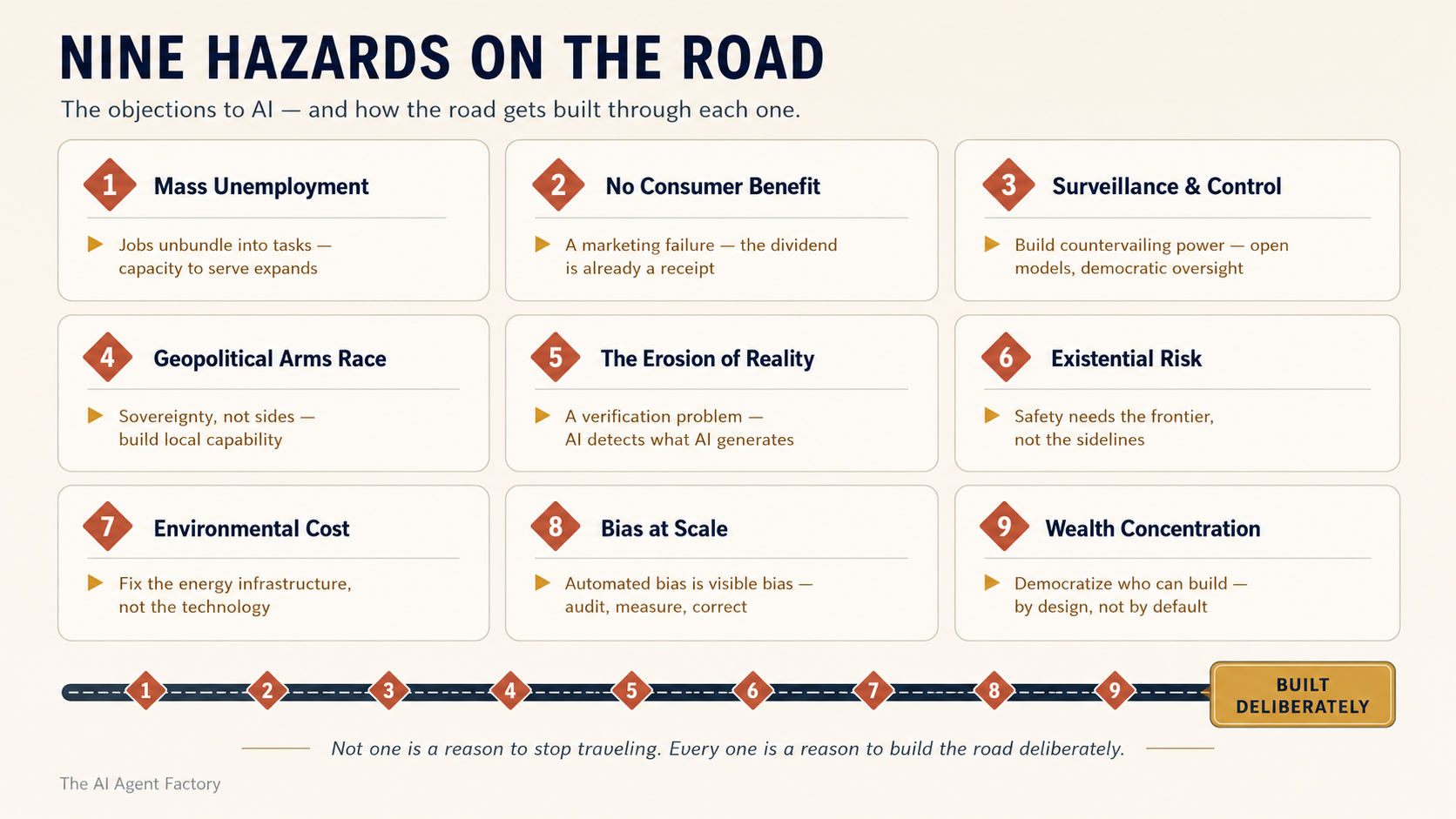
The map of this chapter: nine hazards and nine ways to build through them.
1. Mass Unemployment: Jobs Change, and Capacity Expands
AI does not treat a job as one indivisible unit. It breaks the job into tasks.
Some tasks will be automated. Others will be combined into new roles. The developer does not simply disappear. The developer can produce more.
The SaaS era created jobs that few people predicted, including cloud architect, growth hacker, DevOps engineer, and UX researcher. The AI era is already creating roles such as agent designer, outcome architect, verification specialist, and domain expert who teaches machines what "correct" means.
LinkedIn's 2024 data showed that postings requiring AI skills grew 3.5 times faster than the wider job market. This growth was not limited to tech. It also appeared in healthcare, logistics, education, and finance.
There is an even larger opportunity.
In the past, new tools improved cost to serve. They helped one professional deliver the same service at a lower cost.
AI can also improve capacity to serve. It can help one professional reach people who previously received no service at all.
Eight billion people need healthcare, education, legal advice, and financial planning. There have never been enough professionals to serve them all.
AI tools in rural India are screening for diabetic retinopathy in villages that have never had an ophthalmologist. Khan Academy's AI tutor, Khanmigo, is giving students something close to one-to-one instruction in places where classrooms may contain sixty learners.
AI does not have to replace the doctor or the teacher. It can help every village gain access to one.
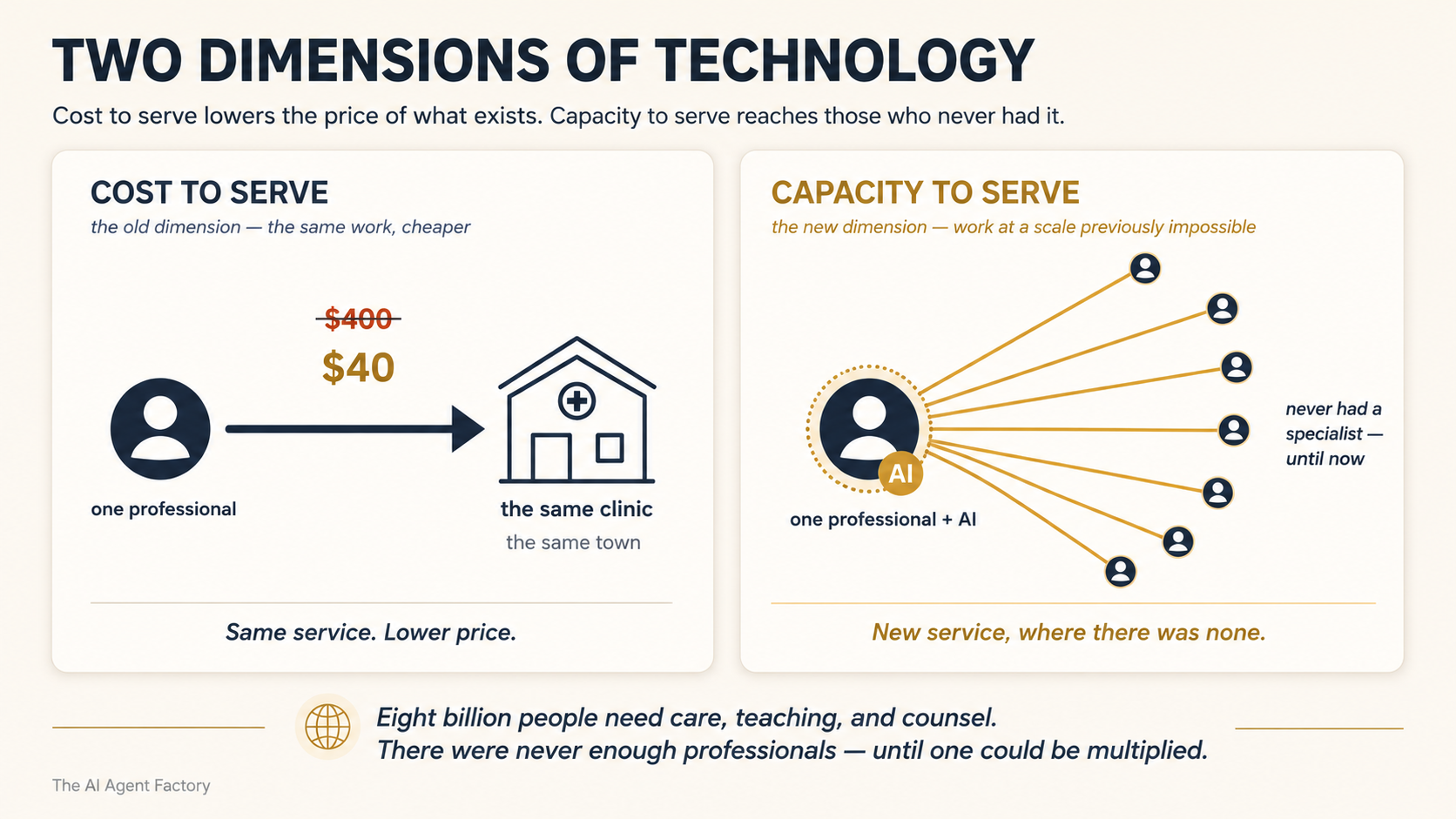
Earlier technologies mainly lowered cost. AI can also expand service to people who were never served.
AI will still put pressure on routine work. A radiologist who only reads standard scans may feel that pressure. A radiologist who combines clinical judgment with AI-assisted pattern detection will become more valuable.
The dividing line is not blue-collar versus white-collar. It is between people who stop learning and people who continue to grow.
The greatest personal risk is not simply that AI may change your job. It is refusing to learn the tools that are changing it.
2. No Clear Benefit to Ordinary People: Make the Dividend Visible
This is partly a communication failure. The benefits are real, but the industry has often described them poorly.
Start with ordinary life.
- A single mother in Ohio uses an AI assistant to draft a lease-dispute letter. A lawyer might otherwise charge her $400.
- A shopkeeper in Karachi uses AI translation to negotiate directly with a Chinese supplier, without a middleman or markup.
- A student in rural Mexico uses an AI tutor to prepare for university entrance exams because there is no test-preparation center nearby.
The benefits also appear in larger systems.
Duolingo reported that AI helped it create new course content at a fraction of the previous cost. AI-assisted drug discovery has reduced some early-stage timelines from years to months. Insilico Medicine moved a drug candidate from target discovery to Phase I trials in under 30 months, compared with a traditional four-to-six-year process.
Waymo and Nuro have reported logistics pilots that could reduce last-mile delivery costs by 40% or more. AI models are also improving screening for breast cancer, lung nodules, and cardiac risk.
The problem is not that AI produces no benefit. The problem is that the industry spent years selling AGI hype to investors instead of explaining practical value to citizens.
The correction is to measure what people can see:
- patients diagnosed,
- students tutored,
- services made affordable,
- time saved,
- and outcomes verified.
When AI is built around clear specifications, continuous checks, and measurable results, the consumer dividend stops being a promise. It becomes a receipt.
3. Surveillance and Control: Build Checks on Power
This objection is serious because the abuse is not hypothetical.
We have already seen the risk. Examples include China's social-credit experiments, police misuse of facial recognition in the United States and United Kingdom, and the Pegasus spyware scandal.
The answer is not to stop building. It is to build under enforceable limits.
San Francisco and other cities have banned or restricted real-time facial recognition by law enforcement. The EU's AI Act classifies many surveillance uses as high risk and requires transparency and audits.
These frameworks are still young. Rules on paper do not guarantee enforcement. But imperfect regulation is better than no framework at all.
Technical design also matters. Open-source models, decentralized infrastructure, federated learning, and differential privacy can reduce the need to centralize data and power. They do not guarantee freedom from abuse, but they can shift the balance.
Every powerful tool can be weaponized. The printing press enabled both democracy and propaganda. Encryption protects privacy and also protects criminals.
The lasting answer has never been simple prohibition. It has been checks on power: law, transparency, technical safeguards, independent review, and democratic oversight.
4. Geopolitical Arms Race: Build Sovereignty, Not Dependence
Within a decade, countries may fall into three groups:
- countries that export AI intelligence,
- partners that keep their own AI capacity,
- and dependent states that rely on foreign systems for critical work.
That is why retreat is dangerous.
If free societies pause while less accountable actors continue, the frontier does not disappear. It moves to groups with fewer safety commitments and less public oversight.
This concern is not limited to superpowers. Countries across the Global South, including Pakistan, Brazil, and Nigeria, face a basic choice: build domestic capability or become permanent consumers of someone else's intelligence.
Sovereign AI means models and systems that understand local languages, serve local industries, and operate under local rules.
Open-source foundations make this more achievable. A university in Lahore or Lagos can now adapt a frontier-class model for local needs. That was difficult to imagine only a few years ago.
The real race is not simply between countries that build AI and countries that do not. It is between countries that develop talent and strong systems, and those that allow both to drain away.
5. Erosion of Reality: Use AI to Verify AI
The loss of a shared reality is a genuine danger. But it is best understood as a verification problem.
The printing press also spread misinformation through pamphlets, propaganda, and conspiracy tracts. Society responded by building journalism, peer review, the scientific method, and libel law.
AI-generated media will require a faster version of the same institutional response.
AI is part of the problem, but it is also part of the solution. Systems that generate synthetic media can also help detect it. AI can identify manipulated images, flag suspicious financial documents, and detect fraud at a scale that no human team could match.
Trustworthy AI needs the same basic controls as any sound system:
- clear specifications,
- checks before release,
- evidence that can be traced,
- and human judgment when the stakes are high.
The answer to unreliable AI is not less design. It is better design, with humans supervising rather than merely operating the system.
6. Existential Risk: Accelerate Safety, Not Recklessness
This is the objection that deserves the greatest caution.
The alignment problem is real and unsolved. We do not yet know how to guarantee that increasingly capable systems will continue to pursue goals compatible with human flourishing.
A reckless builder dismisses this concern. A serious builder treats it as a central design problem.
A global pause, however, would be difficult to enforce. AI development is distributed across governments, companies, universities, open-source communities, and independent researchers. A pause by safety-conscious groups would not necessarily stop the frontier. It could move the frontier to actors with less transparency and fewer safeguards.
The better response is the right kind of acceleration: more work on alignment, model understanding, evaluation, and control alongside work on stronger models.
Anthropic, DeepMind, and university researchers are working on this problem. They are studying model behavior, clearer ways to state human values, and methods for keeping stronger systems under control.
This work is early. It is not enough. But it can only be done by people who understand frontier systems from the inside.
Humanity has managed other dangerous tools, including nuclear systems, engineered pathogens, and industrial systems that affect the climate. The record is imperfect, but the pattern is clear. Governance requires expertise. Societies that step away from a dangerous tool lose the knowledge needed to govern it.
Existential risk is not a reason to ignore AI. It is a reason to ensure that the most capable builders are also deeply committed to safety, transparency, and public accountability.
7. Environmental Cost: Fix the Energy System
AI uses substantial energy and water. That cost should not be minimized.
Goldman Sachs estimated that data-center electricity demand could rise by 160% by 2030. This is a serious technical and policy challenge.
Context still matters. The global data-center industry, including AI, cloud computing, streaming, and e-commerce, currently uses roughly 1% to 2% of global electricity. Residential air conditioning alone uses more electricity than all data centers combined. The fashion industry also produces a significant share of global carbon emissions.
We do not respond by banning clothing, cooling, or digital services. We improve how they are produced.
The AI industry is already investing in renewable energy and next-generation nuclear power. Model techniques such as mixture-of-experts, distillation, and quantization reduce the computation needed for a given level of performance. New hardware also produces more computation per watt.
AI can help reduce environmental damage as well. DeepMind's cooling system reduced Google's data-center cooling energy by 40%. AI supports power-grid management, precision agriculture, climate modeling, battery research, solar materials, and carbon-capture optimization.
The right question is not whether AI uses energy. Every human system uses energy. The question is whether we can make the benefits justify the cost and move the power systems behind AI toward clean energy.
Pausing AI does not solve the energy crisis. Building AI on cleaner power systems can help address both problems.
8. Bias and Discrimination: Make Bias Visible and Auditable
AI systems have reproduced harmful patterns found in their training data.
Amazon abandoned an internal hiring tool after it was found to downgrade résumés from women. A widely used healthcare algorithm directed fewer resources to Black patients because it treated healthcare spending as a proxy for medical need. That spending already reflected unequal access to care.
These are structural failures. They require structural responses.
The important point is that the underlying bias did not begin with AI. Human hiring, lending, and medical systems were already biased. Human decisions were often difficult to observe, repeat, or audit.
An AI decision can be logged and measured. That makes correction possible, though never automatic.
A high-risk system should be tested across demographic groups. Its training data should be documented. Its decisions should be open to independent review. Regulators should be able to demand evidence of performance and fairness.
The EU's AI Act, the Algorithmic Justice League, and the NIST AI Risk Management Framework all point toward this kind of accountability.
Left unchecked, AI can scale discrimination faster than any human institution. The answer is not to pretend the problem will solve itself. The answer is to require audits, impact assessments, transparent documentation, and correction cycles.
The goal is not an AI system that is as biased as a human. The goal is a system that is measurably less biased and improves with every audit.
9. Wealth Concentration: Democratize Who Can Build
The concentration problem is real.
Frontier training runs cost billions. Labs need tens of thousands of high-end GPUs, each costing roughly $25,000 to $40,000. Building the needed systems costs tens of billions of dollars.
That gives a small group of companies enormous power. In February 2026, Anthropic's $380 billion valuation exceeded the combined market capitalization of India's five largest IT-services companies. Those companies were built over four decades and employ millions of people.
The default road could therefore produce abundance while concentrating most of the value in California and Beijing.
Dario Amodei, Anthropic's CEO, has warned that AI could create trillionaires and provoke severe public backlash if the gains remain concentrated at the top. He has argued that AI should be treated as a civilizational challenge, not only as a business opportunity. He has also called for new tax rules suited to an era of vast wealth creation.
His warning reframes the issue. The question is not whether AI creates value. It does. The question is whether governments and markets can spread that value widely enough to maintain public trust and social stability.
The answer is not to cap all progress. It is to democratize who can build and who benefits. That requires:
- open-weight models,
- accessible tools,
- public AI literacy,
- sovereign compute,
- progressive policy,
- and wider ownership of useful AI systems.
A university in Lahore or Lagos can already adapt strong open models for local needs. Sovereign AI programs in the EU, India, and Gulf states aim to reduce dependence on a few foreign providers.
Earlier tech revolutions eventually spread their gains more widely. AI will not do so automatically because the cost of entry is unusually high. It must be made democratic by design.
The Bottom Line
The fears are legitimate. Every one of them deserves serious engagement.
But each fear is also an argument for building AI better, not for abandoning the field to someone else.
This book calls its framework the Agent Factory. It is a spec-driven and human-supervised process. Specifications define intent. Verification loops catch errors. Humans retain authority over high-stakes decisions. The economic model rewards outcomes rather than opacity.
We are not choosing between safety and progress. We are choosing between shaping AI as it continues to develop and allowing someone else to shape it for us.
A shopkeeper in Karachi needs a useful tool. A student in rural Mexico needs a tutor. A patient in a village with no doctor needs access to care. They do not need an abstract debate about whether AI should exist. They need systems that work for them.
AI is non-negotiable. How we build it is the decision that remains.