Digital FTE Founders & FDE Program
From certified AI engineers to startup founders and Service Forward Deployed Engineers.
This is a 24-week program for engineers who have passed PCAO-F, Panaversity's Associate Foundations exam. It ends with a working Digital FTE built for a real customer. A Digital FTE is an AI worker designed to perform a defined business role, with clear responsibilities, measurable results, and appropriate human oversight. FTE means full-time equivalent, the work of one full-time employee. The program leads to two roles. One is startup founder. The other is Forward Deployed Engineer, or FDE. An FDE is an engineer who works inside a customer's business to make a product work there.
Pass PCAO-F and you become eligible immediately. Enrollment is automatic and there is no program fee. You join the next Stage 2 cycle after you pass. A cycle is one scheduled run of a stage, and a new cycle starts every 12 weeks. The first cycle begins in February 2027.
The program has four stages. Stage 1 is passing PCAO-F. Stage 2 and Stage 3 are the 24-week core, 12 weeks each. Stage 4 comes after graduation and has no end date.
Stage 2 is the common foundation for everyone. You pass PCAR-F, Panaversity's Architect Foundations exam; build your first Digital FTE pilot and contribute to the shared Digital FTE tools; and interview at least ten possible customers while studying candidate verticals. You state your preferred track when you enter, and your track is confirmed at the end of Stage 2.
In Stage 3 your team builds one Digital FTE for one vertical, with a real customer. A vertical is one industry or one business function, such as banking or customer support. Founders build the shared tools, then a product and a company of their own. They leave with a product and an application package for startup programs. Service FDEs deploy Digital FTEs for real customers, leave with a documented real deployment, build a deployment portfolio, and move toward placement. Placement means a job with one of Panaversity's client organizations.
Quick glossary
- Digital FTE: an AI worker that performs one defined business role, with clear responsibilities, measured results, and human oversight. FTE means full-time equivalent.
- Forward Deployed Engineer, or FDE: an engineer who works inside a customer's business to make a product work there.
- Service FDEs: the FDEs in this program. They deploy Digital FTEs for real customers.
- vertical: one industry or one business function, such as banking or customer support.
- cycle: one scheduled run of a stage. A new cycle starts every 12 weeks.
- stage-gate review: the review at the end of a stage. It results in Pass or Revise.
- pilot: the first limited run of a new system with real users, under close supervision.
- placement: a job with one of Panaversity's client organizations after graduation.
- Zia Developer AI: a plugin for Claude Code and OpenCode that turns a business problem into a spec and a working agent.
- KSoR: the open-source Knowledge System of Record SDK used to build governed knowledge records for professions, industries, and organizations. Vertical KSoRs can expose that governed knowledge to AI agents through MCP.
- Vertical Digital FTE Builders: reusable systems for creating Digital FTEs for specific industries and business functions.
- credits: free cloud or AI usage that companies give to startups.
- equity: a share of ownership in a company.
- accelerator: a short program that gives a startup money and coaching, usually for a share of the company.
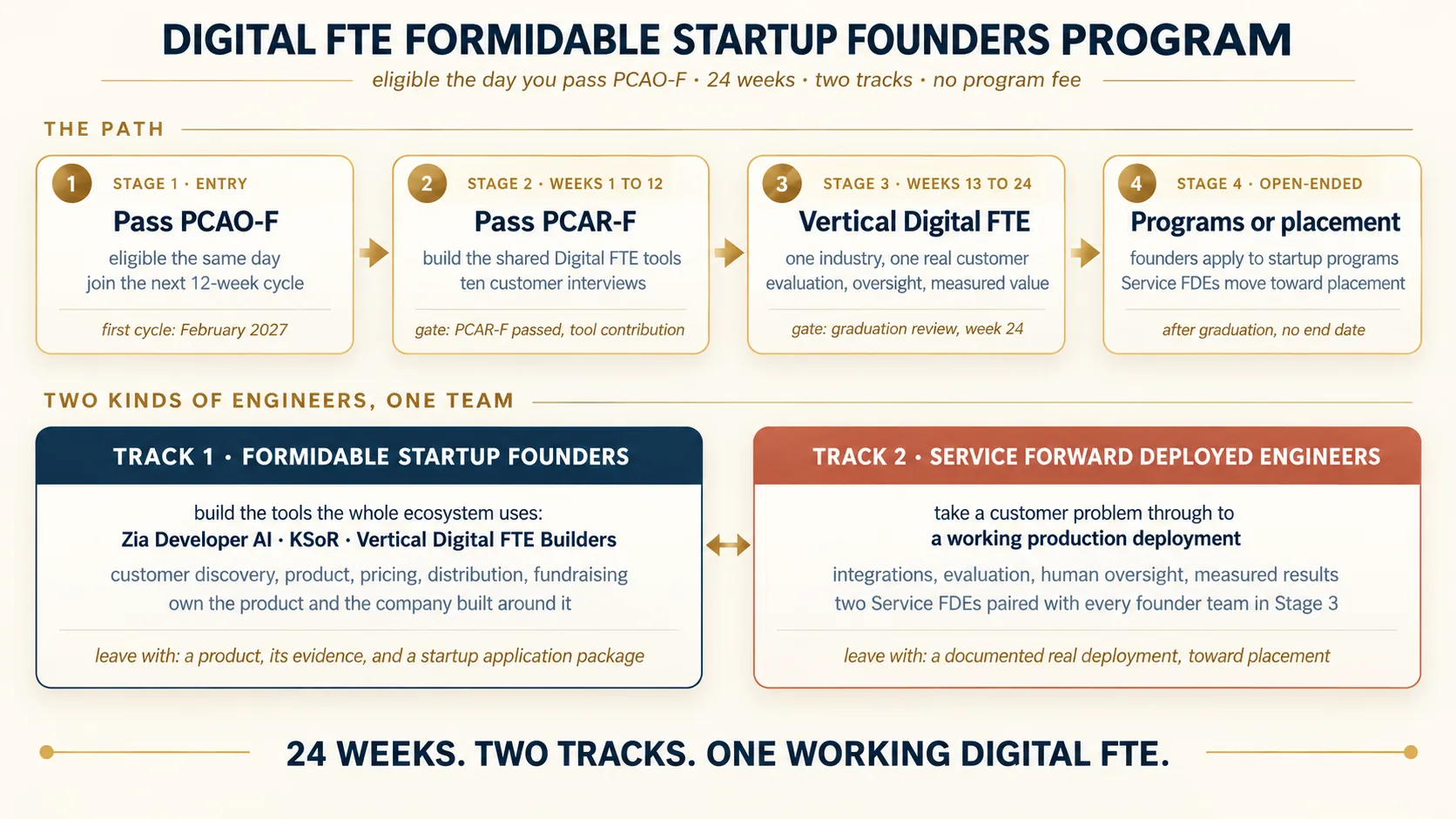
Executive Summary: From Certification to Startup Founder or Service FDE
Panaversity's first students take PCAO-F, the Associate Foundations exam, from September 20, 2026. Passing this exam is not the end of the journey. It opens the door to the next stage of your professional development.
The day you pass PCAO-F, you become eligible for the program and are automatically enrolled in the next Stage 2 cycle. Stage 2 is a common foundation for everyone. You state your preferred path when you enter, and your track is confirmed at the end of Stage 2 based on your work, customer discovery, and intent to form a company.
Track 1, Formidable Startup Founders. This track is for students who want to build the tools, frameworks, platforms, and companies that will power the Digital FTE economy. You will work toward building a real startup and incorporating a U.S.-based company. You will prepare to apply to leading startup incubators and accelerators, such as Y Combinator, a16z Speedrun, Sequoia Arc, and others. Complete details: Track 1 below.
Track 2, Service FDEs. This track is for students who want to become Forward Deployed Engineers capable of working directly with customers. You will learn how to use the tools and frameworks developed by the Founder teams to:
- Understand a customer's business problem.
- Design the appropriate Digital FTE.
- Customize and integrate it with existing systems.
- Deploy it inside the customer's organization.
- Improve and operate it in the real world.
Complete details: Track 2 below.
In simple terms: Startup Founders build the tools. Service FDEs use those tools to build Digital FTEs for customers. We need both.
The Common Foundation: Your First Three Priorities
During Stage 2, everyone works on three things at the same time.
- Prepare for and pass the Architect Foundations exam. You will move beyond Associate-level knowledge and begin developing the architecture skills required to design production-grade agentic systems. Exam and study guide: PCAR-F.
- Build your first Digital FTE pilot and contribute to the shared tools. You will apply what you have learned by building a working FTE pilot, the First Pilot, an AI support worker for GIAIC/PIAIC/Panaversity. From there, you begin contributing to the shared Digital FTE tools and frameworks.
- Talk to real customers and study possible verticals. Every team completes at least three customer interviews during Stage 2. What you learn helps shape the product, the customer problem, and the vertical you will pursue in Stage 3.
After the Common Foundation, Your Track Is Confirmed
Founder track. You will begin developing reusable Digital FTE tools and frameworks. One of the first major projects will be Zia Developer AI. Zia Developer AI is an AI system for building Digital FTEs. Requirements: Zia Developer AI Requirements. From there, Founder teams will work toward:
Build Tools → Build Products → Incorporate a Startup → Acquire Customers → Apply to World-Class Incubators
Service FDE track. You will focus increasingly on solving real customer problems using the tools created by the Founder teams. Your progression will be:
Understand the Business → Design the FTE → Configure and Integrate → Deploy for a Real Customer → Document the Deployment → Build a Deployment Portfolio → Move Toward Client Placement
The objective is to develop FDEs who can walk into an organization, understand how it operates, deploy Digital FTEs that create measurable business value, and build evidence of successful real-world deployments.
One Ecosystem, Two Career Paths
Pass PCAO-F → Join the Next Stage 2 Cycle → Pass PCAR-F + Build the First Digital FTE Pilot + Contribute to Shared Tools + Interview at Least 3 Customers → Track Confirmed
From there:
Founder → Build reusable tools and products → Build a vertical Digital FTE → Form a company → Acquire customers → Prepare startup-program applications
Service FDE → Work with real customers → Integrate and deploy Digital FTEs → Complete a documented deployment → Build a deployment portfolio → Move toward client placement
We are not preparing students only to pass certifications. We are preparing one group to build the Digital FTE platforms of the future. We are preparing another group to take those platforms into companies and put them to work.
Purpose
The Digital FTE Founders & FDE Program is part of the Panaversity FDE Internship Program. It prepares students to build AI tools, frameworks, and industry-specific AI workers. It then helps them turn that capability into startups that can grow, or into professional deployment services for customers.
Students become eligible the day they pass PCAO-F, Panaversity's Associate Foundations exam, and join the next Stage 2 cycle. They continue in the internship after passing PCAR-F, Panaversity's Architect Foundations exam. The core program runs 24 weeks. Every participant helps build real Digital FTE tools and frameworks. Each finishes with a working vertical Digital FTE, ready to present to customers and to leading startup programs.
Two Kinds of Engineers
The program trains two kinds of engineers. Both hold Panaversity's Claude-focused certifications and are prepared for Anthropic's official exams. Both begin with the same Stage 2 common foundation after passing PCAO-F. Students state a preferred track at entry, and track assignment is confirmed at the end of Stage 2.
Track 1: Formidable Startup Founders
This track develops engineers who can identify valuable problems, build products that customers choose, and start companies that grow.
Founders build and improve the tools and frameworks that the whole ecosystem uses, such as:
- Zia Developer AI: a plugin for Claude Code and OpenCode. It turns a business problem written in plain language into an architecture decision, a spec, and a working agent that is ready to deploy. Overview: Zia Developer AI
- KSoR, the Knowledge System of Record SDK: an existing open-source foundation for building governed knowledge records for professions, industries, and organizations. Founder teams can use and contribute to KSoR rather than rebuilding a knowledge platform from scratch. Vertical KSoRs expose approved domain knowledge to AI agents through MCP.
- Vertical Digital FTE Builders: reusable systems for creating Digital FTEs for specific industries and business functions.
The Agent Factory System of Record is already live over MCP and supplies the shared Agent Factory method. KSoR provides the reusable foundation for building governed Vertical Systems of Record. Zia Developer AI consumes these governed sources to specify, build, test, and hand over Digital FTEs. The projects therefore form complementary layers rather than duplicating one another.
Founders learn to combine engineering with customer discovery, product development, pricing, distribution, and fundraising. Customer discovery means talking to possible customers to learn what they need before you build. Distribution means how a product reaches its customers. Fundraising means raising money from investors.
The goal is to build a product that customers need and a company capable of delivering it at scale.
The First Pilot page describes the first worker every team builds, the GIAIC/PIAIC/Panaversity AI Support worker. The Zia Developer AI Requirements describe the builder that founder teams develop next. The pilot is that builder's first customer worker. Both pages are published in this section.
Track 2: Service Forward Deployed Engineers
This track develops Service FDEs, Forward Deployed Engineers who work directly with customers to implement Digital FTEs.
Using the shared tools and frameworks built or improved by the Founder teams, Service FDEs learn to:
- Understand customer workflows and find suitable opportunities for AI workers.
- Configure and extend tools to meet specific business requirements.
- Connect Digital FTEs to customer systems, knowledge, and communication channels.
- Evaluate reliability, set up human oversight, and deploy working solutions.
- Measure business results and improve performance after deployment.
The goal is to develop engineers who can take a customer problem through to a successful production deployment.
The two tracks work closely together. Founders provide reusable products. Service FDEs bring implementation experience and customer feedback that improve those products. After graduation, Service FDEs continue toward placement with Panaversity's client organizations.
Program Structure
- Duration: 24 weeks from the start of Stage 2. Stage 2 runs 12 weeks and ends with the PCAR-F exam. Stage 3 runs 12 weeks and ends with the graduation review. Stage 4 is open-ended, continues after graduation, and is not counted in the 24 weeks. Waiting time before a cycle starts is also not counted.
- Entry: Students become eligible the day they pass PCAO-F and join the next scheduled Stage 2 cycle. Cycles begin every 12 weeks. The first cycle begins in February 2027.
- Team size: Founder teams have two to three engineers. Each founder team is paired with two Service FDEs for Stage 3.
- Track selection: Students state a preferred track at entry. Track assignment is confirmed at the end of Stage 2, based on each student's Stage 2 work, customer interviews, and intent to form a company.
- Customer access: A pilot is the first limited run of a new system with real users, under close supervision. Panaversity introduces pilot customers from its client network, and teams also contact possible customers on their own. Every team has at least one possible customer identified before Stage 3 begins.
- Reviews: Each team has a weekly progress review with a mentor. Each stage ends with a stage-gate review. This is a review by Panaversity instructors and industry mentors, and it results in Pass or Revise. See Stage Gates and Assessment.
- Format: Hybrid, which means partly in person and partly online. Live weekend sessions take place in Karachi, Lahore, Islamabad, Faisalabad, and Peshawar, and online for students elsewhere. Expect about 20 hours of project work per week.
- Costs: No program fee. Panaversity provides shared development infrastructure for program work: hosting, databases, and a Claude API usage allowance per team, set for each cycle. Students supply their own computer and internet connection, and pay Anthropic's exam fees if they take the official exams. Startup credits are free cloud or AI usage that companies give to startups. When a team wins credits, they add to what Panaversity provides, but the program never depends on them.
The Path
Stage 1: Entry
Pass PCAO-F, Panaversity's Associate Foundations exam. Students become eligible for this program the day they pass it and join the next Stage 2 cycle.
Panaversity assists program participants with registration for Anthropic's official exams. These are Claude Certified Associate Foundations (CCAO-F) and Claude Certified Architect Foundations (CCAR-F). Taking them is optional. Students are encouraged to take each Anthropic exam after passing the matching Panaversity exam. PCAO-F and PCAR-F are Panaversity credentials. The Anthropic credentials are awarded only by Anthropic.
Stage 2: Architect Certification, Tool Building, and Customer Discovery (weeks 1 to 12)
Students work on three things at the same time:
- Prepare for and pass PCAR-F, Panaversity's Architect Foundations exam, using the Panaversity PCAR-F Study Guide.
- Build your first Digital FTE pilot, then the shared tools. Every team starts with the First Pilot, the GIAIC/PIAIC/Panaversity AI Support worker. Founder teams then move on to the shared Digital FTE tools and frameworks, starting with the Zia Developer AI project.
- Talk to customers and study verticals. Every team interviews possible customers and studies candidate verticals while it builds. Teams complete at least three customer interviews in Stage 2 and record what they learn. These findings shape what the team builds and which vertical it selects in Stage 3.
Founders build the core tools and frameworks.
Service FDEs build alongside them and have their own pieces of work to deliver. These include integrations with common business systems, deployment templates, evaluation datasets, sample workflow implementations, documentation, and testing with possible users. This work is released as part of the shared tools. It does not wait for the founder teams to finish.
Founder teams also sign up for the early startup resources listed under Startup Programs below. These provide credits and community, take no equity, and do not require a finished product. Equity means a share of ownership in a company.
Passing PCAR-F is the gate to continue in the internship. Students who have not passed by the end of Stage 2 may retake the exam. On passing, they join Stage 3 in one of two ways. They can join a cycle that is already running, with a catch-up plan agreed with their mentor. Or they can start at the beginning of the next cycle.
Stage 3: Vertical Digital FTE Project (weeks 13 to 24, internship)
Each team selects a business vertical, informed by its Stage 2 customer interviews, and builds its first industry-specific Digital FTE. Use the Choosing Your Vertical guide to structure the choice.
Each project should demonstrate:
- A clearly defined customer, business problem, and AI worker role.
- A working product that performs a useful business workflow.
- Integration with the tools and information the workflow needs.
- Evaluation, monitoring, and a clear way to hand difficult cases to a human.
- Customer feedback, preferably through a real pilot.
- Measurable value, such as time saved, improved accuracy, or faster service.
Founder teams use this project to test their product and business model. Customer feedback is required. A pilot is strongly preferred but not mandatory, because what the founder must deliver is the product and the evidence behind it.
Service FDEs must complete a deployment for a real customer, either a pilot or a production deployment, and document it. This is the main thing a Service FDE must deliver. If a customer delays participation beyond the stage, there are two options. Panaversity assigns another pilot customer, or the Service FDE completes the deployment in a reference environment. A reference environment is a practice copy of the customer's real workflow that Panaversity hosts. Either option satisfies the requirement.
Stage 3 ends with the graduation review in week 24. Founder teams present their vertical Digital FTE and their application package for startup programs. Service FDEs present their deployment documentation.
Stage 4: Startup Programs and Placement (open-ended, after graduation)
Stage 4 has no fixed length and no end date.
Founder teams apply to the funding and accelerator targets under Startup Programs when their product and customer evidence are ready. An accelerator is a short program, often three months long, that gives a startup money and coaching, usually for a share of the company. Panaversity continues to support them with reviews of application materials, introductions, and interview practice. Teams keep acquiring customers and improving their products while they wait for answers. Admission to any program is competitive and is not a condition of graduation.
Service FDEs continue into production support for their customer deployments, build a portfolio of deployments, and move toward placement with Panaversity's client organizations.
Stage Gates and Assessment
Each gate results in Pass or Revise. Revise allows one more submission. A second unsuccessful submission ends the student's place in the current cycle. The student may rejoin a later cycle at the same stage.
| Gate | Evidence required |
|---|---|
| End of Stage 2 (week 12) | PCAR-F passed. At least one engineering contribution to the shared tools, merged (accepted into the shared code) or still in review. Three documented customer interviews. A proposed vertical with a written reason for the choice. |
| End of Stage 3 (week 24, graduation review) | A working vertical Digital FTE. Evaluation results. Customer feedback. Evidence against the agreed business measures. Founders: the application package. Service FDEs: the deployment documentation. |
Graduation Requirements
A student graduates at the end of Stage 3 when the following are complete. Graduation does not depend on acceptance into any startup program.
- PCAO-F passed.
- PCAR-F passed.
- A shipped contribution to a Digital FTE tool or framework, reviewed and merged by the maintainers.
- A working vertical Digital FTE that meets the Stage 3 criteria.
- Founders: a complete application package for startup programs. Service FDEs: a documented customer deployment, pilot or production, as defined in Stage 3.
Anthropic's CCAO-F and CCAR-F exams are recommended, and Panaversity assists participants with registration, but they are optional and not required for graduation.
Ownership and Intellectual Property
Students sign this policy before Stage 2 begins.
Shared tools and the license: The tools and frameworks built or improved as Stage 2 program work are released as open source under the Apache License 2.0. This includes contributions to Zia Developer AI, KSoR, and Vertical Digital FTE Builders. Open source means anyone can read, use, and change the code. This license lets anyone use and change the tools, including in commercial products. By itself, it does not require anyone to share their changes.
What you must contribute: The duty to contribute comes from the program agreement, not from the license. Improvements to the shared tools that a student makes as program work are contributed to the shared repositories under Apache 2.0. This keeps the ecosystem open to everyone who built it. Work done for a customer follows the customer engagement agreement described below.
Who runs the shared repositories: Panaversity hosts the shared repositories in the panaversity organization on GitHub and names the maintainers. A maintainer is a person who reviews and accepts changes to a repository. Contributions arrive as pull requests, which are proposed changes. A maintainer reviews each one. When it meets the contribution guidelines, the maintainer merges it, which means adds it to the shared code. Contributors accept the project's contributor agreement before their first merge.
Founder products: A founder team owns the vertical Digital FTE product it builds in Stage 3 and the company it forms around that product. The shared tools and the founder's commercial product are different things. The tools are the open source foundation, and the product is what the company sells on top of that foundation. The shared tools use a permissive license, which allows this. So a company may keep its product proprietary, which means closed and owned only by the company.
Service FDEs on a founder's product: A Service FDE may work on a founder team's product in Stage 3. This happens only under a written contributor agreement signed before the project begins. The agreement states the FDE's compensation, which means what the FDE receives for the work. That can be a stated equity grant, a payment, or both. The agreement also confirms that the founder team owns the product. Without a signed agreement, Service FDEs work only on the shared tools, not on a founder team's product.
Work done for a customer: Configurations, data, and workflows built for a specific customer belong to that customer under the engagement agreement. Improvements to the shared tools that come out of customer work go back into the shared tools only where the engagement agreement allows it.
Panaversity's position: Panaversity runs the platform and takes no equity in student companies. Founder teams keep the products and companies they build. Service FDEs keep what their signed agreements assign to them.
Startup Programs
Links below were checked on September 16, 2026. On that date, the investment terms for Y Combinator, Techstars, Conviction Embed, a16z Speedrun, and the Anthology Fund were taken from each program's own pages. So were the eligibility notes for Sequoia Arc and Entrepreneurs First. A batch is one group of startups that goes through a program together. All other terms change by batch and location. Confirm every program's current terms on its own page before applying, and confirm that it is taking applications now. If you cannot find a program's most recent batch, mark it "current intake unconfirmed" until someone checks it. Intake means the period when a program accepts applications.
Words you will meet in the startup tables
- Accelerator: a short program, often three months long, that gives a startup money and coaching, usually for a share of the company.
- Equity: a share of ownership in a company. Common stock: the ordinary shares of a company.
- Credits: free usage of a company's cloud or AI service, given to startups.
- Raise: to take money from investors in exchange for equity. "After you raise" means after your first investment round.
- Institutional funding: money from an investment firm, not from friends or family.
- SAFE: an agreement where an investor pays now and receives shares later, at your next priced round.
- Priced round: the first time investors buy shares at a set company value.
- Uncapped: the SAFE sets no maximum company value for its later conversion.
- MFN: most favored nation. The SAFE takes the best terms you give any other early investor before the priced round.
- Valuation cap: the maximum company value used to convert a SAFE into shares.
- Discount: a lower share price for the SAFE investor than for the priced-round investors.
- Pre-seed and seed: the first two rounds of startup funding. Series A: the round after seed.
- Traction: real customers, revenue, or usage that is growing.
- Incorporate: create the company as a legal entity. Flip: move that legal entity to another country. Headquartered: where the company's main legal office is.
- Batch: one group of startups that goes through an accelerator together.
- Emerging markets: countries with fast-growing but still developing economies, such as those in South Asia, Africa, the Middle East, and Latin America.
Early startup resources (credits and community, subject to eligibility)
Sign up during Stage 2. These take no equity and do not require a finished product. Most require a company email address and a website.
| Program | Notes | Link |
|---|---|---|
| Claude for Startups | Open to any early-stage founder. Credits and extras require institutional equity funding and a company founded within the last four years. Join early for the community, then apply for credits after you raise investment. | Program and application |
| AWS Activate | Cloud credits for early-stage startups. | Program |
| Microsoft for Startups | Azure credits and startup benefits. | Program |
| NVIDIA Inception | Free program for AI startups with technical and go-to-market support. | Program |
Startup funding and accelerator targets: start here in Stage 4
Ten programs that fit students from this program best. Some are accelerators, some are investment funds, and some are open-call investment programs with company-building support.
| Program | Terms and fit | Where | Link |
|---|---|---|---|
| Y Combinator | $500K total: $125K for 7% plus $375K on an uncapped MFN SAFE that converts into additional equity at the next round. The best-known program for developer-tool startups. You can apply before you incorporate. | San Francisco, in person | Apply |
| a16z Speedrun | Up to $1M plus $10M or more in credits. Two cohorts a year. Open to founders from any country, with visa and relocation support. | United States, relocation expected | Apply |
| Conviction Embed | $250K on an uncapped, no-discount MFN SAFE, plus large compute credits. AI-native teams only. | Required in-person retreat in San Francisco | Program and application |
| Sequoia Arc | Twice-yearly open call for pre-seed and seed founders, with a company-building program. Only companies headquartered in the Americas or Europe are eligible. | Americas and Europe, hybrid | Program |
| Anthology Fund | Investment fund, not an accelerator. Investments of at least $100K plus Claude credits of $25,000 to $30,000 (Menlo's page lists both amounts, so confirm with the program). Run by Menlo Ventures with Anthropic. | Remote application | Application |
| Techstars | $220K total: $20K for 5% common stock plus $200K on an uncapped MFN SAFE. Asia-Pacific programs invest $120K total on the same structure. Three-month programs. | Many cities | Locations and Apply |
| 500 Global | Main accelerator in Silicon Valley plus regional programs in many countries. See page for current terms. | Silicon Valley plus regional programs | Founder programs |
| Antler | You can join before you have a company or team. Terms vary by location. | 20+ countries, including a MENAP program | Apply |
| Entrepreneurs First (EF) | Co-founder matching for people who do not have a team yet. Programs in London, Paris, Bangalore, and San Francisco, with visa help for applicants from elsewhere. In person only. | London, Paris, Bangalore, San Francisco | Apply |
| Orbit Ventures | Emerging-market accelerator with an active founder community in Karachi and Peshawar. | Asia, Africa, the Middle East, and Latin America | Apply |
Full list
More top venture capital and AI-focused programs
| Program | Link |
|---|---|
| South Park Commons Founder Fellowship | Founder programs |
| PearX | Pear VC |
| Neo Accelerator | Neo |
| HF0 Residency | HF0 |
| Founders, Inc. | Founders, Inc. |
| Soma Capital Fellowship | Soma Capital |
| AI House (formerly AI2 Incubator) | Incubator |
| Betaworks Camp | Betaworks |
Enterprise and business-to-business (B2B)
| Program | Link |
|---|---|
| Alchemist Accelerator | Alchemist |
| Forum Ventures | Forum Ventures |
| Plug and Play (no equity) | Plug and Play |
| MassChallenge (no equity) | MassChallenge |
Other well-known accelerators
| Program | Link |
|---|---|
| Google for Startups Accelerator (for startups with traction, typically Seed to Series A) | Programs |
| Seedcamp | Seedcamp |
| Berkeley SkyDeck | SkyDeck |
| LAUNCH Accelerator | LAUNCH |
Emerging-market and regional programs
| Program | Link |
|---|---|
| Accelerating Asia | Accelerating Asia |
| Iterative | Iterative |
| Flat6Labs | Flat6Labs |
| Antler MENAP | Antler MENAP |
| Station F Founders Program | Station F |
| Founders Factory | Founders Factory |
| Startupbootcamp | Startupbootcamp |
| Startup Wise Guys | Startup Wise Guys |
| EWOR | EWOR |
Application availability and eligibility vary. Some programs accept founders before a product is complete, so suitable teams may apply earlier. Admission and funding are competitive and are not guaranteed by completing this program.
Guidance for Applicants
- Apply in the right order: Sign up for the early startup resources in Stage 2. Apply to the funding and accelerator targets in Stage 4, once the vertical Digital FTE and customer evidence exist. Apply for Claude for Startups credits after you raise institutional funding.
- Read the equity terms, not just the total: Many accelerator offers have two parts. One part buys a fixed share of your company. The other part is a SAFE, an agreement where the investor pays now and receives shares later, at your next priced round. A priced round is the first time investors buy shares at a set company value. An uncapped SAFE sets no maximum company value for that later conversion. An MFN clause is short for most favored nation. It means the SAFE later takes the best terms of any other SAFE you issue, from the MFN start date until your priced round. Those terms can be a lower valuation cap or a discount on the share price. A valuation cap is the maximum company value used to convert a SAFE. So compare offers on how much of your company you expect to keep, not on the dollar amount.
- Separate applying, incorporating, and headquarters rules: You can apply to Y Combinator before you incorporate. To incorporate means to create the company as a legal entity. If accepted, YC invests only in US, Canada, Cayman Islands, or Singapore corporations. It helps you incorporate there or flip an existing company. A flip moves the company's legal home to another country. Techstars invests in US corporations or approved equivalents and helps with the flip. Sequoia Arc requires a company headquartered in the Americas or Europe at the time of application. Budget time and legal cost for a flip.
- Plan for in-person requirements: Most of the main US programs expect the whole team in person for the full batch. Plan travel and visa timing early. Techstars, 500 Global, Antler, and Entrepreneurs First run batches in many cities. Orbit Ventures, Accelerating Asia, and Flat6Labs focus on emerging markets. These may offer a better regional or market fit.
- Confirm that a program is active: Before applying, check the date of the program's most recent batch and whether applications are open. If you cannot confirm this, mark the program "current intake unconfirmed" and do not plan around it.
What Graduates Will Be Ready to Do
Startup founders will be prepared to build and sell Digital FTE products, recruit a team, and work with early customers. They will also be ready to apply to international investors and accelerators.
Service FDEs will be prepared to implement Digital FTEs for customers and build a portfolio of successful deployments. They can then pursue professional roles or start their own service businesses.
How to Enroll
Enrollment is automatic. Every student who passes PCAO-F becomes eligible that day and joins the next scheduled Stage 2 cycle. The first cycle begins in February 2027. You do not need to apply.
The form below tells Panaversity which track you prefer and where you are with PCAO-F. If you already have teammates, you can add their email addresses too. You can fill it in before you pass, and you can change your answers later. Your preference is not the final track assignment; that is confirmed at the end of Stage 2 based on your Stage 2 work, customer interviews, and intent to form a company.
Our ambition is to develop both the founders who create Digital FTE technology and the engineers who deploy it for real customers.