Choosing Your Vertical
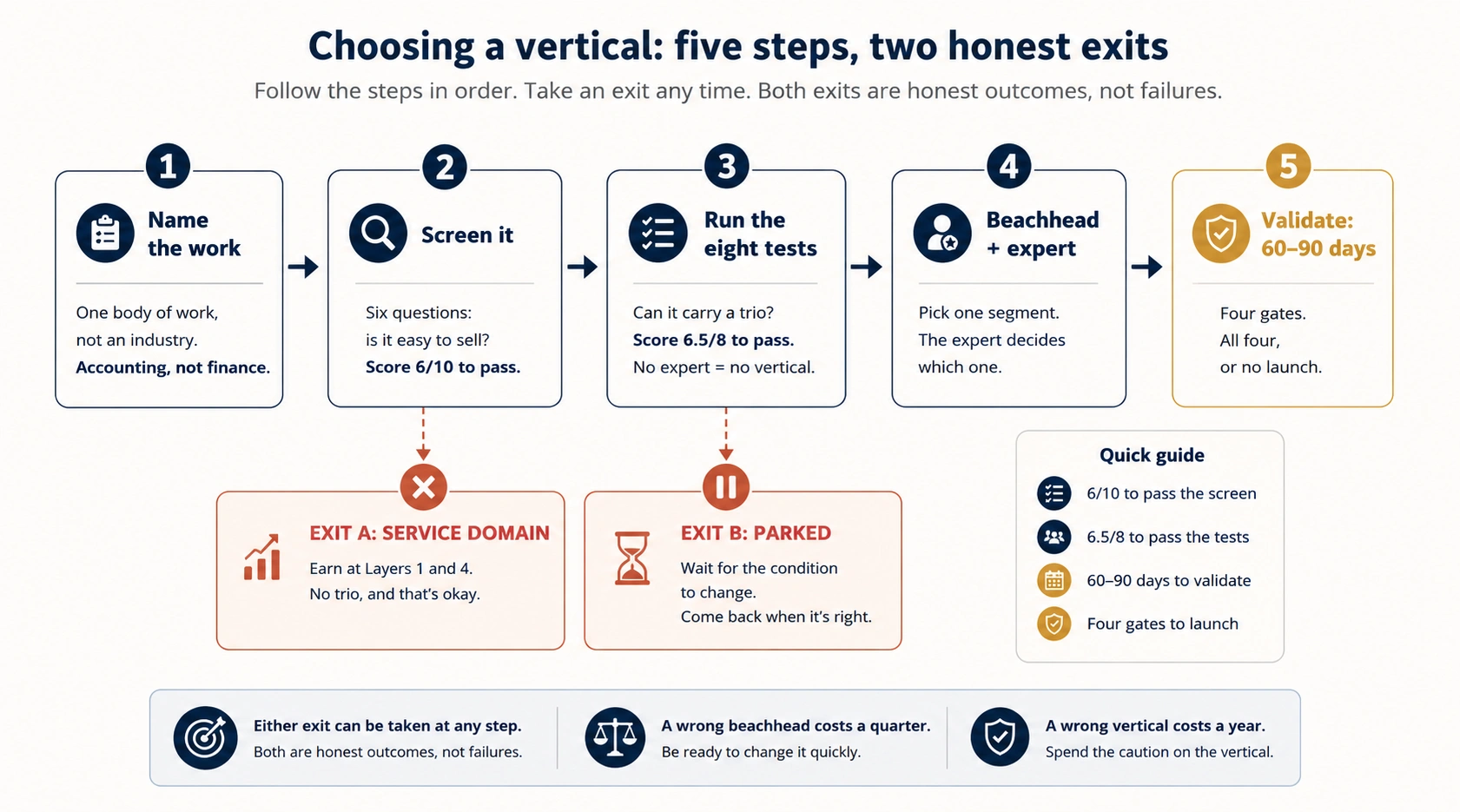
The FDE AF Model explains what a vertical is and how it earns money. This page answers the next question: which vertical should you build? Do not guess. Follow a method. This page gives you that method: five steps, eight tests, and three rules you must never break.

Do not choose the biggest market. Choose the easiest honest sale. A good vertical has three things. You can measure success before you start. A real expert stands behind the knowledge. One shared builder can serve every customer. This page gives you a checklist to find that vertical. It also gives you two safe exits when a candidate fails the checklist. And it tells you the order of the work: you build one small piece of the profession's knowledge before you ever ask a customer for a number.
| Word | Plain meaning |
|---|---|
| Vertical | One professional AI business, built once and sold to many companies |
| Beachhead | The first narrow segment you build inside the vertical |
| Corpus | The governed source material the agents cite |
| Expert twin | The domain expert's teaching, encoded as an AI |
| Builder | The shared tool that manufactures the domain's AI Workers |
| Slice | One professional outcome, covered completely, in the System of Record |
| Sponsor | The named person inside a possible first customer who can agree a starting number |
Every other new word is defined in the glossary.
📚 Teaching Aid
View Full Presentation — Choosing Your Vertical
First, remember three rules from the model itself.
The launch rule. A vertical does not launch without a committed domain expert. The expert twin is the vertical's product. A vertical without one is just a corpus (a collection of documents).
The first-job test. The best first job for a Digital FTE has four properties. The work repeats daily or weekly. The output can be measured. A supervisor already reviews this work today. Mistakes can be fixed.
The order rule. Build first, sell second. Nothing in the vertical business starts until one slice of the System of Record exists: one professional outcome, covered completely. A graduate with nothing governed has nothing to bring to a buyer, and a buyer who has been shown nothing will not name his own starting number. So the slice is not a step that waits for a customer. It is the step that produces one.
Everything on this page exists to protect these three rules. It is much cheaper to check them now than to discover a problem after one year of work.
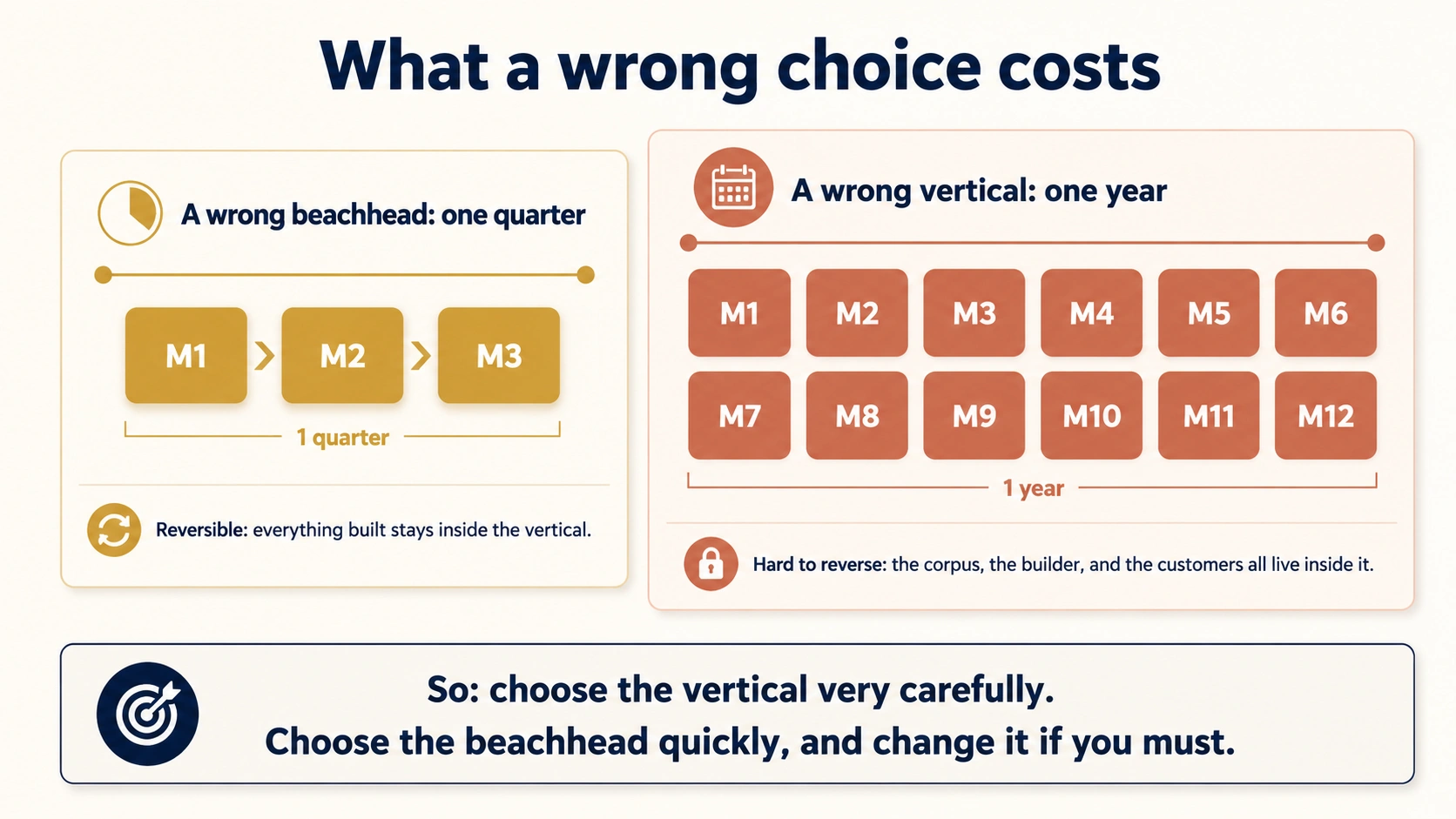
One more idea shapes the whole page: a wrong beachhead costs you three months; a wrong vertical costs you a year. A beachhead is the one segment inside the vertical where you build first. You can change your beachhead, because everything you build stays inside the same vertical. But you cannot easily change the vertical itself. The corpus, the builder rules, and the customer relationships all live inside it. So: choose the vertical very carefully, and choose the beachhead quickly.
Here is why that year matters more than it looks. A vendor-neutral Forward Deployed Engineer carries two Systems of Record into a client. The first is the method, and the ecosystem gives it to her: this book, deep and already governed, the same at every client. The second is the profession, and she builds it herself. Only the second one is hers. So a wrong vertical is not a wrong market. It is a year spent on the one asset she was going to own, and nothing to show for it at the end.
Step 1: Name one body of professional work, not an industry
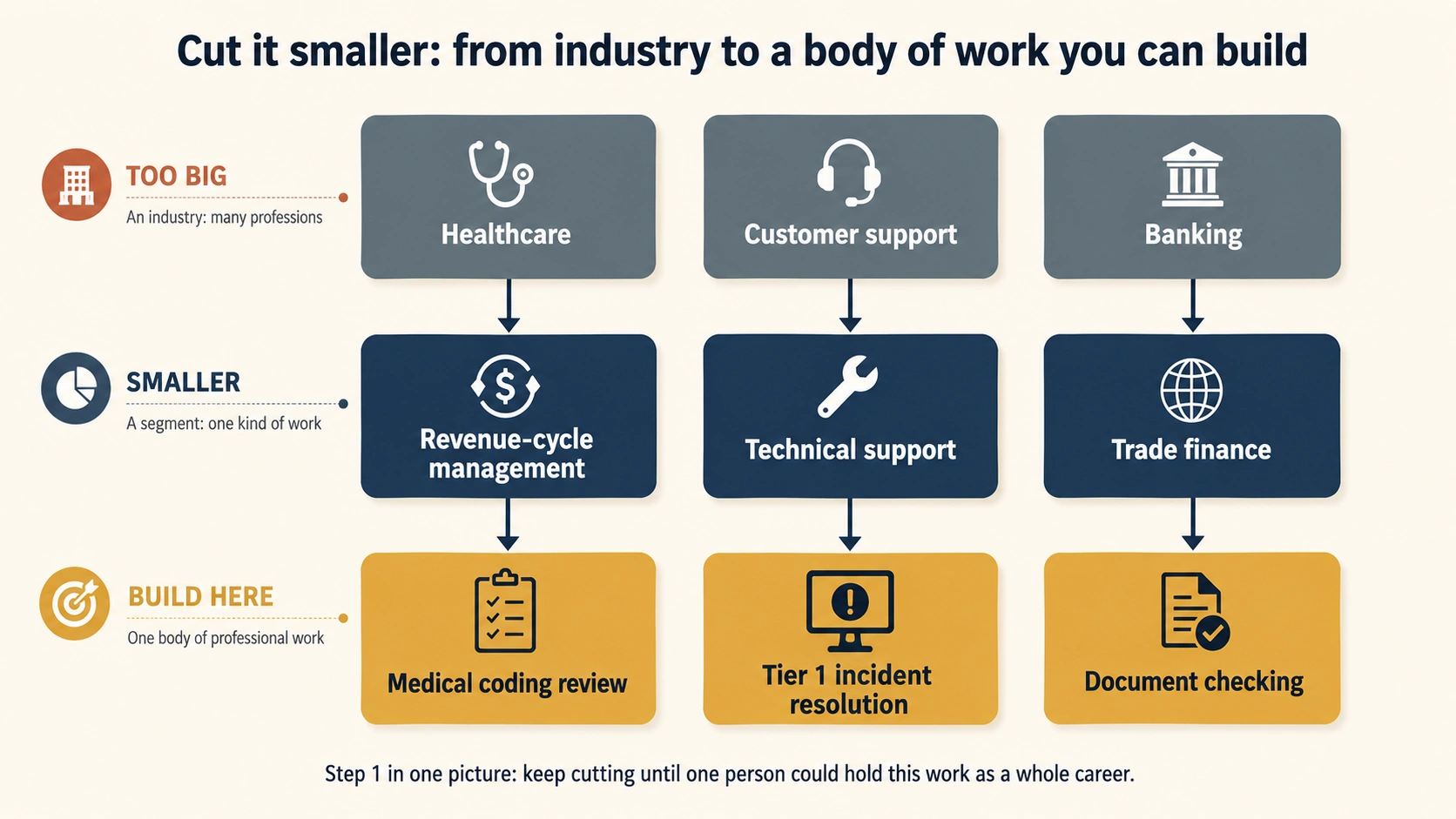
"Banking" is not a vertical. "Healthcare" is not a vertical. These are industries. An industry contains many kinds of work. A System of Record for a whole industry would be a library, not a corpus. No single expert could stand behind it.
A vertical is one narrow body of professional work: work with shared knowledge, recognizable experts, repeatable Workers, common buyer needs, and one reusable builder. A recognized profession, such as accounting, is often the best starting point. But the body of work can be narrower than a full profession: corporate credit, recruitment, tax practice.
Here is a simple test. Can you imagine one person whose whole career is this work? If yes, it is narrow enough. If your answer is "well, several different kinds of people," you have named an industry. Cut it smaller before you continue.
Now the opposite error, which is the more common one in 2026. A narrow, single-purpose agent is not a vertical either. The market uses the phrase "vertical AI agent" in two different senses, and only one of them is ours. Some writers mean an agent with a deliberately narrow job: it finds prospects and does nothing else, or it drafts one kind of message and stops. Others mean a system built for one industry, preloaded with that industry's knowledge and compliance rules. This book means the second, always.
The first sense is not wrong, it is just a different thing, and this book already has a name for it. An agent with one narrow job is a Digital FTE, and how narrow to make its job is the first-job test, not the vertical decision. The distinction matters commercially. A narrow agent is a product you can sell. A vertical is the governed profession that lets you build that product again for the next customer without starting over. Choose the vertical, then name the Workers inside it at Test 2.
Step 2: Screen it for selling ease
The biggest market is not the goal. The easiest sale is the goal. Before any deep work, score the candidate on six questions. Give each question 0 to 10 points. Then take the average.
- Can you define success with one main number? A contract of success needs a starting number and a target number. Both sides must be able to measure them. For example: hours per file, tickets per day, days per filing. Then add two or three guardrail numbers: numbers that must not get worse while the main number improves. For an audit file, the main number is hours per file, and a guardrail is the reviewer correction rate. Speed that creates errors is not success. If you cannot describe success this way in a few sentences, every sale will be slow.
- Does a buyer already spend money on this problem? You want to redirect money the buyer already spends. You do not want to create a new budget. A new budget needs many meetings. Existing spending usually needs far fewer.
- How clear is the path to the first deployment? A domain with no regulator scores high. Every regulatory gate lowers the score, because every gate adds months to your first sale. And your first sale is where you learn everything. A regulator does not disqualify a domain. But it is a delay, and you must count that delay in your score.
- Can you get the knowledge legally? Public laws and government documents are usually the easiest case, though even these often carry a specific open license you must read first. Licensed standards are workable, but you need the license in writing. Private platform policies that change every month are the hardest case. You cannot keep a governed corpus current when its owner rewrites the rules without notice and keeps no version history.
- Does an expert probably exist in your network? Not confirmed yet. Probably. Your aunt, your former boss, your professor, a colleague with twenty years of practice and written material. You confirm this at Step 4.
- Can one builder serve every customer? The model has a strict rule: one builder per domain, never a separate copy per customer. Ask: are the companies in this domain similar enough that one shared builder works for all of them? If every customer would need its own version, this domain breaks the model's economics before you start. One builder does not mean identical customers: each customer keeps its own settings, permissions, and private corpus. The rule forbids a separate copy of the builder itself for each customer.
How do you choose a number? Use these anchors, and write one sentence of evidence beside every score:
| Score | Meaning |
|---|---|
| 0 to 2 | No evidence, or a severe barrier |
| 3 to 4 | Weak evidence, and major unsolved problems |
| 5 to 6 | Possible, but uncertain |
| 7 to 8 | Strong evidence, and the problems look solvable |
| 9 to 10 | Confirmed evidence and an unusually clear path |
A score without a sentence of evidence is a feeling, not a score.
Score 6/10 or higher: continue. Below 6: take an exit.
There are two exits. Both are honest outcomes. Neither is a failure.
- If the candidate scores high on questions 1 and 2 but fails the rest, it is a service domain. Serve it through Layer 1 System of Record builds and Layer 4 engagements. Earn money from it. Do not build a trio for it.
- If the candidate fails broadly, park it. Write down what would need to change for you to look at it again.
Some domains sell very well but still fail as verticals. A common reason: the knowledge is mostly each customer's own documents, so there is no shared corpus. Another reason: no expert has written the knowledge down. That is fine. The graduate earning ladder starts at Layer 1. Building a governed System of Record from a client's own manuals is paid work. It builds your reputation. Many graduates should earn in service domains first and choose their vertical second, with real experience behind the choice.
Notice that the order rule does not apply here. A service domain needs no slice, because it sells no vertical: you build the client's own governed source, or you manufacture Workers with the deployed generic tools, and the client pays for that work. So there are two ladders, and they start in opposite places. The service ladder starts with a client. The vertical ladder starts with a slice.
Why the method demands written evidence
The rules on this page may look strict: a sentence of evidence beside every score, no invented numbers, honest exits written down. They are not style preferences. The science of decision-making backs each one. Psychologists call the underlying skill metacognition: checking your own thinking before you act on it. Three findings matter here.
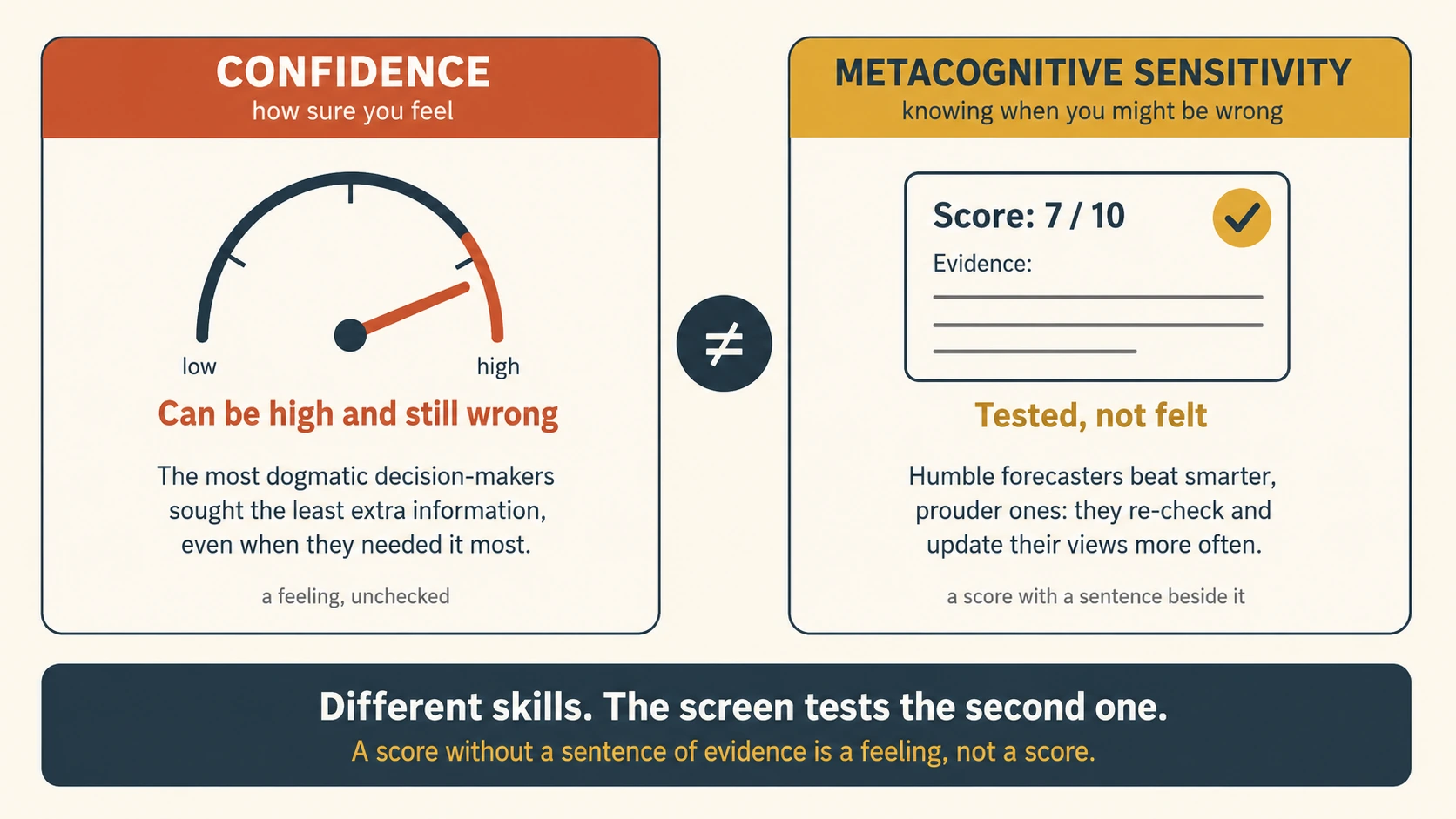
Confidence and accuracy are different skills. Steve Fleming's lab at UCL shows that some people know when they are likely to be wrong, and some do not, whatever their raw ability. The skill of knowing is called metacognitive sensitivity. Writing one sentence of evidence beside every score is how you test your confidence instead of trusting it.
Overconfidence blocks learning. A study in PNAS found that the most dogmatic people were the least willing to seek extra information before deciding, even when they needed it most. The screen forces you to seek that information. That is its whole job.
Humility beats intelligence at forecasting. Early research by Igor Grossmann's group suggests that intellectually humble experts predict long-term trends better than smarter but prouder ones, because they update their views more often. This is why the portfolio table carries dates and re-check schedules. A choice you never re-score is a choice you have stopped testing.
One last technique from Grossmann's work is built into this page on purpose. People who describe their decisions in the third person show measurably better judgment and perspective-taking than people who write "I" and "my." So do not write "my vertical." Write "a graduate is considering this domain," and score that graduate's evidence the way a reviewer would. The whole checklist works this way. It makes you the reviewer of your own excitement.
Step 3: Run the eight tests
The screen asks: does this domain sell? The eight tests ask: can this domain carry a trio?
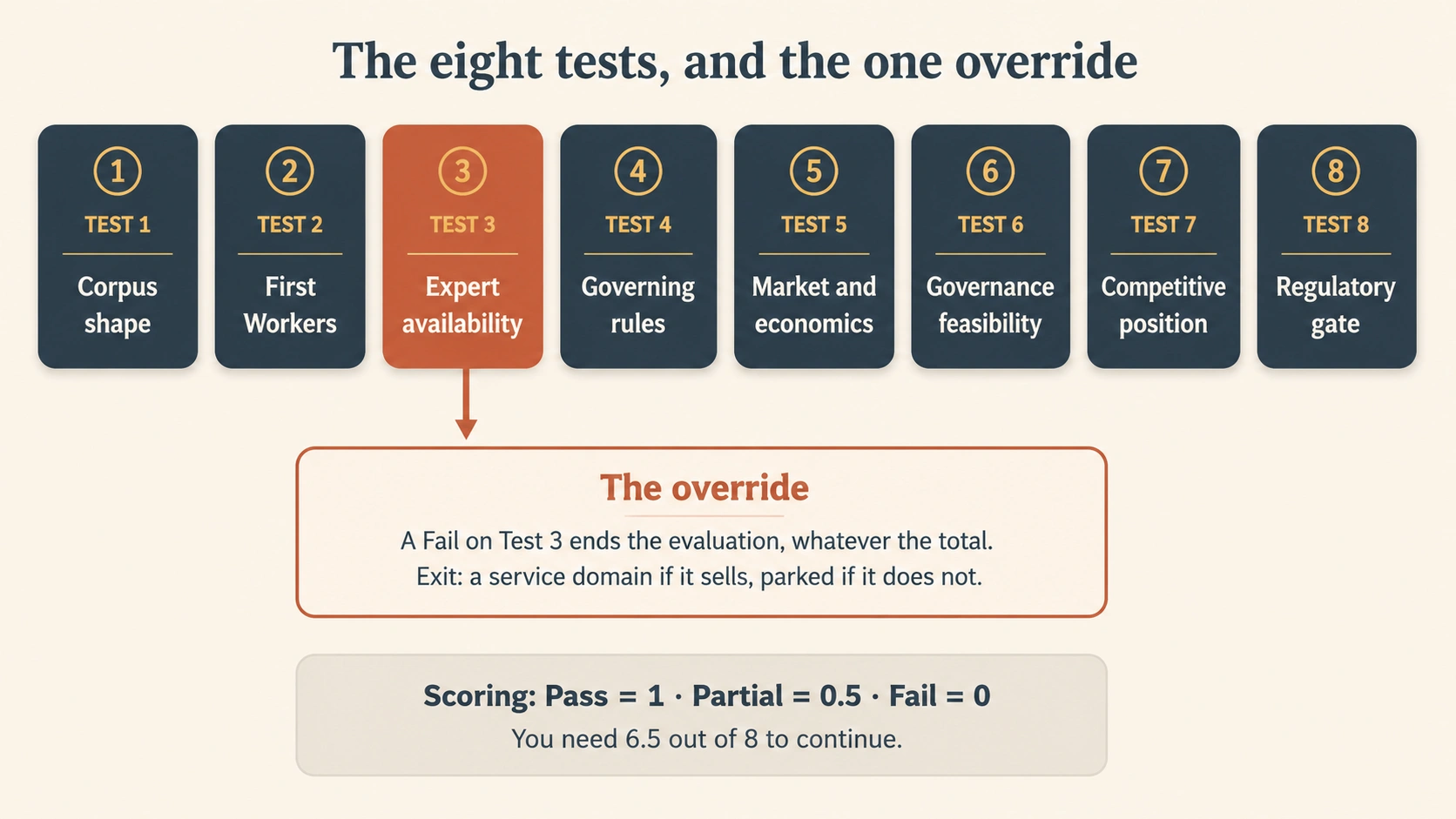
Answer every test in writing, with evidence. Score each test: Pass = 1 point, Partial = 0.5 points, Fail = 0 points. You need 6.5 out of 8 to continue.
One rule stands above the points: if Test 3 fails, the vertical evaluation ends. The total score does not matter, because the launch rule cannot be broken. Where does the failed candidate go? Back to the two exits from Step 2. If it passed the screen and can support profitable customer work, it becomes a service domain and earns. If not, it is parked with a written condition.
Test 1: Corpus shape. The model organizes domain knowledge in three forms: a corpus the agent cites, a map of rules that is always loaded, and reflexes (procedures the agent follows step by step, completely). Does this profession's knowledge fit these three forms? Evidence: name the ten most important sources, three rules that can never be broken, and three complete procedures. If you cannot name them, the knowledge may be too thin, too private, or never written down.
Test 2: First Workers. Can you name three or more Digital FTEs that pass the first-job test? Evidence: three named Workers. For each one, write its starting number and the human role that reviews this work today. A domain that cannot produce a provable first Worker cannot produce a contract of success. A vertical without a contract of success cannot sell. One of these three will become your first slice, so name them precisely enough that you could choose between them.
Test 3: Expert availability. Is there a named person who will license their persona and their written material to your startup? The material must be rights-cleared: they own it, or they have written permission to license it. This person is the Subject Matter Expert as Skill Author. Their judgment becomes the twin. Their written material becomes the corpus. The common failure: a domain has many practitioners but no author. Knowledge that was never written down can still be captured, but capturing it adds months of writing, checking, and testing. An expert who already has written material gives the vertical a large head start. Give the expert search a deadline. If the list is empty on the deadline, that is your answer.
The order rule gives this test a second edge. Without a committed expert there is no slice either, because the procedures inside a slice are authored in the expert's voice and derived from the expert's own real files. So a failed Test 3 does not only block the launch. It blocks the one thing that would have earned you a first meeting.
Test 4: Governing rules. What rules govern this work, and can you name them? The answer has two shapes. For jurisdictional work (tax, accounting, banking, medical coding), name the country or region, the regulator, and the versioned public rules. For non-jurisdictional work (sales, support, recruitment), name the professional frameworks, operating standards, or policies that experts in the domain accept as authority. Evidence: name the organizations and their documents. For each document, record its rights status. For jurisdictional domains, remember what the model teaches: each jurisdiction is a separate build and a separate opportunity. A trio built for one country's rules can be built again for another country's rules. A graduate serving foreign clients from home is the model working exactly as designed.
Test 5: Market and economics. Who buys? How many buyers exist? How difficult is their purchasing process? Is the revenue recurring (paid again and again)? One rule protects you here: do not invent money numbers. A license cost is a fact you can ask for. An engagement price is a guess until your first buyer conversation tests it. An invented number is worse than an empty space. It fixes your own thinking on a number that has no basis in your market.
Test 6: Governance feasibility. Can the corpus have an owner, versions, reviews, and access control within months, not years? Search alone is not a System of Record. The governance is the product. Name the owner and the review process. Name the slowest parts. The usual slowest parts: permission from third-party publishers, and your expert's limited review time. A corpus nobody can approve is a corpus nobody can trust.
Test 7: Competitive position. Who already serves this profession? Name the companies. Then write one sentence: your answer when a customer asks, "why you, and not our current vendor?" The answer that usually wins: we do not replace your current system; we extend it, and we put the profession's judgment layer beside it. Test your sentence honestly. If it only sounds good in your own meetings, the test is not passed.
One 2026 development belongs inside this test, because in several families on this page's longlist it changes who the incumbent is. The competitor is no longer only a software vendor. It is the professional services firm itself.
In March 2026, PwC's US CEO Paul Griggs told the Financial Times that the firm would start offering alternatives to billing clients by the hour, and would convert parts of its tax and consulting practice into AI-powered tools clients could use directly, without a PwC professional involved in the first steps, potentially sold as an annual subscription (FT, summary). The platform shipped as PwC One, opening with six automated services covering ground from M&A due diligence to tax rules.
Read this correctly, in both directions.
It confirms the model. A Big Four firm is doing exactly what the FDE AF Model describes: taking a profession's governed knowledge, serving it as AI Workers, and pricing it by outcome instead of by hours. Nobody has to be persuaded that the vertical is real. The largest incumbent in the domain has already agreed.
And it raises the bar. In accounting, tax, and legal domains, your Test 7 answer now has to work against a competitor that already holds the profession's judgment, the brand, and the client relationships. "We extend your current system" is still the winning sentence, but the system you are extending may now be a Big Four platform rather than a piece of software.
What it does not do is close the domain, and the reasons are the same three that this whole page runs on.
Jurisdiction. The Big Four build for their largest markets first. Test 4 already told you each jurisdiction is a separate build, and it is a separate build for them too.
Buyer size. PwC One serves PwC's clients. The mid-size firm in Ayesha's story is not one of them and never will be. Most professions are mostly mid-size and small firms, and they buy nothing from the Big Four.
The expert. Their platform carries their methodology. Yours carries a named person's twenty years, licensed to you. That is Test 3, and it is the one thing scale cannot copy.
So the honest effect on your score is a half point off Test 7 in the domains the Big Four have entered, not a fail. Write down which firm, which platform, which jurisdiction, and which buyer size it serves. Then write your sentence against that, and not against the software vendor who used to be the answer.
Test 8: Regulatory gate. If a regulator governs the buyer, which of its rules touch your work? Can you design the engagement so it clearly stays outside anything the rules forbid? For regulated buyers, the safe default boundary is preparation and recommendation. The Worker prepares and recommends. A named human approves and acts. Nothing that cannot be undone happens automatically. Passing this test means you can enter the buyer's compliance meeting already speaking the language of their rules. That is not a burden. In regulated domains, that is the sales pitch.
Step 4: Choose the beachhead, and let the expert decide
A profession-sized vertical still contains several bodies of knowledge and several Worker families. Do not build everything at once. Choose one beachhead: the segment with the clearest knowledge, the most checkable first Worker, and the shortest path to a signed contract of success.
What if two beachheads look equally good on buyers, numbers, and licensing? The expert decides. The launch rule makes expert commitment the deciding factor between comparable segments. It does not replace buyer evidence: a committed expert in a segment nobody buys is still a failed screen. But between two segments that both sell, the one with the strongest committed expert relationship is the one you build. This is why Ayesha's story on the model page begins with her aunt, not with a market report. The aunt's twenty years of practice and her written material are the vertical decision.
One more rule before validation. It protects you from a mistake that is easy to make and very hard to fix. Owning a book is not a license to serve that book through a system. Buying a standards handbook does not give you the right to serve it from a System of Record. Before validation, give every source in your corpus a documented rights basis. There are five: public domain, an open license (read its exact terms, because even government texts often carry one), an existing commercial license, direct written permission, or a completed replacement plan. When you write to a publisher, ask about the specific uses you need: storing and indexing, embedding for search, retrieval and display, quoting, derivative procedures, and commercial customer access. For each source, also write down a backup plan. If a publisher says no and you have no backup, that kills the beachhead, not the vertical. Pick another segment and keep the vertical.
Step 5: Validate against four gates in 60 to 90 days
Validation is a fixed period of 60 to 90 days with one purpose: replace your guesses with facts. This is not the time to build the whole vertical. This is the time to prove the vertical deserves building.
Four gates. The rule is simple: all four gates, or no launch.
And the four are not a checklist you may work through in any order. Two gates come first. Then you build one slice. Then the last two gates become possible at all. The order is not a preference. Gate 3 asks for a named sponsor who will discuss a starting number, and nobody discusses his own numbers with a stranger who has shown him nothing. The slice is what earns that conversation.
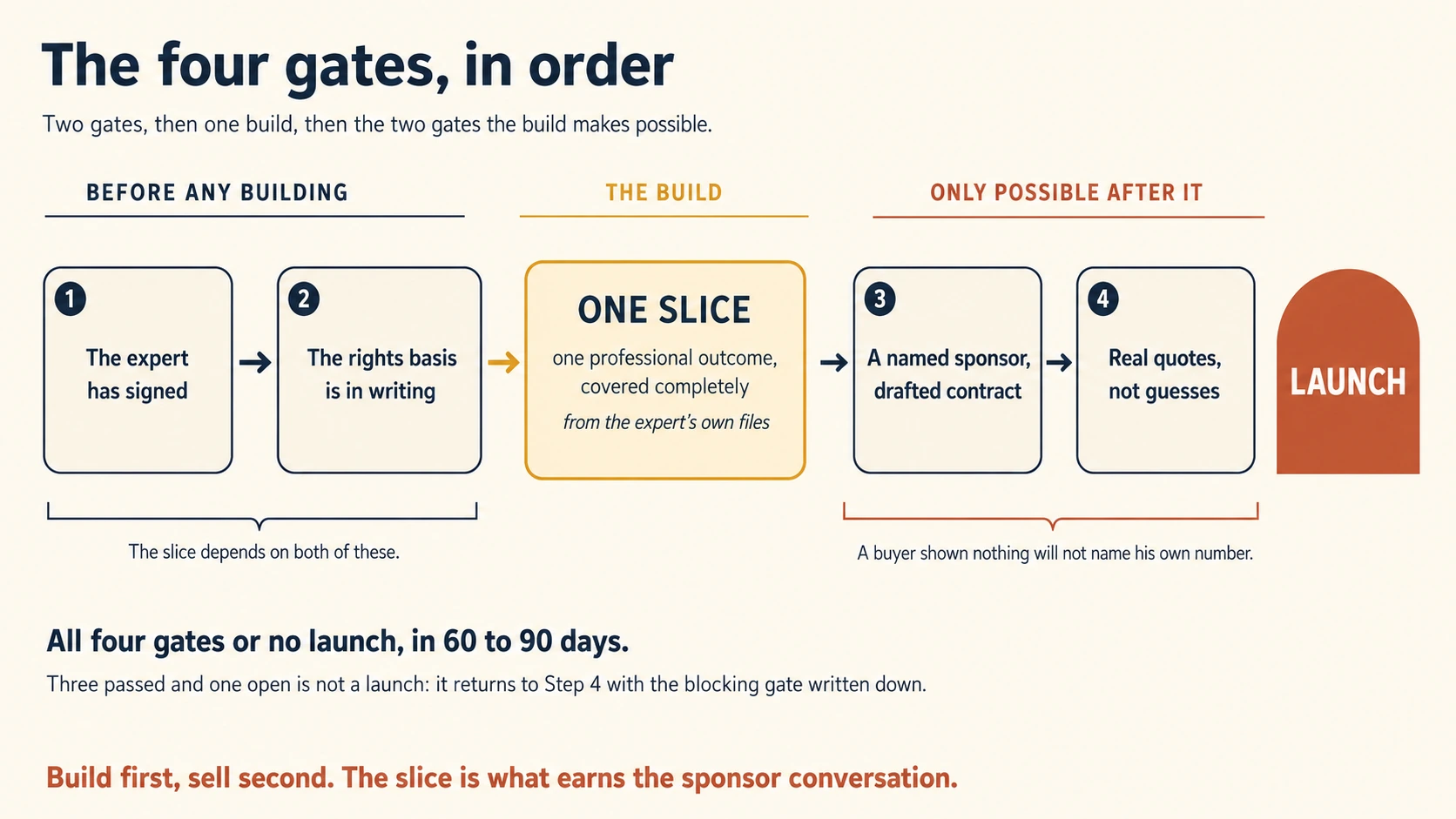
The two gates that come before any building
- The expert has signed. Not "agreed in principle." Signed. The partnership agreement covers the persona license, the rights-cleared material, the revenue share, and the platform terms. All of it is agreed before launch. After launch, it changes only by written agreement from both sides, never by surprise.
- The rights basis is confirmed in writing. Every third-party source has a documented rights basis for the uses you need: public domain, open license, commercial license, or direct permission. Where none exists, the backup plan is complete.
These two are first because the slice depends on both. The expert authors the procedures inside it and opens her own files for the archaeology. The rights basis decides which sources may legally sit inside it. Build the slice before either gate, and you may have to throw it away.
Then build one slice
One professional outcome, covered completely. Its outcome contract, its invariants, its decision map, its exception list, one derived procedure, its checker, and its evaluation set. Published the way the whole System of Record will be published: a website its human readers can read, and the same content agents can cite.
Two words matter here, and they are about breadth, never about care. A System of Record with one outcome is thin. One with many outcomes is thick. Both cover every outcome they contain completely. A slice that handles only the clean cases is not thin, it is unfinished, and it will not survive a professional's first hard question. So the evaluation set includes the awkward cases from the start: missing evidence, a source from the wrong jurisdiction, and a request the Worker must refuse.
Where does the material come from, when you have no customer yet? From the expert. She has twenty years of real files, including the one that failed review and the one that had to be escalated. That is the archaeology the slice is derived from. Designing the Vertical System of Record is the full method for this build, and its definition of done is also your definition of ready to sell.
The two gates the slice makes possible
- A named sponsor exists with a drafted contract of success. One real company. One named executive sponsor. One drafted (not yet signed) contract of success for your first Worker: the starting number, the target number, the acceptance criteria, the forbidden actions, and what passing buys. A sponsor who will not discuss a starting number is not a sponsor. Bring the slice to this conversation. A buyer reading one governed page of his own profession, with the plain words at the top and his own rules cited below, is not sitting through a pitch: he is reading his own work, and the next question usually comes from his side of the table.
- The money numbers are real quotes, not guesses. Quoted license costs. The sponsor's real purchasing timeline. Your staffing plan. The engagement economics are calculated from these inputs. No invented number survives to the launch decision.
Notice which number the sponsor supplies. The slice came from the expert's files, but the baseline in that drafted contract is measured in the customer's own workflow, because that is the only measurement a buyer can verify. Two sources, two moments, and no contradiction between them.
A candidate that passes three gates does not launch on excitement. It completes the fourth gate inside the window, or it returns to Step 4 with the blocking gate written down as its next action.
After launch: the System of Record keeps coming first
The gates are passed. Now you build the trio. The trio has three parts, and the model fixes the order of building: the domain System of Record comes first. Always. You have already begun it. The slice from validation is its first outcome, and everything from here thickens it.
Why first? Because the other two parts stand on it. The expert twin teaches from it. The domain builder gives Workers skills that point into it. Every Worker you ever manufacture will cite its rules and procedures from it. Build the twin or the builder first, and they have nothing trusted to read: the agents guess, and agents that guess cannot be sold.
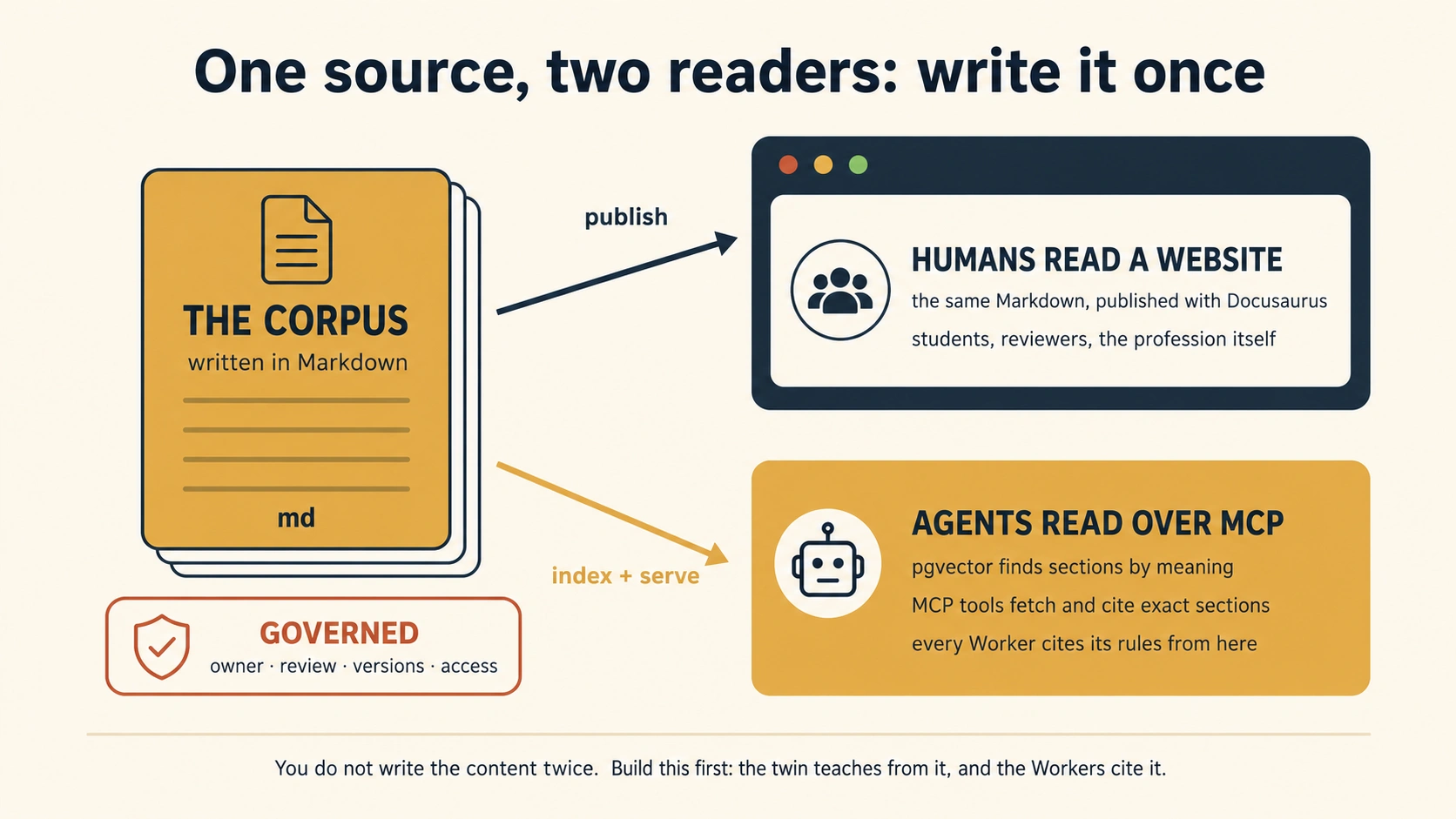
One source, two readers. This is the part beginners miss, so read it twice. The rule itself does not depend on any technology: one governed source must serve both human readers and agent readers, with an owner, versions, review, permissions, and citable retrieval. In the Agent Factory reference implementation, the rule looks like this:
- Humans read it as a website. The corpus is written in Markdown and published with Docusaurus. Your expert's students, your customers' reviewers, and the profession itself read it in a browser, like the book you are reading now.
- Agents read the same content over MCP. The same Markdown is indexed with pgvector, so agents search it by meaning, and served through MCP tools, so agents fetch and cite exact sections.
You do not write the content twice. One governed source serves both readers, because the Layer 1 kernel is built that way: Markdown in, website out for people, MCP out for agents. The technologies may change over the years. The rule does not.
And remember the warning from the model: search alone is not a System of Record. The content also needs a named owner, review and approval, versions, and access control. Set up the governance in the same week you load the content, not later. That includes the slice: it is a governed asset from its first day, not a draft you tidy up afterwards. The System of Record page shows the first deployed instance. AI Searchable Context teaches the retrieval layer, and Skills & Connectors teaches MCP.
How to decide what goes inside it, and how to redesign the profession's work from first principles instead of copying the old workflows, is its own discipline: Designing the Vertical System of Record.
One last thing about growth. The System of Record thickens outcome by outcome, and there is one move that looks like growth and is not: adding a country. A trio built for one jurisdiction's rules and one built for another are two builds inside one governed home, sharing only your expert's own methodology. Each starts thin again. That is not a setback. Test 4 already told you it is a separate opportunity.
Ayesha runs the checklist
Watch the whole page become one short story.
Ayesha, the graduate from the model page, considers three candidates.
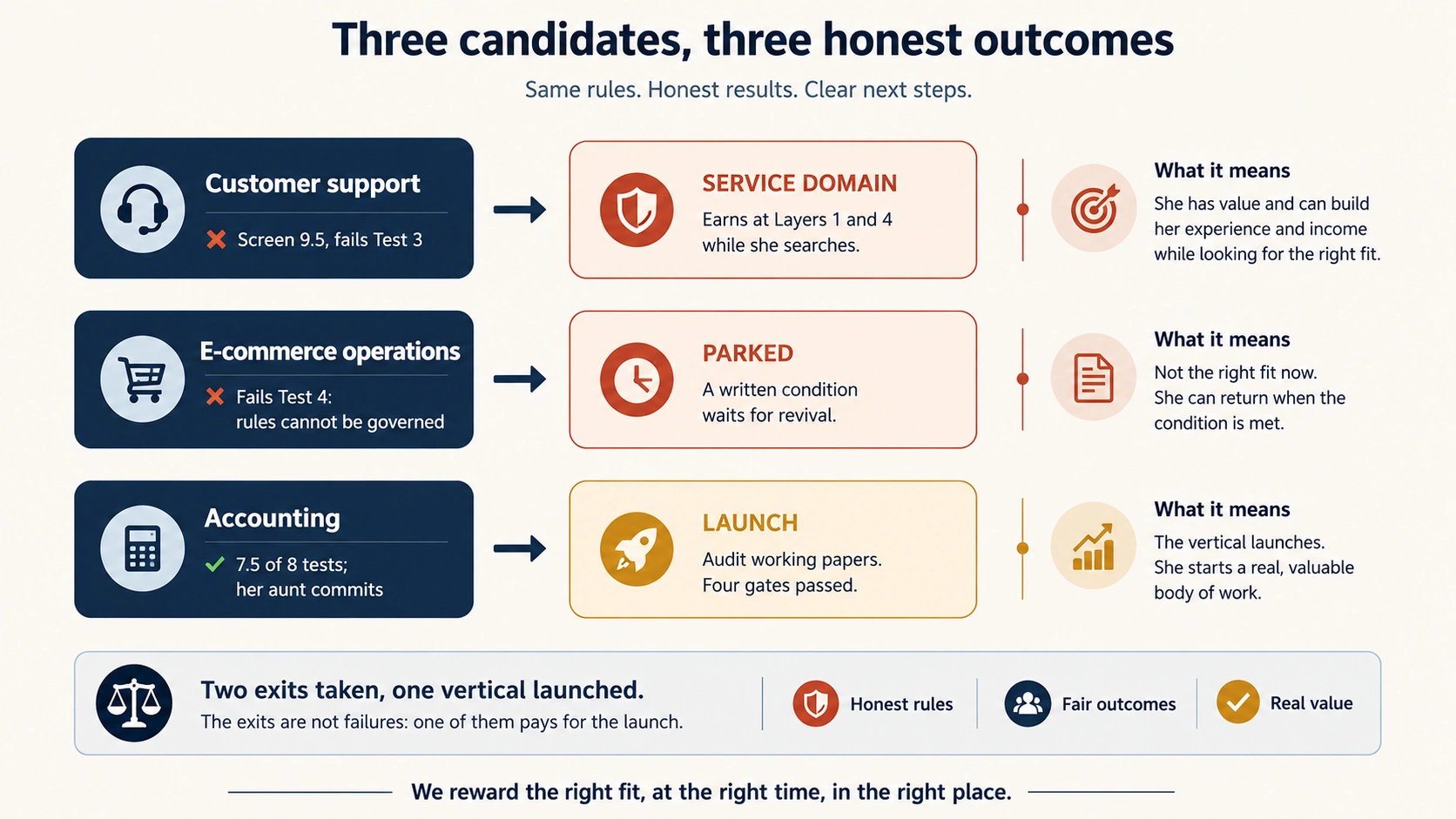
Customer support scores highest on the screen. Every company buys it. The contract of success is easy to write. But it fails Test 3. The knowledge is mostly each client's own documents, and she knows no support expert with written material. So it becomes her service domain. She builds client Systems of Record and runs Layer 4 engagements there. It earns while she searches, and it needs no slice, because it sells no vertical.
E-commerce operations fails Test 4. The "rules" are marketplace policies that change without notice. That corpus cannot be governed. Parked.
Accounting passes the screen and 7.5 of the eight tests. Test 3 is where it wins: her aunt, twenty years in practice, with her own written material. The expert decides. Audit working papers, with their written standards and checkable output, are the beachhead.
Then the window runs in order. Her aunt signs, and every source in the corpus gets a licensing answer: two gates, and no code yet. Now she builds one slice, on her aunt's own files. The outcome: a complete working paper, evidence-backed, ready for reviewer approval. Five real files with her aunt, including the one that failed review. The invariants her aunt will not bend, including the going-concern judgment only a partner may sign. One derived procedure, one checker, and an evaluation set with the missing-evidence case in it. Published as a Docusaurus website her aunt's students can read, and the same content her Workers will cite over MCP.
That slice is what gets her the third gate. A partner at a mid-size firm reads one page about working papers, written better than his own firm has written it, and asks what it would do for the four hours his juniors spend on each file. There is the baseline, and it came from him, not from her. A drafted contract of success follows: four hours to forty minutes, with his own reviewers as the acceptance criteria. Real quoted costs replace her guesses. Four gates. Launch. Her first engagement is that same working-paper file, delivered in forty minutes: exactly where the model page picks up her story.
A starting longlist, with example scores
Here is a long list of possible domains, scored for selling ease. Use it as a starting point for your own screen, not as a final answer.
Four warnings before you read it.
- These scores are one assessment, for one time and place. They reflect a 2026 view from Pakistan and the Gulf. Your country, your city, and your year will change the numbers. Re-score every candidate yourself.
- A high score does not make a vertical. Customer support scores highest here, and it still usually fails Test 3, because the knowledge is each client's own documents and few support experts have authored material. A high score with a failed test means: excellent service domain.
- Your network beats this table. A domain with a score of 7 and your committed aunt beats a domain with a score of 9 and no expert. The launch rule always wins.
- Most names on this list are starting points, not finished verticals. Some are industries. Some are business functions. Step 1 still applies to every one of them: cut it smaller until you reach one body of professional work. Healthcare becomes revenue-cycle management, then medical coding review. Customer support becomes technical support, then Tier 1 incident resolution. Banking becomes trade finance, then document checking. The list gives you the door. You still walk to the room yourself.
The list is grouped into six families, because domains in the same family fail in the same ways. Learn the family, and you can score a domain that is not on this list.
Read every domain name with three silent words after it: in the agentic AI era. "Payroll" does not mean payroll software. It means payroll AI Workers: Digital FTEs that run the payroll, measured like a hire. "Sales" does not mean a CRM. It means a sales workforce of AI Workers, with the profession's judgment in a governed System of Record behind them.
The old SaaS era version of each domain does not interest us, and we do not compete with it. The SaaS products that already exist in a domain are simply the incumbents in Test 7: we extend them, and we put the profession's judgment layer beside them. The scores below measure one thing only: how easy it is to sell AI Workers with a governed corpus into that domain today. A domain full of successful SaaS companies can still score low for us, and a domain the SaaS era ignored can score high, because we are selling a workforce, not software.
Family 1: Money and numbers domains
Success is a money number, so the contract of success is easy to write, and buyers pay fastest for work that touches money.
| Domain | Selling ease | The short reason | The usual trap |
|---|---|---|---|
| Sales | 9 | Success equals revenue numbers. Buyers pay fastest for things that make money. | Crowded market. Your System of Record must be the difference. |
| Accounting and finance | 8 | Clear numbers, strong written rules, and real experts exist. | Test 6: the standards (IFRS and similar) need licenses. |
| Tax practice | 8 | Public laws, fixed deadlines, checkable output. The cleanest corpus of all. | Seasonal income: busy months, quiet months. |
| Bookkeeping outsourcing | 8 | Codified, repeating, recurring revenue. Foreign clients can be served from home. | Price pressure: many low-cost competitors. |
| Payroll services | 7.5 | Repeats every month. Success is measured in errors and hours. | Strong existing software. Your answer must extend it, not replace it. |
| Tax for freelancers and small firms | 7.5 | A huge, underserved buyer group with public rules. | Small tickets. You need volume, not big deals. |
| Credit collections | 6.5 | Recovery rates are a clear number. | Strict conduct rules. One bad interaction damages the client's name. |
| Compliance and AML | 6 | Fintechs buy fast. Alert review time is measurable. | Mistakes carry regulatory consequences. Your testing must be excellent first. |
| Microfinance operations | 5.5 | Codified loan processes, social importance. | Regulated, and budgets are thin. |
| Wealth management | 5 | High-value clients, clear rules. | Regulated advice. Liability slows every buyer. |
Family 2: Documents and rules domains
The work is reading, checking, and preparing documents against written rules. This shape fits agents perfectly, because the rules are the corpus.
| Domain | Selling ease | The short reason | The usual trap |
|---|---|---|---|
| Medical billing and coding | 7.5 | Fully codified (ICD and CPT codes). A large outsourcing market already exists. | Patient-data rules, and every insurance payer has its own requirements. |
| Trade documentation | 7 | Document checking fits agents perfectly. Rules are international and written. | Old bank and customs systems slow every integration. |
| Freight forwarding and customs | 7 | Filings, declarations, and schedules: codified, repeating work. | Fragmented small buyers, informal habits. |
| Immigration services | 7 | Public rules, document-heavy, measurable outcomes. | Rules change quickly, and a mistake harms a real person's life. |
| Company filings and corporate compliance | 7 | Registrar filings repeat on a fixed calendar with public rules. | Small tickets per client. You need many clients. |
| Paralegal and legal document work | 6.5 | Measurable document output for law firms. | Rules about who may practice law. Stay clearly on the preparation side. |
| Islamic finance | 6.5 | Few competitors. Trust is the product, and that fits our model. | The buyers are banks and funds: slow purchasing. |
| Patent and IP filings | 6 | Codified filing processes with clear deadlines. | Deep experts are rare and expensive. |
| Legal services | 5.5 | High value per engagement. Clean corpus: laws and cases. | The most careful buyers of all. Fear of liability slows everything. |
| Takaful (Islamic insurance) | 5.5 | Standards-based and underserved. | Very few buyers, all regulated. |
| Pharmacovigilance | 5.5 | Codified safety reporting with fixed formats. | Regulated, and the buyers are large slow companies. |
| NGO and donor reporting | 5.5 | Grant compliance reporting is codified and repeating. | The buyers have small budgets by design. |
| Insurance | 5 | Claims work is measurable. | Few buyers, slow and regulated. |
Family 3: Operations domains
The work is running daily business operations. Numbers are easy to find, but the knowledge often lives inside each company, not in a shared corpus.
| Domain | Selling ease | The short reason | The usual trap |
|---|---|---|---|
| Customer support | 9.5 | Every company buys it. Success is easy to measure: tickets, response time. | Fails Test 3: no shared corpus, no author-expert. Usually a service domain. |
| E-commerce operations | 8 | Many fast-moving buyers. Clear numbers: listings, orders, returns. | Fails Test 4: the "rules" are platform policies that change monthly. Usually a service domain. |
| IT helpdesk and managed services | 7.5 | Ticket numbers, response times, uptime: all measurable. | Crowded, and mostly each client's own systems. Usually a service domain. |
| Property management | 6.5 | Recurring monthly work: rent, maintenance, tenant questions. | Fragmented small buyers. |
| Automotive dealerships | 6.5 | Lead follow-up and service booking are measurable. | Conservative buyers with strong existing dealer software. |
| Travel and tour operators | 6.5 | Itineraries, bookings, and follow-ups are repeating and measurable. | Seasonal, price-sensitive buyers. |
| Textile and garment exporters | 6.5 | Order tracking and compliance documents repeat with every shipment. | Thin margins make buyers cautious. |
| Hospitality and hotels | 6 | Bookings, reviews, and guest questions are measurable. | Thin margins, high staff turnover. |
| Logistics | 6 | Clear numbers: dispatch time, exceptions, tracking. | Every deployment needs heavy integration work. |
| Construction and engineering | 6 | Tenders and compliance documents are heavy, repeated work. | Project-based buyers: they think in projects, not subscriptions. |
| Facilities management | 6 | Work orders and inspections repeat on schedules. | Low-margin buyers, informal processes. |
| Restaurants and food service | 5.5 | Orders, reviews, inventory: all measurable. | Very small buyers who often close. High churn. |
| Manufacturing and procurement | 5 | Real pain in RFQs and vendor documents. | ERP integration takes over every deal. |
Family 4: People domains
The work is about people: finding them, teaching them, persuading them. Measurable in parts, sensitive in parts.
| Domain | Selling ease | The short reason | The usual trap |
|---|---|---|---|
| Recruitment agencies | 7.5 | Screening speed is money for an agency. One builder serves many agencies. | Test 3: practitioners exist, authors are rare. |
| HR management | 7 | Onboarding and policy questions are measurable. | HR budgets are defensive. Buyers move slowly. Sensitive data. |
| Marketing and content | 7 | Easy to sell. | Hard to prove results. Very crowded. Often better inside a sales vertical. |
| Real estate | 7 | Measurable work, few regulations. | Buyers are small and scattered. Processes are informal. |
| Education administration | 6 | Credible and familiar. Admissions and student services are measurable. | Buyers have small budgets. |
Family 5: Hard-mode domains
Big prizes with slow doors. Strong on the tests, weak on the screen. These are the domains you park with a written condition, not the domains you start with.
| Domain | Selling ease | The short reason | The usual trap |
|---|---|---|---|
| Telecom operations | 5 | Huge repeating work volumes. | Only a few giant buyers, each with long purchasing. |
| Clinical trials administration | 5 | Codified protocols and reporting. | Heavily regulated, slow institutional buyers. |
| Corporate banking | 4 | Banks need citable AI more than anyone. Our architecture fits their need exactly. | The slowest purchasing on this list, with regulatory gates before it. |
| Healthcare | 4 | An enormous long-term prize. | The hardest rules and liability. Start with administration work only, if at all. |
| Utilities | 4 | Large, stable, repeating operations. | Regulated near-monopolies. Purchasing moves in years. |
| Government services | 3 | Large and important. | Purchasing takes longer than a startup can wait. Enter through programs, not sales. |
Family 6: Shrinking domains, a warning
These domains look easy because the work is text. But the general model already does the core task, without any corpus. Before building here, ask one question: after the model does the core task, is there still enough governed knowledge, checking, and workflow left to carry a vertical? If the answer is thin, do not build here. Learn from here.
| Domain | Selling ease | The short reason | The usual trap |
|---|---|---|---|
| Translation and localization | 6 today, falling | Measurable, text-based, huge demand. | The general model does the core work already. Prices fall every year. |
| Medical transcription | 5, falling | Codified and repeating. | Speech models replaced the human work. What remains is thin. |
| Data annotation | 4, falling | Clear, measurable piecework. | The models are learning to label their own data. |
| General content writing | 4, falling | Everyone needs text. | The model writes. Buyers know it. There is nothing to govern. |
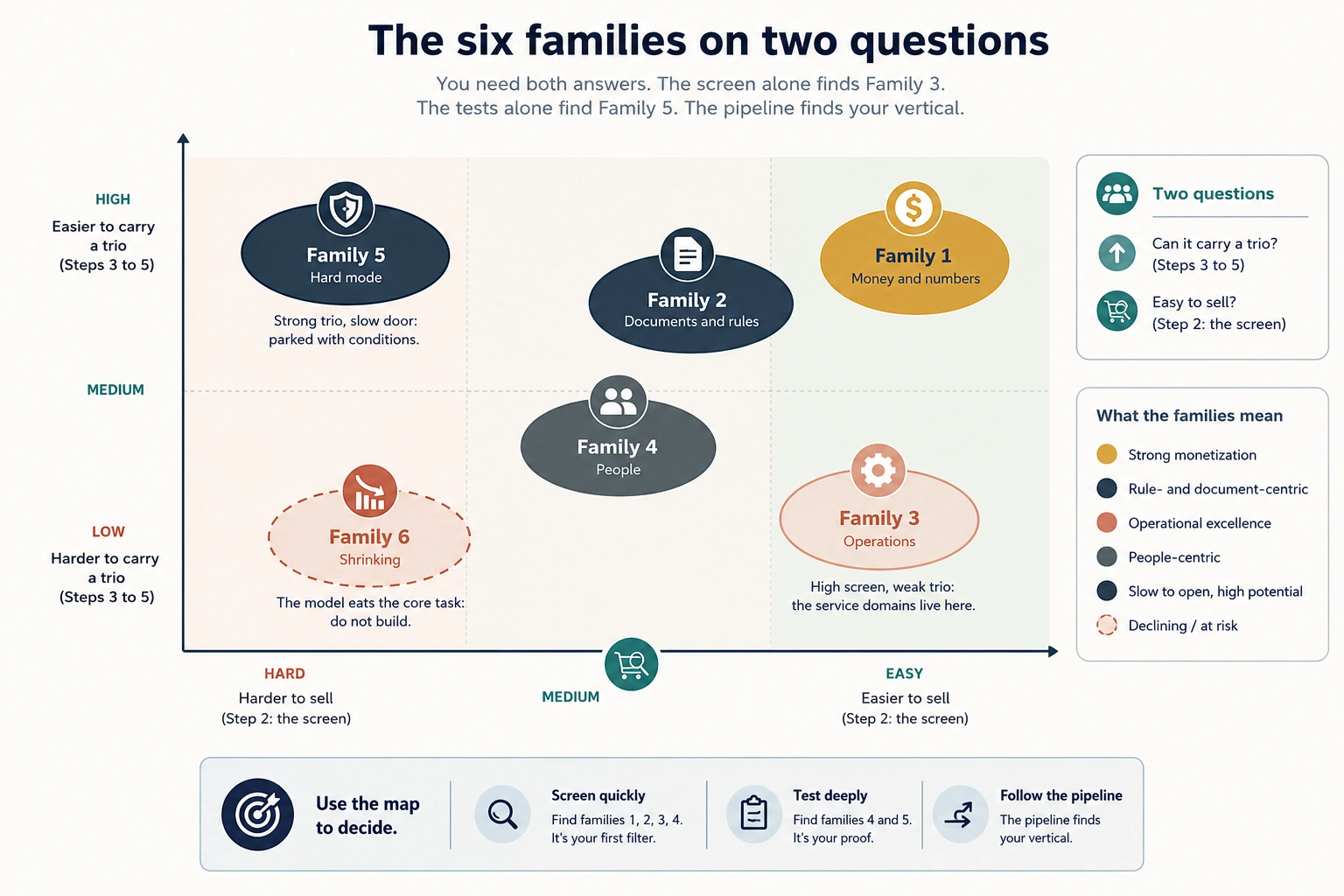
The patterns to learn
Read across all six families and four patterns appear. These patterns are the real lesson of this section, because they let you score a domain that is not on any list.
- Every high scorer has the same three things. Success in one main number. Money the buyer already spends. Rules that are written down. When you meet a new domain, check these three first.
- Every low scorer has the same one thing. A slow door: a regulator, a procurement office, or a committee between you and the first deployment. The work may be perfect for agents. The door still sets the score.
- Beware the domain the model eats. If a general model does the whole job with no corpus, no expert, and no governance, there is no vertical there. A vertical needs knowledge that must be governed, not just generated.
- The screen and the tests measure different things. Family 3 is full of high screens that become service domains. Family 5 is full of low screens that are strong verticals waiting for their condition. Neither number alone decides. The pipeline decides.
- Score the agentic era, not the SaaS era. Do not ask "is there good software in this domain?" Ask "can an AI Worker do this domain's work, with a governed corpus behind it and one number to prove it?" The two questions give different answers, and only the second one matters to us. A domain crowded with SaaS tools may be empty of AI Workers. That emptiness is your opening.
Our own choices, in the open
We teach this method, so we also show you our own results with it. This is the model applied to itself again: the same discipline we ask of you, run on ourselves, in public.
One rule shapes our portfolio. We hold three seats at a time. The prover is the vertical with the easiest sale: it proves the model in the market. The moat is the vertical with our deepest expert advantage: it is harder to copy. The option is a candidate we keep alive with an open expert search and a deadline. Domains without a committed expert run underneath as service domains. They earn, and they wait.
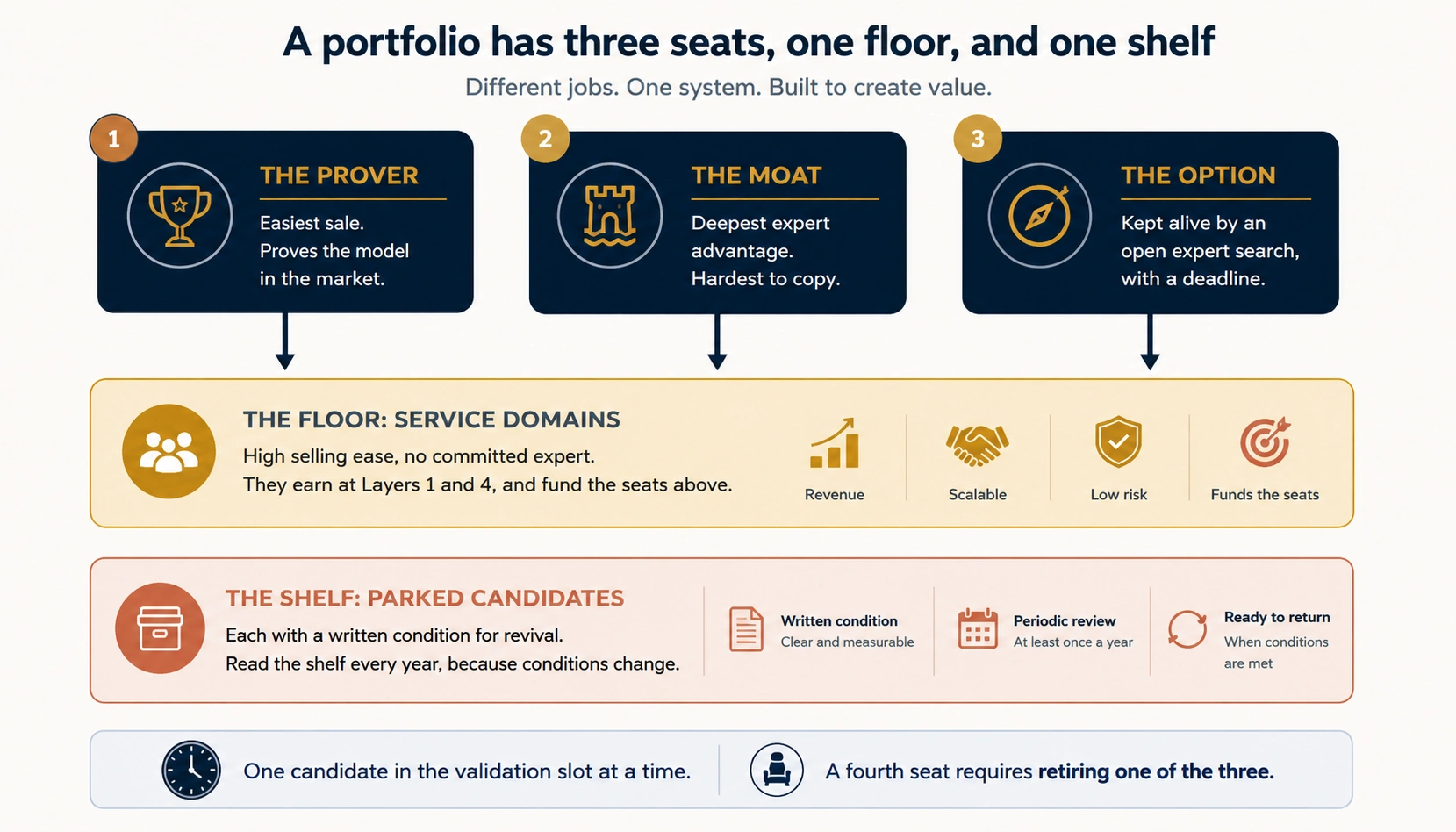
Here is the full list, with each candidate's position, as of July 2026. This table will change, and that is the point: a portfolio that never changes is a portfolio nobody is testing.
| Candidate | Screen | Tests | Status | Beachhead | Where it stands |
|---|---|---|---|---|---|
| Sales | 9/10 | Passed | Launched. Our first vertical, and the prover seat. | Deal execution | The founding corpus (the FISTA Sales Book) is complete. Next full re-check: July 2027. |
| Accounting and finance | 8/10 | 7.5 / 8 | In validation. The moat seat, and our single validation slot. | Tax practice | The expert is inside our own team. The open work: written licensing answers from the standards bodies, the IFRS Foundation plus the professional institute in our first jurisdiction, which is gate 2, and the gate the first slice waits on. Test 7 was re-scored in July 2026 after PwC One shipped into tax: we hold the score, because our buyers are the mid-size and small firms the Big Four do not serve, and our jurisdiction is not their first. |
| HR | 7/10 | About 6.5 / 8, Test 3 still open | Conditional. The option seat. | Recruitment agencies | The expert search is open, with a deadline. An empty list on the deadline closes this candidate. |
| Customer support | 9.5/10 | Fails Test 3 | Service domain. | None | The highest screen score on the list, and still not a vertical: no shared corpus, no author-expert. We earn here through Layer 1 builds and Layer 4 engagements. It re-enters the moment a real expert commits. |
| E-commerce operations | 8/10 | Fails Tests 1, 4, and 6 | Service domain. | None | The rules are platform policies that change without notice. That corpus cannot be governed. Layer 4 work only. |
| Corporate banking | 4/10 | Strong on Tests 1, 2, 4, and 8; slow on Test 5 | Parked, with conditions. | Trade finance, if revived | Banks need citable AI more than anyone, and our architecture fits that need exactly. But bank purchasing is the slowest on this list. It revives when the foundation is stable and a named bank sponsor exists. |
| Legal services | 5.5/10 | Not yet run | Parked. | None | Revives with a committed senior expert. More realistic in year two. |
| Healthcare | 4/10 | Not yet run | Parked. | Administration work only, if revived | Revives only with an institutional sponsor. The clinical side stays out. |
| Insurance | 5/10 | Not yet run | Parked. | None | Few, slow, regulated buyers. Re-checked every year. |
| Manufacturing and procurement | 5/10 | Not yet run | Parked. | None | ERP integration takes over every deal. Re-checked every year. |
| Government services | 3/10 | Not yet run | Parked. | None | Purchasing is slower than a startup can wait. If we enter, we enter through programs, not through sales. |
Every other domain in the longlist above (marketing, real estate, trade documentation, Islamic finance, construction, education, logistics, compliance, and the rest) holds longlist status: screened for selling ease, tests not yet run. Any of them can enter the pipeline the day someone brings an expert and an owner.
Notice what the table teaches. Our highest-scoring domain is not a vertical. Our hardest domain is not dead, only parked with a condition. Our moat seat now has a Big Four competitor in it, and it kept its score, because a competitor is a fact you write down and score against, not a reason to leave. And only one candidate holds the validation slot at a time, because every vertical multiplies the foundation's bugs, and we prove the pattern on one before opening it wide. Your portfolio can follow the same three seats: one prover, one moat, one option, and honest exits for everything else.
Where to go from here
Two paths open from this page. They match the two halves of the decision.
Path 1: test the idea cheaply, before building anything. Most questions on this page have answers you can find in one evening, not one quarter. Everything in this path is a probe: it produces evidence for your scores, and nothing more. A probe is not a slice. It has no owner, no versions, no review, and no evaluation set, so it never becomes part of your System of Record. Three states, in order: probe, then thin, then thick.
- Give a real sample of the profession's work to a general agent in a browser. See if the first-job idea holds. That is General Agents on the Web, applied to Test 2.
- Load a small part of the candidate corpus into pgvector. Check that search and citation actually work. That is AI Searchable Context, applied to Test 1.
- Write the contract of success as a real spec, because that is what it is. Spec-Driven Development teaches you to write intent a Worker can be held to. That is exactly what the Gate 3 sponsor conversation needs.
- The acceptance criteria are a checking question: how will the customer's own reviewers verify the Worker's output? That is Trusting the Checker, before any Worker exists.
Path 2: build, in the fixed order. First the slice, inside the validation window, after gates 1 and 2. Then, after all four gates pass, the rest of the trio: the System of Record thickens, then the expert twin that teaches from it, then the domain builder that manufactures Workers against it. Designing the Vertical System of Record is the method for the slice and for everything that follows it: what goes inside, and how to derive it instead of copying the profession's old workflows. The Mode 2 courses teach the manufacturing. Building a Digital FTE teaches the unit. Eval-Driven Development teaches the production proof your contract of success will demand.
And if your honest answer today is "I have no committed expert yet," your path is not blocked, and the order rule is not aimed at you. It governs the vertical ladder only. The model is telling you where to start instead: earn at Layers 1 and 4 first, on the service ladder, which starts with a client and needs no slice. Let the engagements bring you to the expert. How to Get Paid in the Agentic AI Era maps both ladders end to end, including what each one earns and how long the walk takes.