One System of Record.
Products that teach and build on it.
We turned the book into one source of truth, then started building on it. The products on it teach you the Agent Factory and build it with you, and more will grow from the same source, following one blueprint: the FDE AF Model. This is the thesis, shipped.
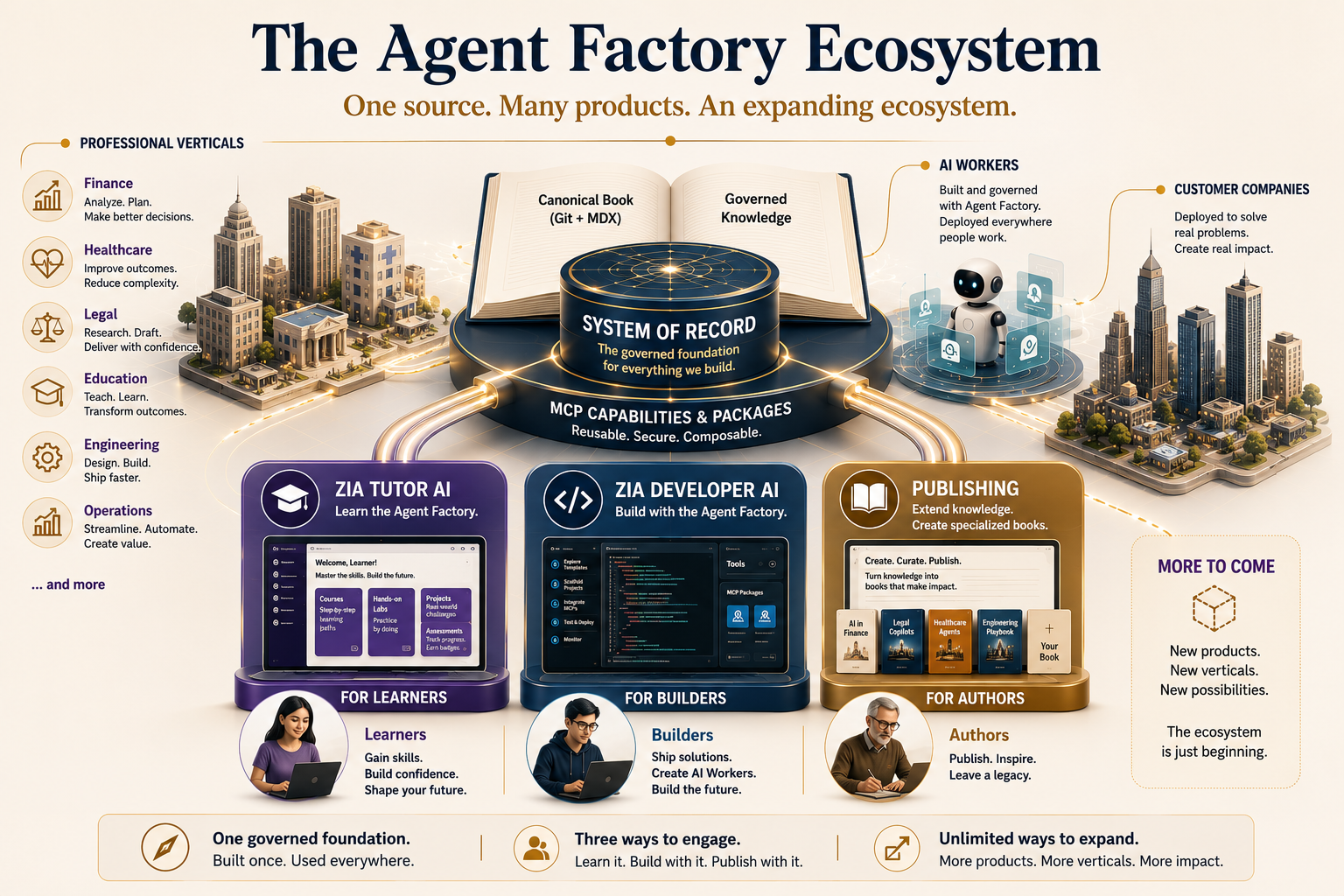
How it's wired: one source, three gateways
The diagram reads top to bottom: who uses the system, what they connect to, what those connections are made of, and where the truth lives. Four layers, one flow.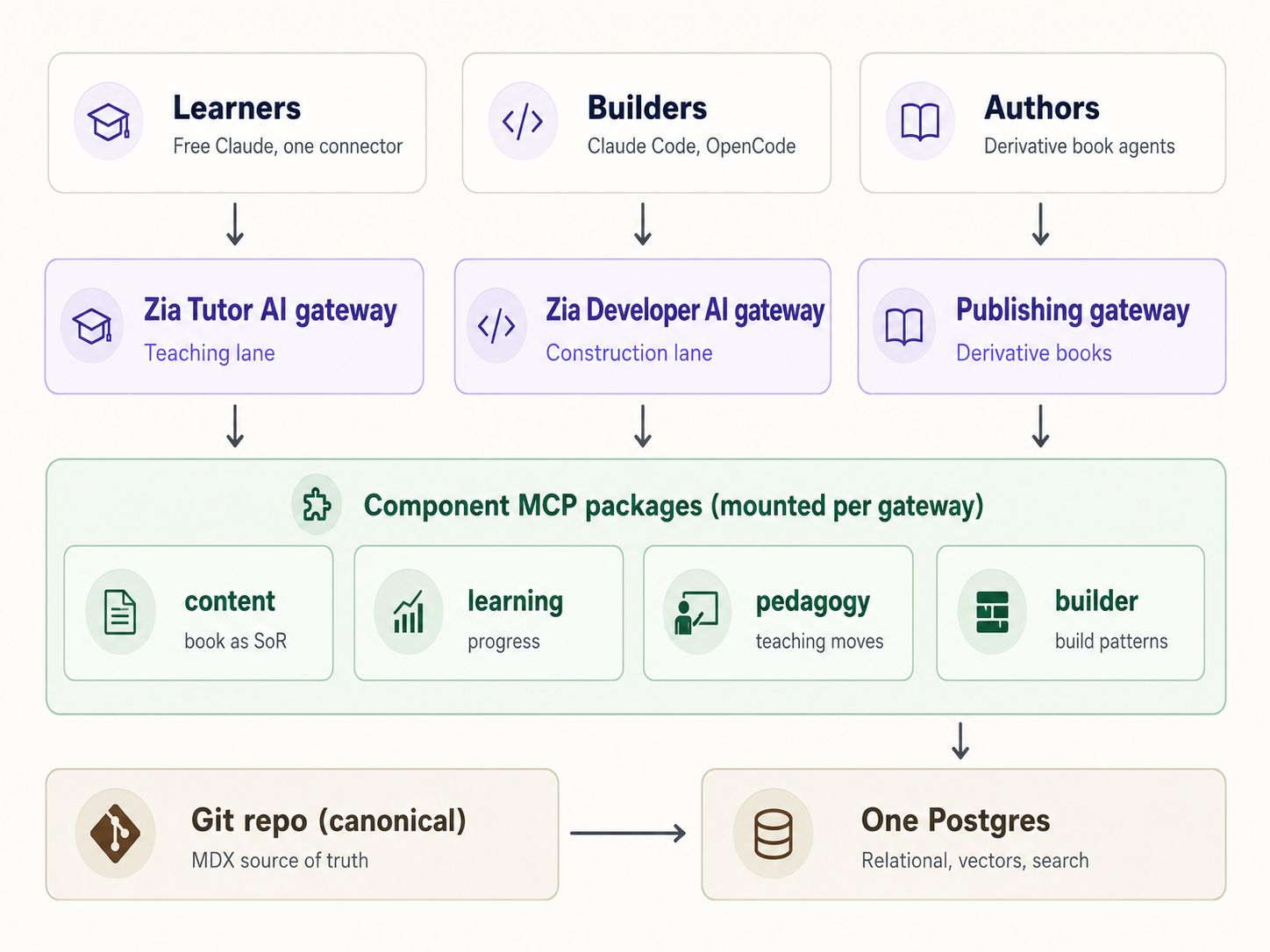
- Learners arrive on their own free Claude. Add one connector, authorize once, and start learning. Nothing to install, nothing to pay for.
- Builders arrive inside their coding agent, Claude Code or OpenCode. Their door is a plugin, because that is where construction work happens.
- Authors are the agents that produce the derivative books, rewritten by topic, age, and profession. Their door is a publishing pipeline.
Meet every audience where they already work. No new app to adopt, no new habit to form.
- Zia Tutor AI gateway the teaching lane: what a learner's Claude talks to when Zia greets them, checks understanding, and records progress.
- Zia Developer AI gateway the construction lane: what the coding agent talks to when Zia picks an architecture, writes a spec, and builds to it.
- Publishing gateway the derivative-book pipeline, feeding author agents the canonical material they specialize and rewrite.
Gateways are deliberately thin: they decide what their audience can reach and shape it for them. All real functionality lives one layer down.
- content the book as a System of Record. Every lane reads verified chapters, definitions, and patterns instead of guessing from training data.
- learning learner state. Progress, history, where you left off. This is what lets Zia Tutor AI resume a conversation days later.
- pedagogy teaching moves. How to explain, when to quiz, how to correct, encoded as tools rather than left to model improvisation.
- builder build patterns. The specs,
SKILL.mdtemplates, and recipes Zia Developer AI assembles into working agents.
Composition, not duplication. Each gateway mounts only what it needs, so fix the content package once and all three lanes get the fix.
- Git repo (canonical) the book as MDX. The master copy of every chapter, figure, and definition. Change the book here, and everything above inherits it.
- One Postgres everything else: relational data, vector embeddings, and full-text search in a single database. Canonical MDX is ingested into it so the packages query fast.
The book's own thesis applied to itself: consolidate by default, specialize deliberately.
Truth is defined once (Git), stored once (Postgres), exposed through reusable capabilities (packages), and delivered through thin, audience-shaped doors (gateways). Adding a new product later (a new audience, a new lane) is just one more thin gateway on the same packages. The source never changes. That is what makes it an ecosystem, not three separate apps.
Connector-native apps and plugins bring the tools; the user brings the model. That inverts the economics: value reaches people on the free tier of the AI apps they already use, so we can scale to hundreds of thousands without the LLM bill that usually caps reach — at home and abroad. You can learn to build these yourself:
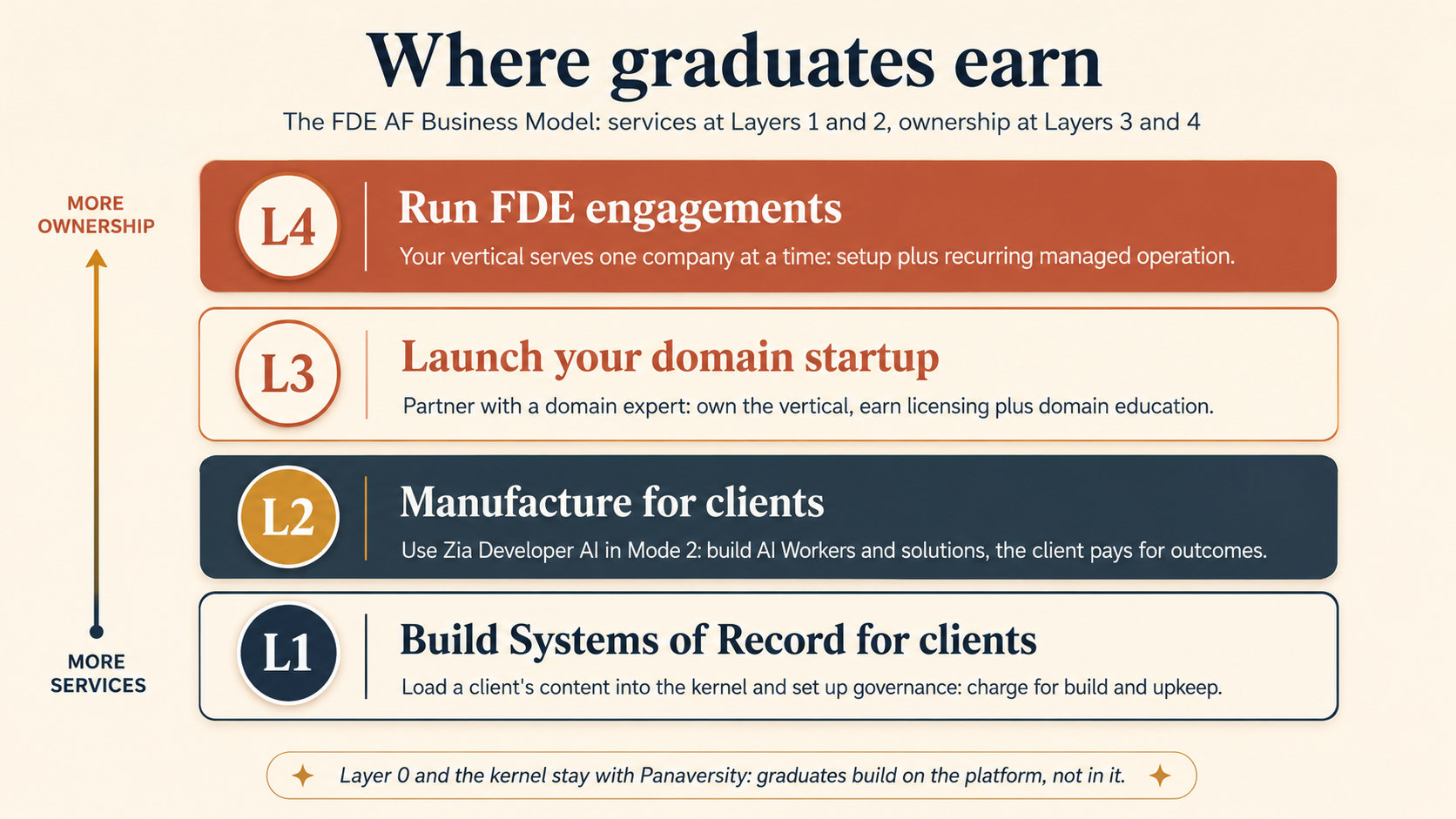
One base, five layers: every layer above the foundation earns
The ecosystem you've just seen is one instance of a repeatable pattern: the FDE AF Model. The same base becomes vertical, AI-native businesses, and every layer above the foundation is a place our graduates build on and earn from.
MCP, Markdown, pgvector, Better Auth. Built once; the ground everything stands on.
Build and license reusable SoR components, solo or as ecosystem contributions.
Education at scale, at near-zero inference cost, because the user brings the model.
Domain partnerships: license the expert twin and rights-cleared material.
FDE engagements: deploy to one company, then run it for recurring revenue.
Already sold on the model? Choosing Your Vertical is the method: the screen, the eight tests, and the launch gates. Then Designing the Vertical System of Record is what goes inside the first thing you build.
The seat that matters most
The bigger the AI workforce grows, the more it depends on a human who can say, precisely, what it should build — the Outcome Architect, the role that owns intent. These products are what that role builds with, and the ecosystem is built to grow into vertical businesses that role can run.
Read about the roles this book trains, or start with the full story of the ecosystem.