Panaversity Certified Architect: Foundations
PCAR-F is designed to prepare you for Anthropic’s CCAR-F (Claude Certified Architect – Foundations) exam. It follows the same published blueprint, covering the same objectives at the same weights, but it does not stop there.
PCAR-F takes that blueprint one level up by testing the concepts in a broader, vendor-neutral context, adding related topics that are important in real-world AI work, and filling gaps that are outside the scope of the official exam.
Passing PCAR-F therefore gives you a strong, low-cost signal that you are ready to attempt the official Anthropic certification while also building a more complete foundation for practical AI engineering.
Read the official CCAR-F exam guide.
| Exam | Items | Duration | Cut score | Fee |
|---|---|---|---|---|
| PCAR-FPanaversity | 60 items | 120 minutes | 720 / 1,000 | Students: two free attempts, then a fee |
| CCAR-FAnthropic | 60 items | 120 minutes | 720 / 1,000 | $125 per attempt |
PCAR-F is the second exam on the FDE path, and the one that closes the gate. It examines the design layer: how work is split across agents, what a tool interface has to say before a model will use it correctly, where MCP is the right seam, and what a system does when the context window runs out.
It is written for the person who will be asked to design the system rather than operate it. PCAO-F asks whether you can use and evaluate AI responsibly. This one asks whether you can be trusted with the architecture. Take them in that order.
To a stranger, the credential says one specific thing. You sat a proctored exam built on Anthropic's published Architect blueprint and cleared 720 out of 1,000. Not that you have read about agent design. That you were examined on the trade-offs, under a clock, with someone watching.
Same Blueprint, One Level Up
PCAR-F takes the same blueprint one level up. Not a warm-up for CCAR-F, and not a knock-off of it: it examines the official blueprint whole, then keeps going, because the courses do, with the same judgment asked across vendors.
It asks every task statement on Anthropic's Architect Foundations blueprint, at the published weights. The twin is CCAR-F, Claude Certified Architect – Foundations: 60 items in 120 minutes for $125 USD, framed inside four production scenarios drawn from a bank of six. All of that is examined on PCAR-F. Then the sitting continues past it.
What it adds is vendor neutrality. CCAR-F tests architectural judgment inside one vendor's product surface: the Agent SDK's hooks, CLAUDE.md hierarchy, plan mode, the built-in tools. Those are real and worth knowing. They are also one implementation of a question that exists whether or not the customer runs Claude.
A graduate stands in front of a customer who may run Claude, or may run something else, and has to be right either way. That is the whole reason the Panaversity sitting reaches further.
None of that makes CCAR-F the lesser exam. It is the credential the market recognises, issued by Anthropic and checkable by anyone. PCAR-F is built to sit beneath it and hold it up: the same blueprint, taken first, plus the vendor-neutral half a customer will ask you about long before they ask which SDK you used.
| PCAR-F | CCAR-F | |
|---|---|---|
| Full name | Panaversity Certified Architect: Foundations | Claude Certified Architect – Foundations |
| Blueprint | Every CCAR-F domain at the published weight, then vendor-neutral coverage | The five published domains |
| Passing score | 720 out of 1,000 | 720 out of 1,000 |
| Fee | Free for enrolled students on the first two attempts | $125 USD list price |
| Proctored by | Panaversity, independently | Pearson VUE, registered through the Partner Academy |
Study Guide
Study these courses to prepare for the exam. Flashcards, knowledge checks, and build projects are included along the way to help you prepare.
| Exam area | Read |
|---|---|
| The loop, and the signal it stops on | The Loop by Hand |
| Plan mode, direct execution, and the Explore subagent | Claude Code and OpenCode |
| Agents, subagents, hooks, sessions, tools, and context | Claude Agent SDK |
| Where instructions live, and what a team can share | Claude Code for Teams |
| Running Claude Code with nobody watching | Claude Code as a CI Worker |
| Schemas, retries, batches, and calibrated human review | Structured Extraction Pipelines |
| Decomposing work without losing coverage, and keeping the sources | Graph Engineering |
| Provenance, conflicting sources, and what a citation has to carry | Building the Context Layer |
Five of the eight carry Exam link callouts naming the task statement being tested, and in several cases the distractors the item will offer. Twenty-four of the blueprint's thirty task statements have one. Where a callout is missing, the course still teaches the objective; the callout is only the label.
The vendor-neutral half. Those eight cover the blueprint. PCAR-F then asks three questions the twin does not, listed under What It Tests, and none of the eight answers them at exam depth. These eight do, in the sections named. Read the section first; the rest of each course is there if you want it.
The last two rows cover something the blueprint assumes away rather than asks. Every CCAR-F scenario is written from inside a system you run yourself. A customer may not run theirs, and deciding that is an architecture call before it is anything else. Read the general case first, then the Anthropic-hosted instance of it.
| Exam area | Read |
|---|---|
| Fixed pipeline or adaptive decomposition, and the contract at each handoff | Choosing Agentic Architectures (Concepts 6, 8 and 14) |
| A handoff that survives a retry, a crash, and a resume | Give Your AI Agent a Nervous System (Concept 4, Decision 5) |
| What a prompt cannot enforce, in either harness | Harness Engineering (Concept 3) |
| The other half of that: no permission layer at all, so the prompt is the only bound | Claude Code Routines (Concepts 1 and 2) |
| Where an app's rules live when the harness is a chat you do not configure | Connector-Native Apps (Concept 9) |
| In, on, or out of the loop, and who owns what ships | Loop Engineering (Concept 1, Part 6) |
| The governance surface: who reviews a failure, who audits, who can stop it | Designing Agent Experiences (Concept 16) |
| Telling the agent's decisions from yours: the ledger and the override | Identic AI (Scenarios 4 and 5) |
| Where the agent runs, who keeps it alive, and what leaks into a vendor's console | Leaving the Laptop (Concepts 2, 6, 7 and 11) |
| Renting the harness instead of running it, and what that costs | Claude Managed Agents (Concepts 7 and 15) |
What It Tests
Five domains, in the order the official CCAR-F guide numbers them. The weights are the guide's own, and the guide calls them approximate proportions of the scored items.
Every course in the blueprint table touches every domain somewhere. The last column is where each domain's centre of mass lives: the course to read first, then the one or two that carry the rest of its objectives.
| # | Domain | Weight | Where it is taught |
|---|---|---|---|
| 1 | Agentic Architecture & Orchestration | 27% | Claude Agent SDK · The Loop by Hand · Graph Engineering (decomposition that loses coverage) · Choosing Agentic Architectures (Concept 6, the test that tells a fixed pipeline from adaptive decomposition) |
| 2 | Tool Design & MCP Integration | 18% | Claude Agent SDK · The Loop by Hand (a tool is a description; telling the model a tool failed) |
| 3 | Claude Code Configuration & Workflows | 20% | Claude Code for Teams · Claude Code as a CI Worker · Claude Code and OpenCode · Claude Agent SDK (Concept 17, and the Four Moves in Part 5) |
| 4 | Prompt Engineering & Structured Output | 20% | Structured Extraction Pipelines · Claude Code as a CI Worker (criteria, examples, the independent reviewer) · The Loop by Hand (tool_choice) |
| 5 | Context Management & Reliability | 15% | Claude Agent SDK · Structured Extraction Pipelines (confidence and review) · Graph Engineering · Building the Context Layer |
Three domains carry two-thirds of it. Agentic Architecture & Orchestration at 27 percent, Claude Code Configuration & Workflows at 20, and Prompt Engineering & Structured Output at 20 add up to 67 percent of the exam. Read the table the other way and those three domains lean on three courses: Claude Agent SDK, Claude Code for Teams, and Structured Extraction Pipelines. That is a sharper study hint than the percentages alone.
Notice what is at the top. Orchestration, not prompting.
The heaviest domain is about loops that terminate on the right signal, coordinators that decompose work without losing coverage, subagents that do not inherit the context you assumed they had, and sessions that can be resumed and forked. That is the thesis of the credential, stated as a number.
Nothing else is far behind it. The spread runs from 15 to 27 percent, so there is no domain you can skip and no domain that will carry you. The scenario structure sharpens that: the exam draws four scenarios from a bank of six, so one weak domain can be over-represented on your particular draw and under-represented on somebody else's.
Your CCAR-F score report shows percent-correct by domain, but the guide is explicit that those section percentages are not used to determine pass or fail. The result is your total scaled score against a cut score of 720. A weak domain cannot fail you by itself. It is still the domain most likely to fail you on a different scenario draw, which is why a strong total hiding one thin area is the profile worth worrying about.
The six production contexts in that bank are published, and they are the best description of the exam anyone can give you:
- Customer Support Resolution Agent. A high-ambiguity support agent on custom MCP tools, and knowing when to escalate.
- Code Generation with Claude Code. Generation, refactoring, debugging, and documentation inside a team's workflow.
- Multi-Agent Research System. A coordinator delegating to search, analysis, synthesis, and reporting subagents.
- Developer Productivity with Claude. Exploring unfamiliar codebases with the built-in tools and MCP servers.
- Claude Code for Continuous Integration. Automated review and test generation, with false positives as the enemy.
- Structured Data Extraction. Extraction from unstructured documents, validated against JSON schemas.
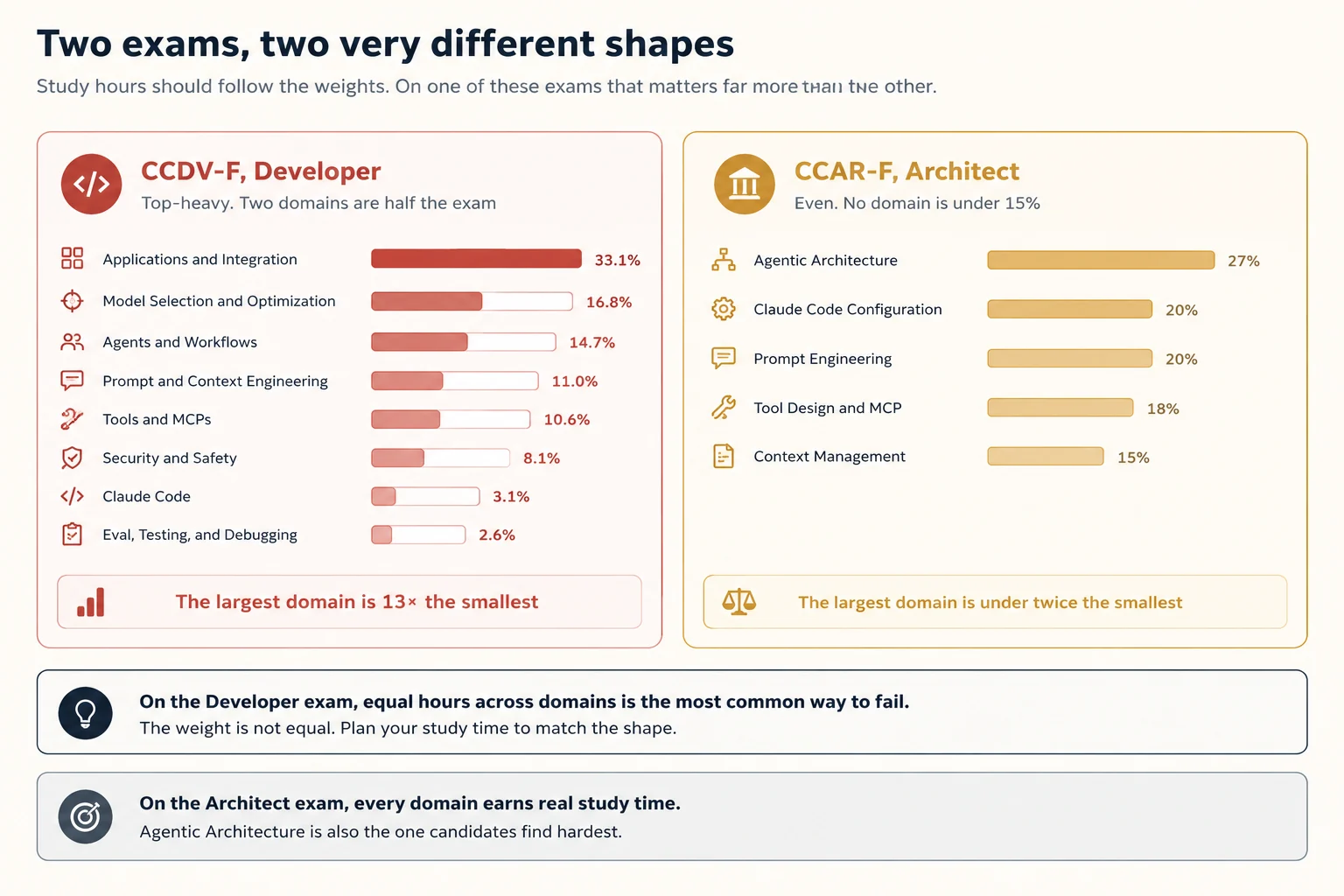 The shape matters more than the numbers. CCAR-F has no dominant domain to lean on, which is the opposite of the Developer exam beside it.
The exam was written against a fixed snapshot and the products have moved. Four places matter. On two of them this book teaches you today's behaviour, which is right in your code and wrong on the answer sheet.
| The guide says | The product does | On the exam |
|---|---|---|
allowedTools must include "Task" to spawn subagents | SDK metadata names the spawning Agent block | Answer Task |
allowed-tools in skill frontmatter restricts tool access | It pre-approves for the invoking turn: Claude Code for Teams, Concept 10 | Answer restricts |
| Names PostToolUse, while describing pre-call blocking | PreToolUse is the blocking hook: Claude Agent SDK, Concept 11 | Answer the described behaviour |
tool_use with a JSON schema is the reliable structured-output path | output_config.format is what you write today | Answer tool_use |
Three artifacts appear in the guide's own sample distractors and exist in no product: a .claude/config.json with a commands array, a CLAUDE_HEADLESS=true variable, and a --batch flag.
Every weight above is honoured on PCAR-F. What the Panaversity sitting adds is a second half to each domain, asked without the vendor framing:
- Agentic Architecture & Orchestration. The twin asks how a subagent receives its context in the Claude Agent SDK, given that it does not inherit the coordinator's history. PCAR-F asks that, then asks what has to be true of any coordinator handing work to any worker before that handoff is safe.
- Claude Code Configuration & Workflows. The twin asks how
CLAUDE.mdscoping and path-specific rules resolve. PCAR-F asks that, then asks where an agent's standing instructions belong when the harness is not Claude Code, and what breaks when two sets of them disagree. - Context Management & Reliability. The twin asks when to escalate to a human inside the scenario's product surface. PCAR-F asks that, then asks who is accountable for the escalation that never happened, which is a question your customer raises long before any vendor does.
None of the eight blueprint courses answers those three questions at exam depth. The seven courses in the second study table do. Read the first entry in each row before the others.
| PCAR-F asks | Where it is taught |
|---|---|
| What has to be true of any coordinator handing work to any worker before the handoff is safe | Give Your AI Agent a Nervous System (Concept 4, Decision 5) · Choosing Agentic Architectures (Concepts 8 and 14) · Harness Engineering (Concept 3) |
| Where standing instructions live when the harness is not Claude Code, and what breaks when two sets disagree | Claude Code and OpenCode (Section 8) · Claude Code for Teams (Concept 3) · Connector-Native Apps (Concept 9, the chat-host case) · Leaving the Laptop (Concept 11, a rule that lives only in a vendor's console) |
| Who is accountable for the escalation that never happened | Loop Engineering (Concept 1, and Part 6 on in, on, or out of the loop) · Designing Agent Experiences (Concept 16) · Identic AI (Scenarios 4 and 5) |
Two of those courses, and one blueprint course, teach a pattern the key does not reward. Choosing Agentic Architectures and Claude Code and OpenCode both build the reviewer from a different model family; the exam's answer to a multi-pass review item is an independent instance without the generator's context, not a different vendor. Give Your AI Agent a Nervous System fans work out by subscription as well as through a parent; the exam's answer to a routing item is hub-and-spoke through the coordinator.
Sit a Sample First
The Panaversity sample exam for PCAR-F is coming soon. It will be free and it will not consume an attempt. There is no date yet, and this page will not invent one.
Until it lands, the closest full rehearsal in this book is the Anthropic-twin one. CCAR-F Practice Exam is 60 items in 120 minutes, weighted to the published blueprint, framed inside all six production scenarios rather than the four you draw on the day, and scored by domain. Every answer explains why the correct option addresses the cause and why each plausible-sounding alternative does not.
It rehearses the Anthropic exam. It is not a PCAR-F sample and a score on it is not a PCAR-F result. Read your per-domain breakdown rather than your total: a strong total hiding one weak domain is the profile most likely to fail on a different scenario draw.
Anthropic's own free material is the other half of a study week. Anthropic Academy is free; work the courses that match the five domains above, alongside the official docs on agents, context management, and tool design.
Schedule Your Exam
PCAR-F is proctored, one candidate at a time, and there are two routes to a seat. Enrolled in the matching Panaversity course, your attempt is free and you arrange it with your teacher. Not enrolled, you buy an attempt and sit it with one-on-one proctoring. The card below handles both, including the request form.
Two attempts come free for enrolled students; the retake fee and the external proctoring fee are not announced yet.
After You Pass
Passing PCAR-F completes the Panaversity qualification stage. With PCAO-F already behind you, the gate is closed.
PCAO-F → PCAR-F → FDE Internship Program → CCAO-F → CCAR-F, if you choose to sit them
The internship is the practical part of that sequence. Anthropic's exams register through the Anthropic Partner Academy and require an eligible organisational account; personal addresses are not accepted and there is no individual sign-up route. Panaversity assists qualifying internship participants with registration, and sitting the Anthropic pair is optional.
Anthropic does not require PCAR-F, or PCAO-F, or any other Panaversity exam. The gate is Panaversity's own, kept for two reasons. An Anthropic attempt costs a fee, and a failed one costs 14, 30, or 90 days before the next. And Panaversity is putting its own name behind yours, which is a claim it has to be able to stand behind.
One thing worth knowing before you plan the year: CCAR-F counts toward Claude Partner Network tier eligibility and CCAO-F does not. The Developer and Architect Professional credentials count as well. If tier standing matters to your organisation, this is the half of the recommended pair that shows up in it.
PCDV-F and PCAR-P come after, for people who want them. Neither is part of the internship gate.
The Anthropic Twin
| Field | CCAR-F |
|---|---|
| Credential | Claude Certified Architect – Foundations |
| Exam code | CCAR-F |
| Fee | $125 USD |
| Items | 60 |
| Structure | 4 scenarios drawn from a bank of 6; multiple-choice and multiple-response, each item stating how many responses to select |
| Time limit | 120 minutes |
| Passing score | Scaled score of 720 on a scale of 100 to 1,000 |
| Delivery | Proctored, online or at a test centre, through Pearson VUE |
| Validity | 12 months from the date the credential is awarded |
| Renewal | Free, non-proctored assessment on the Partner Academy if you renew on time. A lapsed credential means retaking the full exam at the full fee |
Two caveats belong with that table. $125 is list price, and checkout shows the final fee. And 720 is a scaled score, not 72 percent. The exam is criterion-referenced against a standard set by a formal study, and the per-domain percent-correct printed on your score report is explicitly not what decides your result.
If exam content changes significantly, Anthropic may require holders to retake the full exam rather than complete the renewal assessment.
The retake limit sits alongside the waiting periods: you may take any one exam up to four times within a rolling twelve-month period, and the fee applies to each attempt. Limits apply per exam, so failing this one does not block you from registering for a different one.
The guide's appendix also prints an explicit out-of-scope list, and reading it will save you a study week. Fine-tuning, authentication and billing, MCP hosting and infrastructure, Constitutional AI and RLHF, embeddings and vector databases, computer use, vision, streaming, rate limits and pricing math, OAuth and key rotation, cloud-provider configuration, benchmarking, prompt-caching implementation, and tokenization are all outside what CCAR-F tests.
- Official guide: Claude Certified Architect, Foundations, Exam Guide v1.0
- Registration and current downloads: Architect Foundations on the Partner Academy
The direct PDF link can change. If it stops working, open the Partner Academy page and download the current guide there. Treat that guide, not this page, as the authority on what CCAR-F tests.
Where to Go Next
The certification path has the full sequence, what each stage costs, and how registration and renewal work. PCAO-F is the exam that comes before this one, and the one to sit first if you have not. PCDV-F is the implementation credential, and PCAR-P is the professional capstone.