Proof you can carry in.
Independently verified.
A Vertical FDE is often hired before there is much work to point at, sometimes by someone who cannot evaluate the work directly. A proctored certification is the rare piece of your portfolio that does not need them to read your code or take your word for it. Two Panaversity exams open the FDE Internship Program, and the internship is where Panaversity helps you register for Anthropic’s official exams, if you choose to sit them.
- Stage one · firstPCAO-FAssociate: Foundations
- Stage one · thenPCAR-FArchitect: Foundations
- You qualifyFDE Internship Programwith assisted Anthropic registration
- Stage two · firstCCAO-FClaude Certified Associate
- Stage two · thenCCAR-FClaude Certified Architect
First prove you are ready through Panaversity. Then enter the internship. Then, optionally, sit the official Anthropic exams, with Panaversity assisting your registration.
What the whole path costs
The training itself can stay free: this book and the Anthropic Academy courses cost nothing. For the recommended FDE path, the direct Anthropic exam cost is $224 at list prices.
| Step | Panaversity student | Everyone else |
|---|---|---|
| PCAO-F, first two attempts | Free | Proctoring fee |
| PCAR-F, first two attempts | Free | Proctoring fee |
| A third or later attempt on the same Panaversity exam | Retake fee | Proctoring fee |
| FDE Internship Program | No additional fee for qualifying participants | No additional fee for qualifying participants |
| CCAO-F | $99 list price | $99 list price |
| CCAR-F | $125 list price | $125 list price |
| Optional Anthropic pair: CCAO-F + CCAR-F | $224 at list prices | $224 at list prices |
Panaversity proctoring and retake fees are still being set. The Anthropic prices are Anthropic’s own published fees. The Panaversity stage is free for students within the stated attempt policy, so the main investment is your study time.
The previous page made a simple argument: what you carry between companies matters more than what you leave behind. Your skills, your library, your judgment.
A proctored certification is the most portable item on that list, and this page turns it into a path.
An independent credential changes the starting point of the hiring conversation.
Claude certification registration runs through the Anthropic Partner Academy and requires an eligible organisational account. Anthropic's registration guide is explicit: personal email addresses are not accepted, and there is currently no individual sign-up route.
Passing PCAO-F and PCAR-F qualifies you for the Panaversity FDE Internship Program. Panaversity assists qualifying internship participants with registration for the official exams.
Sitting the Anthropic exams is optional, and the choice is yours. The Panaversity credentials and the internship stand on their own.
Updated on 1 September 2026 against Anthropic's certification materials and current public company information. The four certification guides referenced below are Version 1.0, effective July 2026.
Download the current guide before you book. Exam blueprints, domain weights, registration rules, and programme details can change.
Why Anthropic Matters Now
In our view, Anthropic is currently the foremost AI lab in the world and is at the forefront of the transition toward agentic AI. That is an opinion, but the scale and speed of the company's growth make the certification programme unusually important for anyone preparing to build, deploy, advise on, or lead AI-native systems.
Anthropic is no longer simply a frontier-model research company. Claude now spans conversational AI, coding, long-running agentic work, enterprise deployment, APIs, tools, MCP, and partner-led implementation. Anthropic's own Economic Index notes that Claude Code and Cowork have pushed usage increasingly toward long-running agentic tasks, not just short chat interactions. See Anthropic Economic Index: Cadences.
The commercial growth has been extraordinary. On 28 May 2026, Anthropic announced a $65 billion Series H at a $965 billion post-money valuation and said its run-rate revenue had crossed $47 billion. See Anthropic's Series H announcement.
Anthropic is also building a large implementation ecosystem around Claude. The company says the Claude Partner Network is backed by a $100 million investment in partner training, technical support, and shared marketing; by June 2026, more than 40,000 firms had applied and more than 10,000 consultants had earned a Claude certification. See Anthropic's Partner Network update.
The next step may be public markets. Anthropic confidentially submitted a draft Form S-1 to the U.S. SEC on 1 June 2026, formally opening the path to an IPO. Anthropic itself says the number of shares and offering price have not yet been set. See Anthropic's S-1 announcement.
Current reporting goes further. Reuters reported on 27 August 2026 that Anthropic was preparing to publicly unveil its IPO prospectus after Labor Day, with a possible listing in late September or early October. Separate Reuters reporting has described a $2 trillion valuation as plausible under aggressive forward-growth assumptions. That would put Anthropic among the largest technology IPOs ever if it materializes. The important distinction is that $2 trillion is a reported potential valuation, not an announced IPO price or completed valuation.
For a learner, the conclusion is practical: an Anthropic certification is becoming a portable proof of capability inside one of the most consequential AI ecosystems in the world. Panaversity's path is designed to make sure you are ready before you spend an official exam attempt.
Stage One: Panaversity Qualification and the Internship
Before Panaversity offers a candidate the FDE Internship Program, the candidate must first clear the Panaversity qualification stage.
For the recommended FDE path, the readiness gate is now deliberately Associate first, Architect second:
PCAO-F → PCAR-F → FDE Internship Program
Panaversity's certification framework contains four proctored exams, each aligned to an Anthropic credential. The two exams used for the FDE Internship gate are PCAO-F and PCAR-F.
Each Panaversity exam takes the same blueprint one level up: every objective of the matching Anthropic credential at the published weights, at the same 720 out of 1,000 threshold. Panaversity administers and proctors these exams independently. Each has its own page: the official domain weights, the study guide for it, a sample to sit first, and how to book a proctored seat.
| Panaversity exam | Code | Blueprint | Role in the path | Page |
|---|---|---|---|---|
| Panaversity Certified Associate: Foundations | PCAO-F | CCAO-F | Required first | PCAO-F |
| Panaversity Certified Architect: Foundations | PCAR-F | CCAR-F | Required second | PCAR-F |
| Panaversity Certified Developer: Foundations | PCDV-F | CCDV-F | Additional technical credential | PCDV-F |
| Panaversity Certified Architect: Professional | PCAR-P | CCAR-P | Advanced / professional track | PCAR-P |
The Panaversity Qualification Stage
For the Vertical FDE role this book trains for, Stage One has two required exams: PCAO-F first, then PCAR-F. Pass both before moving into the FDE Internship Program.
The order is deliberate.
Take PCAO-F first. Associate Foundations establishes the baseline judgment every AI professional should have before specializing: effective prompting, output evaluation and validation, workflow integration, appropriate model/product use, governance, responsible use, and knowing when human review is required.
Take PCAR-F second. Architect Foundations then moves from AI fluency into system design: agentic architecture, Claude Code configuration, prompt engineering, tool design and MCP, and context management.
This progression asks two questions in order:
- Can you use and evaluate AI responsibly and effectively?
- Can you design the systems in which AI will operate?
Only after both answers are demonstrated through proctored exams does Panaversity offer the candidate the FDE Internship Program.
Pass both PCAO-F and PCAR-F to qualify for the Panaversity FDE Internship Program. Panaversity students and external candidates are held to the same proctored exam standard. External candidates who pass both exams also qualify for this route; they do not need to be enrolled in a Panaversity course.
If you then choose to sit the official Anthropic exams, take them in the same sequence: CCAO-F first, then CCAR-F. Panaversity assists internship participants with registration.
Keep the responsibilities separate:
Panaversity qualification (PCAO-F → PCAR-F) → FDE Internship Program → assisted Anthropic registration, if you choose it → official Anthropic exams (CCAO-F → CCAR-F)
Anthropic does not require PCAO-F or PCAR-F. Those are Panaversity's readiness requirements for this route.
What the Panaversity Exams Cost
Panaversity students get two free attempts per exam. A third or later attempt is charged a fee, which is not announced yet.
Everyone else pays only the proctoring fee, which is also not announced yet. You do not have to study with Panaversity to sit the exams.
The two-attempt policy is deliberate. One attempt creates too much pressure. Unlimited attempts turn the exam into trial and error.
Two attempts give you a real second chance while still rewarding preparation.
Sit a sample before you spend an attempt. Each certification page has a Sit a Sample First section; samples cost nothing and do not count against you.
Use practice to discover your weak areas before a real sitting does.
Why the Gate Exists
The gate exists for two reasons. Neither is revenue.
An Anthropic attempt costs money and time. A sitting costs $99 to $175. Successive failures bring waits of 14, 30, and 90 days.
Booking before you are ready can cost both a fee and months of delay.
Your first two Panaversity attempts cost nothing. A free proctored exam against the corresponding blueprint gives you a much cheaper readiness check.
If you cannot clear 720 on PCAO-F and PCAR-F, do not assume the corresponding CCAO-F and CCAR-F exams will go differently.
The credential also has to mean something. Panaversity is using the gate to protect the quality of the candidates for whom it provides the internship and registration assistance.
Why Associate First, Then Architect
The two Foundations exams test different layers of FDE readiness.
PCAO-F comes first because judgment is the foundation. Before designing an agentic system, you should be able to prompt effectively, evaluate output, detect hallucinations and inconsistencies, validate results, choose appropriate workflows, understand product capabilities and limitations, and apply governance and responsible-use principles.
PCAR-F comes second because architecture builds on that judgment. It asks you to make system-level trade-offs around agents, tools, MCP, prompts, Claude Code configuration, and context.
Together they form a cleaner progression for a future Vertical FDE:
Use AI well → evaluate it correctly → govern it responsibly → design the system.
The internship then provides the environment in which those skills can be turned into deployment experience.
The two-exam requirement is Panaversity's, not Anthropic's.
Anthropic does not require one certification before another. It requires an eligible organisational account for registration. Panaversity decides who qualifies for its FDE Internship Program.
The Panaversity exams are therefore not Anthropic prerequisites. They are Panaversity's readiness gate before it puts its name and assistance behind your attempt.
Stage Two: CCAO-F → CCAR-F
Once you have passed PCAO-F and PCAR-F and entered the FDE Internship Program, you can move to the official Anthropic exams. They are optional; Panaversity assists participants who choose to sit them.
For the FDE path in this book, take them in this order:
CCAO-F first → CCAR-F second
Anthropic itself does not impose this order. It is Panaversity's recommended sequence because it mirrors Stage One: establish broad Claude judgment first, then validate architecture.
The full Anthropic certification program contains four credentials:
| Certification | Code | Price | Questions | For |
|---|---|---|---|---|
| Claude Certified Associate – Foundations | CCAO-F | $99 | 60 | Using, evaluating, advising on, and leading Claude adoption |
| Claude Certified Architect – Foundations | CCAR-F | $125 | 60 | Designing Claude and agent systems |
| Claude Certified Developer – Foundations | CCDV-F | $125 | 53 | Building and shipping Claude applications |
| Claude Certified Architect – Professional | CCAR-P | $175 | 63 | Owning solutions end to end |
Every price and every count above comes from Anthropic's published exam guides.
The Official Exam Guides
Anthropic publishes a guide for each exam. Treat the guide as the authority on what is tested. This page defers to it.
Anthropic's Exam Registration Guide is also useful. It walks through the process from Partner Academy registration to Pearson VUE scheduling.
Each exam also has a Partner Academy page for registration and guide downloads:
The direct PDF links can change. If one stops working, open the exam's Partner Academy page and download the current guide there.
The exams share the same basic mechanics.
Every exam is proctored and identity-verified through Pearson VUE, and each runs 120 minutes. You can take it online through OnVUE or at a test centre.
Scores run from 100 to 1,000, with a 720 cut score. You pass by meeting a fixed standard, not by beating other candidates.
There Are No Anthropic Certification Prerequisites
No Anthropic exam requires another Anthropic certification. The credential is awarded on the exam result itself.
That is separate from eligibility through Panaversity. Anthropic's programme does not require CCAO-F before CCAR-F, but Panaversity recommends that order after its own two-exam qualification gate.
Which Credentials Are Yours
The four Anthropic credentials are role-based, not a formal ladder. But this book has a specific target role: the Vertical FDE.
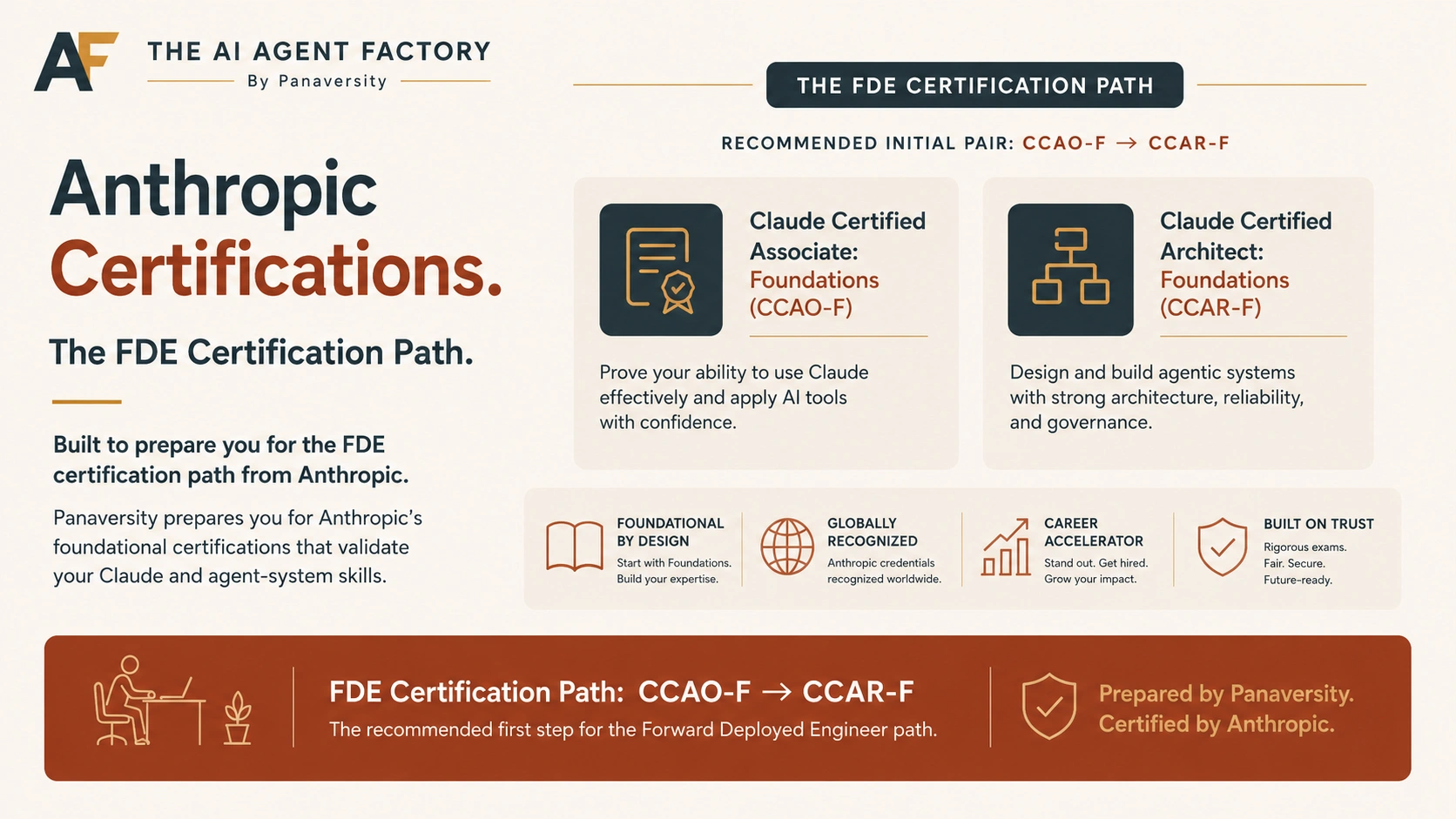
For that role, the recommended initial pair is:
CCAO-F → CCAR-F
Start with CCAO-F. It validates the broad judgment an FDE needs when working with customers and teams: prompting, output evaluation and validation, workflow integration, product selection, configuration and knowledge management, governance, responsible use, troubleshooting, and knowing where human review belongs.
Then take CCAR-F. It validates the architectural judgment needed to design agent systems: agentic architecture, Claude Code configuration, prompt engineering, tool design and MCP, and context management.
The other two credentials remain valuable:
- CCDV-F is the natural additional credential for FDEs who want deeper proof that they can build and ship Claude applications, integrations, agents, workflows, tools, and production systems.
- CCAR-P is the professional capstone for senior architects who own solutions end to end, including stakeholder communication and lifecycle management.
Course Badges Are Not Certifications
Anthropic offers two things that sound similar. Do not confuse them.
Anthropic Academy courses are free and self-paced. Completing one can earn you a course badge. There is no proctor, fee, or identity check.
The Claude Certification Program is different: it is the four proctored exams above.
| Academy badge | Certification | |
|---|---|---|
| Cost | Free | $99 to $175 per attempt |
| Assessment | Course quizzes, or none | 53 to 63 scored items, proctored |
| Identity check | None | Government photo ID |
| Credential | Completion badge | Credly digital credential |
| Says | "I took the training" | "I passed an independent exam" |
Both can be useful, and the free Academy courses are good preparation.
Do not write "Claude Certified" on your CV until you have passed the Pearson VUE exam.
Registration, Retakes, and Renewal
Panaversity exams. Register through Panaversity. The qualification requirements and access route are described in Stage One above. Complete PCAO-F and PCAR-F before the FDE Internship Program is offered.
Anthropic exams. These are optional. For internship participants who choose to sit them, Panaversity assists with registration through the Anthropic Partner Academy. For the recommended path, take CCAO-F first, then CCAR-F.
Open your exam page, download the guide, register, and pay. Then use Pearson VUE to schedule either OnVUE or a test-centre appointment.
Rescheduling. You can reschedule free up to 24 hours before the appointment. Inside that window, you forfeit the fee.
Retakes. You may make up to four attempts at the same exam in a rolling 12 months.
The waits are 14 days after the first failure, 30 after the second, and 90 after the third. Each attempt costs the full fee. Failing one exam does not stop you registering for a different exam.
Renewal. Each credential lasts 12 months. On-time renewal is free through a non-proctored refresher; let the credential lapse and you must retake the full proctored exam at full price.
Exam day. Bring government photo ID that exactly matches your registration name. For online proctoring, expect webcam supervision, a clear workspace, and no phones, notes, or second monitor.
You must accept a non-disclosure agreement before starting. Declining it ends the session without a refund.
Accommodations. Request them through Pearson VUE and get approval before you schedule.
Results. You receive a Credly digital credential and a score report with performance by domain.
Six Mistakes Worth Avoiding
Booking before you are eligible. Complete PCAO-F and PCAR-F and enter the FDE Internship Program before booking the official Anthropic exams through the Panaversity route.
Studying every domain equally. On CCDV-F, a 2.6% domain should not get the same time as a 33.1% domain. Read your exam's weights before you plan.
Confusing a course badge with certification. A completion badge is not the proctored Claude certification credential.
Watching without building. The exams test applied judgment: batch versus real-time, workflow versus agent, MCP server versus custom tool.
You develop that judgment by building.
Using a real attempt as practice. Each certification page has a Sit a Sample First section; work it before you spend an attempt or pay an Anthropic exam fee.
Letting the credential lapse. Put the renewal date in your calendar when you pass. The renewal rules are in the Registration section above.
An Honest Word on Value
These credentials are still new. There is no mature salary data, and employers do not yet filter for codes such as "CCAO-F" or "CCAR-F" the way they might for an established cloud certification.
What you get is an early-mover signal. The exams are proctored, criterion-referenced, and independently verifiable.
That makes the signal meaningful even though the market has not yet had years to price it.
For a Vertical FDE, the value comes back to trust. A hiring manager may have limited evidence about you.
A proctored credential is evidence that did not come from your own claims.
The limit matters just as much: a certification demonstrates skill. It does not replace skill.
If you cannot yet build and deploy an API-backed application, start there. The exam should come after the capability.
Where to Start
PCAO-F. It is the first exam on the path, the judgment layer everything else builds on, and its page has the study guide, the sample, and the seat request.