The Agent Is the Operating Layer
How the Agentic Era Dissolves SaaS, the App, and the Personal Computer as We Know It
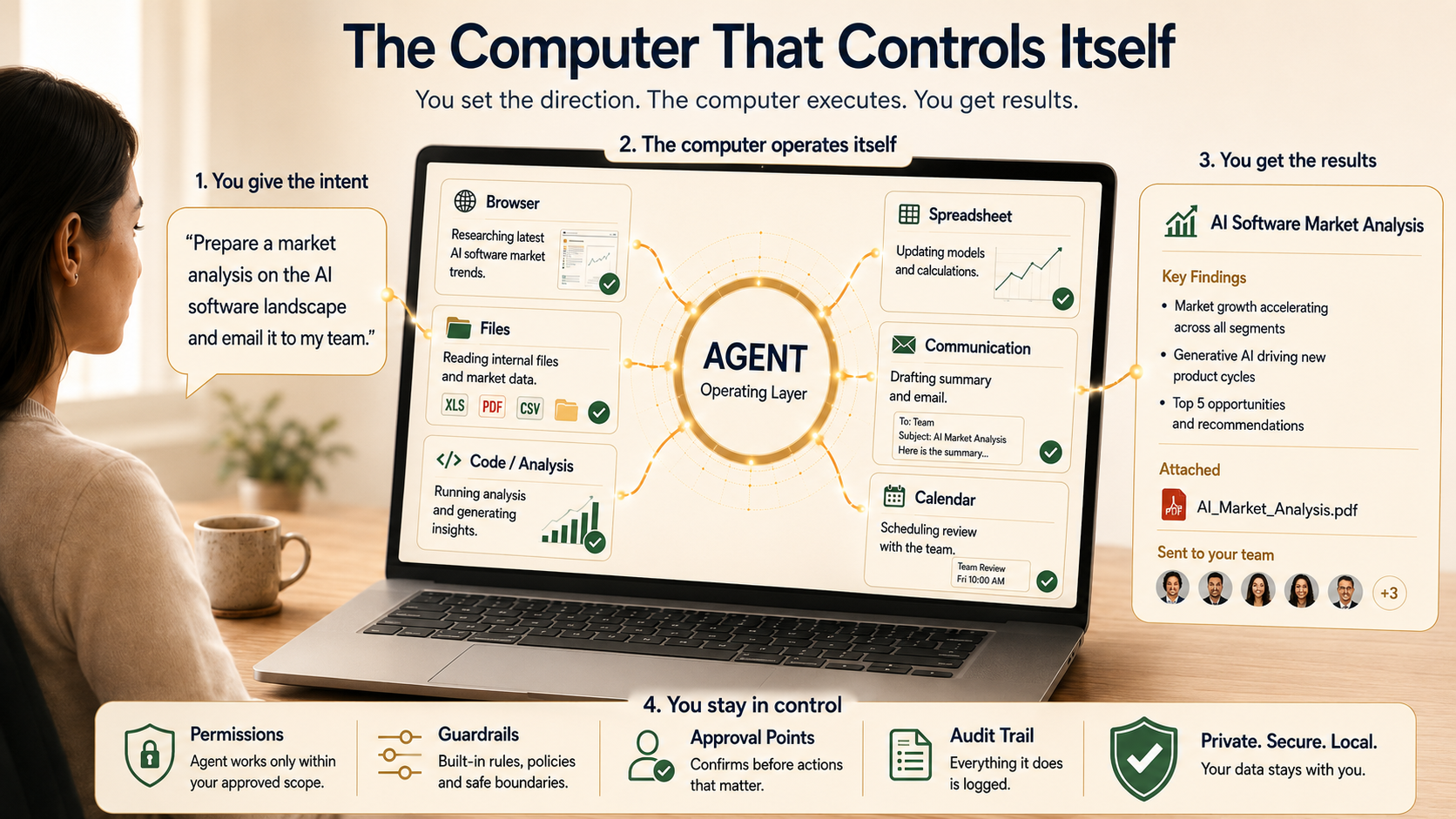
"For forty years, you launched apps. Click. Type. With RTX Spark and Microsoft Windows, you ask — and the PC does the work."
— Jensen Huang, NVIDIA, GTC Taipei, June 1, 20261
On June 1, 2026, NVIDIA stood on a stage in Taipei and quietly declared the end of the personal computer as we have known it.
The announcement looked like a chip launch. RTX Spark combines an Arm-based processor, a Blackwell GPU, roughly a petaflop of on-device AI compute, and up to 128GB of unified memory. NVIDIA built it with Microsoft so agents can run locally on Windows without sending every task to the cloud.1
The press treated this as a hardware story: NVIDIA entering the PC business and challenging Apple silicon and Qualcomm.
That framing is too small. RTX Spark is not merely a faster laptop. It supports a change in who operates the computer.
For forty years, the answer was: you do. You open the apps. You move the windows. You click, type, save, and switch. The machine waits for your hands.
This paper argues that this arrangement is ending. It takes two casualties with it.
The first casualty is SaaS. The second is the PC itself.
One clarification before the argument: this is a direction, not an overnight switch. It starts with work that is digital, bounded, and recoverable, especially knowledge work and software development. Humans will remain at the screen longest when the stakes are high, the rules are strict, or the work is physical. Section 8 defines the limits and likely pace.
1. Two deaths, not one
The "SaaSpocalypse" is now a familiar argument, and it is largely correct. A general agent can read data, reason over it, call tools, and complete a workflow from beginning to end. When that happens, the SaaS product no longer needs to be the place where the user works.
The user stops logging in, navigating screens, and performing each step. The agent performs the workflow instead.
SaaS does not vanish. It is unbundled into capabilities that agents call: an API, an MCP server, or another tool. The interface, brand, seat-based pricing, and daily-active-user moat lose their power. The underlying capability survives, but as a function the agent calls.
This is real, and it is happening. But it is the appetizer.
The larger claim is harder to say: the personal computer, as something humans operate by hand, is becoming obsolete. This begins with digital, bounded, recoverable work and advances from there.
The silicon does not disappear. The box on the desk does not disappear. What changes is the operating model: apps on an operating system, presented through a graphical shell that a human must learn and drive.
That stack was built for a person who had to perform the work. Once the work is delegated, much of that interface becomes unnecessary.
SaaS dies as a destination because the agent replaces the app. The PC as we know it dies because the agent replaces you at the controls.
2. The SaaSpocalypse, in full
Before the larger change, the smaller one deserves a complete explanation. It is already underway, and its mechanism becomes the template for the rest of this paper.
The Preface tells the market story of the SaaSpocalypse and the trillion-dollar repricing of February 2026. This section explains the mechanism beneath it.
Software-as-a-service was a business model dressed as a product. Strip away the packaging and a SaaS application contains three layers:
-
A system of record that holds the trusted data: customers, invoices, tickets, and documents.
-
A set of capabilities that can create, query, transform, or route that data.
-
A workflow UI that lets a human operate those capabilities through screens, forms, and buttons.
For thirty years, these layers were welded into one product. Users logged in, learned its interface, and paid for each seat.
The agent pulls them apart.
The workflow UI dies first. Its purpose was to let a human operate the capabilities. An agent can read the record, choose an operation, and execute it without navigating those screens.
A dashboard you once opened every morning becomes an agent that reads the same data. It tells you what changed and what needs a decision. The UI does not get redesigned. It gets bypassed.
The capabilities survive, but they are demoted from product to function call. The useful operations still matter: send the invoice, route the ticket, run payroll. But an agent reaches them through an API or MCP server and never asks the user to open the product.
The capability remains valuable. It is no longer a destination. The product dissolves into operations that become interchangeable parts of an agent's workflow.
The system of record is the prize. An agent needs trusted data before it can act safely. The owner of that record therefore holds the layer that survives.
Agents do not displace the database. They make it more strategic. An agent is only as good as the record it reasons over. The SaaS vendors that endure will realize that they were a database with a UI, and the UI was the disposable half.
For knowledge-intensive work, the same logic extends beyond transactional rows. Agents also need authoritative knowledge: source material, policy, methods, decisions, provenance, and the context that explains why the record means what it means. That is the role of a Knowledge System of Record (KSOR). Models and agent vendors may change; trusted organizational knowledge must persist.
The business model breaks on contact. Seat-based pricing assumes humans are clicking through screens. Remove those humans and per-seat revenue has nothing useful to measure.
Daily active users measure human attention. But agents do not care about familiar menus or product habits. They can compare tools and switch between them without resistance.
The economics therefore invert. Value moves away from occupying human attention. It moves toward being callable, trustworthy, and authoritative for an agent.
So the SaaSpocalypse does not mean that all SaaS disappears. It means SaaS gets unbundled, and the bundle was the business.
The capability survives as a tool. The record survives as the contested high ground. The UI loses its central role, along with pricing and loyalty built around that UI.
The companies that thrive will stop selling screens to humans. They will sell capabilities and trusted data to agents, governed by clear permissions.
Section 3 applies the same logic one level deeper. The agent splits SaaS into capability, record, and a bypassed UI. It splits the PC into compute, an operating system that becomes plumbing, and a shell that loses its central role.
Same mechanism. Larger system.
3. The forty-year stack, and why it is ending
Consider the architecture we have used since the 1980s. At the bottom sits the operating system: Windows, macOS, or Linux. It manages files, memory, processes, devices, and security.
Applications sit above it: Word, Excel, Photoshop, Chrome, and Slack. A graphical shell sits between the person and the machine: the desktop, taskbar, dock, windows, folders, and app grid.
The genius of this design was that it gave a human a map of the machine. The tragedy of it is that the human had to read the map and walk every path. To produce a quarterly report, you opened a spreadsheet and found the file. You wrote formulas and exported the result. Then you opened a document, pasted and formatted the data, opened email, attached the file, and sent it. Each app was a silo with its own UI you had to master. The OS was the floor you stood on. The apps were the rooms you walked between. You were the one walking.
Each step compensates for a computer that could not understand intent. The desktop metaphor is a forty-year-old aid for that limitation.
Give the machine the ability to understand a goal and carry it out. Much of that aid is no longer needed.
This is the precise sense in which the classical OS interface dies. The kernel remains. Like TCP/IP and the BIOS, it becomes essential but mostly invisible.
What disappears is the OS as the human's main interface and the app as the unit of human work. The shell stops being the place where the work happens.
NVIDIA calls its runtime for this era OpenShell. It sits above the old shell and controls what agents may touch. Microsoft is going further at the Windows platform layer: its On-Device Registry (ODR) provides a system mechanism for discovering agent connectors and MCP servers, while Agent Launchers let applications register agents once so supporting Windows experiences can discover and invoke them.23
The classic UI therefore becomes a thinner surface over a growing agent substrate. The action moves behind it.
4. The AI Operating Layer
The new architecture does not erase the operating system. It adds a layer above it where the human now works. The OS moves into the background.
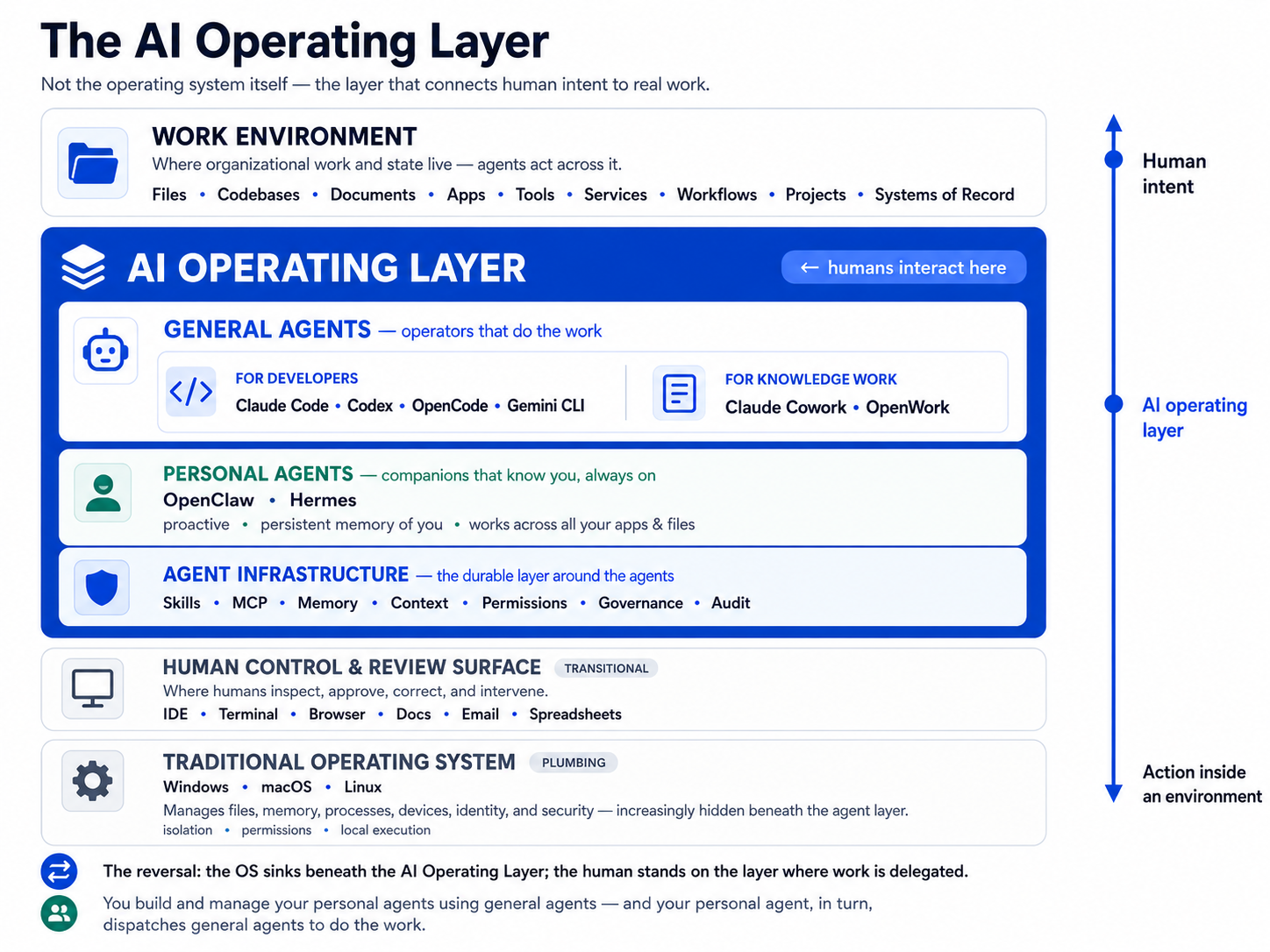
The reversal is the whole story. In the old model, the human stood on the operating system and reached for apps. In the new model, the human stands on the AI Operating Layer.
This layer is not the operating system itself. It connects human intent to real work. The human states a goal. The agent opens files, drives the browser, runs commands, and calls tools on the human's behalf.
The operating system moves into the background, like the engine timing in a modern car.
The browser chat box offered an early hint. A chat answers a question and keeps you inside the chat. A general agent works inside an environment and completes the task there.
An assistant answers in place. An operating layer acts in the world.
4.1 The model is not the operating layer
This distinction matters because several layers that are often called "the AI" are actually different things.
                    HUMAN
                      │
               intent / judgment
                      │
                      ▼
          ┌──────────────────────┐
          │  AI OPERATING LAYER  │
          │                      │
          │ identity + context   │
          │ memory + permissions │
          │ orchestration        │
          │ governance + audit   │
          └──────────┬───────────┘
                     │
              AGENT / HARNESS
                ┌────┴────┐
                │         │
                ▼         ▼
        REASONING MODEL   CAPABILITIES
        Claude / GPT      skills
        Gemini / local    MCP / APIs / CLI
                │         OS + app tools
                └────┬────┘
                     │
              Windows / macOS /
                   Linux

Host ↔ Agent: ACP or native integration
Agent/Host ↔ Tools & Data: MCP / APIs
The exact boundaries vary by product, but the architectural separation is durable.
The model supplies reasoning and generation. The agent or harness turns that reasoning into a loop that can plan, call tools, inspect results, recover, and continue. The AI Operating Layer adds the standing context around that work: identity, memory, permissions, orchestration, governance, auditability, and access to the environment.
The protocols have different jobs. ACP connects an agent to a host such as Xcode. MCP connects an agent or host to tools, data, and external capabilities. Skills package reusable instructions and procedures. Treating them as one interchangeable layer obscures the architecture.
That means the model should not become the architecture.
Claude, GPT, Gemini, and local models can change. Agent implementations can change too. The durable system is the environment around them: the trusted records, skills, tools, policies, permissions, evaluation criteria, and organizational context that let an agent act safely.
Apple now exposes this separation unusually clearly. Xcode 27 can host agents from Anthropic, Google, and OpenAI; plug-ins can add skills and MCP tools; and any compatible agent can connect through the Agent Client Protocol (ACP). The development environment remains while the intelligence provider can change.4
The local stack makes the same point from the opposite direction. Apple demonstrates OpenCode and other agents pointed at a local MLX-LM server through a standard API. The agent does not need to care whether the model is in a hyperscale cloud or running on the Mac beside it.5
4.2 The operating systems are already building it
This is no longer only a forecast about where personal computing might go. Windows now exposes OS-level pieces of an agentic substrate, while Apple's developer and system frameworks on macOS expose the same separation between agents, models, tools, and application capabilities.
Windows: discovery, connectors, containment, and invocation.
Microsoft's On-Device Registry gives agents and applications a system-managed way to discover MCP servers and agent connectors. Windows can expose capabilities such as File Explorer through MCP, while the registry provides a common discovery point instead of requiring each agent to integrate independently with every tool.2
Windows also has Agent Launchers. An application can register an agent once and make it discoverable to supporting system experiences such as Start, Search, or other applications. The operating system is beginning to know that agents exist as first-class invokable entities.3
Security is part of the architecture rather than an afterthought. MCP servers accessed through the Windows ODR can run inside a separate agent session under a separate user account, with access limited to approved resources. The same OS that gives an agent reach also becomes responsible for containing that reach.6
The emerging Windows stack therefore looks less like "Copilot added to Windows" and more like this:
                 HUMAN
                   │
          Windows system surfaces
                   │
                   ▼
       ┌─────────────────────────┐
       │ WINDOWS AGENT SUBSTRATE │
       │                         │
       │ Agent Launchers         │──→ registered agents
       │ On-Device Registry      │──→ MCP servers/connectors
       │ App Actions + MCP       │
       │ agent-session security  │
       │ permissions/containment │
       └────────────┬────────────┘
                    │
          files / apps / services
macOS: multiple agents, open protocols, and local models.
Apple reached the same destination through the development environment first. Xcode 26.3 brought Anthropic's Claude Agent and OpenAI's Codex directly into Xcode. Xcode 27 expands that model to agents and models from Anthropic, Google, and OpenAI, and gives them tools to plan, edit, run tests, inspect previews, and interact with simulators while validating their own work.74
More important than any one vendor integration is the openness of the architecture. Xcode plug-ins can package custom skills and MCP tools, while any compatible agent can connect to Xcode through ACP. This means Xcode is becoming an agent host, not merely an IDE with one proprietary assistant.4
At the broader platform level, Apple's App Intents framework exposes application data and actions to Siri AI, including capabilities such as personal context, app actions, and onscreen awareness. Apple's model frameworks also support Apple models, third-party cloud providers, and custom on-device models. The direction is therefore larger than coding: applications are being taught to expose capabilities that system intelligence can discover and invoke.4
Apple is also demonstrating the whole agentic loop locally. Its MLX guidance shows an agent such as OpenCode using a locally served model, calling tools, reading files, running commands, and iterating until the task is complete — entirely on the Mac except for whatever external tools the task itself requires.5
The emerging Mac stack therefore looks like this:
                 HUMAN
                   │
                  XCODE
                   │
       ┌───────────┼────────────┐
       │           │            │
       ▼           ▼            ▼
  Agent host     Skills      MCP tools
       │
  native / ACP
       │
  ┌────┼─────┬─────────┐
  ▼    ▼     ▼         ▼
Claude Codex Gemini   other
Agent                  agent
  │    │     │         │
  └────┴─────┴─────────┘
           │
    local or cloud model
           │
     Xcode + macOS tools
Linux: the same destination by a different route.
Linux has no single vendor that can declare one canonical agent layer. Unlike the Windows and Apple examples above, this section is a forecast rather than a description of one shipped Linux-wide agent platform. Its likely path is compositional rather than centrally designed.
The ingredients already fit naturally: the shell, filesystem, process model, system services, containers, permissions, desktop APIs, local models, and open agent protocols. General agents such as Claude Code, Codex, OpenCode, and others can already operate in this environment without waiting for a single "Linux agent" product.
A future Linux agentic stack may therefore emerge as an open substrate:
                 HUMAN
                   │
            AGENT / HARNESS
                   │
       Claude / Codex / OpenCode
                   │
          Skills / MCP / tools
                   │
   shell / files / containers / APIs
                   │
            permissions / policy
                   │
                 LINUX
Windows may make the agent substrate a platform feature. Apple may make it deeply integrated with its tools and hardware. Linux may make it the most composable and vendor-neutral version.
All three paths point in the same direction: the operating system increasingly supplies the execution environment, identity, permissions, discovery, containment, and tools; the agent supplies the loop; the model supplies reasoning.
5. Personal agents and general agents
Two kinds of agents occupy the AI Operating Layer. Confusing them makes the rest of the architecture harder to understand.
Both live in the layer where the human now stands. One is oriented toward the work. The other is oriented toward the person.
General agents are operators. They do the work.
For developers, examples include Claude Code, Codex, OpenCode, and Gemini CLI. They build, test, refactor, and deploy. For knowledge workers and domain experts, tools such as Claude Cowork and OpenWork research, analyze, write, and coordinate.
A general agent is not a chatbot attached to a product. It can reason, use tools, and complete work inside a real environment. You call it for a task. It executes the task. The session ends. It is a task-scoped specialist.
The agent should also be separated from the model beneath it. Xcode can host multiple agent providers, and Apple's local MLX stack shows the same agentic pattern running against a local model endpoint. This matters because it turns Claude, GPT, Gemini, or a local model from a permanent architectural dependency into a replaceable reasoning engine.45
Personal agents are your delegate. They know you.
They stay with you, hold your context, plan ahead, and act across many tasks. This category is already forming around RTX Spark. Independent agent makers, including OpenClaw and Nous Research's Hermes, have committed to Windows-native agents on this stack. They are expected to appear beside the first RTX Spark laptops this fall.
A personal agent is oriented toward you, not one task. It can remain private and local. It remembers your work and preferences, acts proactively, and spans your apps and files. It is your standing representative inside the layer.
Together, these agents form the operator and the delegate. The Agent Factory Thesis formalizes this structure as the Two-Layer Model.
At the Edge Layer sits a personal agent that represents the principal. The thesis calls this self-sovereign agent Identic AI: an agent you own rather than rent. Below it sits a workforce of AI Workers that performs the work.
The thesis explains their differences in lifespan, memory, initiative, multiplicity, and governance. This paper asks a narrower question: what does this split do to the interface?
The interface argument depends on one relationship. You build and manage the personal agent with general agents such as Claude Code and OpenCode. Those tools configure its memory, permissions, and skills.
At runtime, the relationship reverses. The personal agent understands your intent, dispatches general agents and AI Workers, and reports back. You use developer tools to manage the chief of staff. The chief of staff manages the rest.
The thesis develops this as its two modes of general-agent use.
This is not only a forecast. A narrow version has already operated at scale.
In 2024, Klarna put an AI agent in front of its customer service. It handled two-thirds of all chats, including 2.3 million conversations in the first month. Klarna said the agent performed work equal to roughly 700 full-time employees. It cut average resolution time from 11 minutes to under 2. The company credited it with about $40 million in annual profit improvement.8
That demonstrates the economics of work handed to agents. It also shows the boundary. By 2025, Klarna had restored human agents for complex cases.9 Customer service is relatively structured, yet a human floor remained.
The lesson cuts both ways. Substitution is large when a task is bounded. It becomes weaker as work grows ambiguous, regulated, or irreversible. The leading edge is advancing, but the whole front is not collapsing at once.
The chip launches imply a second consequence that they rarely name: general agents are not only the new interface. They are also the new means of production.
In manufacturing mode, which the thesis calls Mode 2, a general agent builds the rest of the system. It creates specialized AI Workers and the personal agent that coordinates them.
The layer is recursive: agents you talk to can build the agents that do the work. That recursion drives the AI-Native Company.
The thesis compresses the idea into one line: people set direction, agents do the work, and companies scale intelligence rather than headcount.
The thesis makes the architectural case: who does the work and how the workforce is built. This paper makes the interface case: where the work happens. It moves from an app on an operating system into the operating layer itself.
What You Carry In completes the set with the ownership case. It asks what a practitioner can still hold when models are rented, runtimes change, and the method is freely available in a book.
6. The computer that controls itself
CNN described the RTX Spark moment in blunt terms: the world's biggest technology companies are betting on computers that control themselves. The phrase captures both the promise and the fear.
A computer that controls itself, after receiving your intent, is exactly what the AI Operating Layer promises. Four decades of human-run computing trained us to find that idea unsettling.
The mechanism is becoming concrete. RTX Spark supplies roughly a petaflop of local AI compute and up to 128GB of unified memory. That allows powerful models and autonomous agents to run on the device without sending every task to the cloud.
NVIDIA's OpenShell runtime controls what an agent may do. It can route sensitive work to local models and hide personal information before anything leaves the machine. Microsoft is also wiring agents into Windows under a shared security layer that decides what stays local and what may go to the cloud.10
NVIDIA calls this a move "from tool to teammate." Microsoft calls it a new chapter for the PC. Both describe the same change: the machine stops being an instrument you operate and becomes an actor you direct.
The petaflop on your lap is not there to render prettier windows. It supports a computer that can hold a goal, reason, plan, and act locally. It can do so privately and continuously.
7. Why this time is different
Skeptics have earned their skepticism. For at least a decade, large technology companies promised computers that would act on our behalf. What we received was Siri setting timers and Alexa playing music. CNN's sources are right to recall that those efforts largely fell flat. Why should this generation be different?
Three things changed, and they changed together.
The models crossed a capability threshold. Assistants from the 2010s could parse a command. They could not plan, break down a goal, use tools, recover from errors, or work across several applications. Today's frontier models can.
A parser can follow a request such as "set an alarm." An agent can handle a broader goal, such as reconciling quarterly expenses against contracts and drafting a variance memo.
The change is now measurable. OSWorld places an agent inside a real desktop with real applications. It gives no partial credit: a task either succeeds or fails. Stanford's 2026 AI Index reports that average agent success rose from roughly 12% to 66% in about two years. In late 2025, the first agents crossed OSWorld's roughly 72% human baseline.11
The result needs careful reading. A 66% average does not mean that agents match people on every task. It means they now match people on a meaningful share of tasks. The Siri generation never came close to that line.
The compute came to the device. Agentic work can be expensive and sensitive to delay. It also touches files and records that users may not want to send to a server.
A local machine with large unified memory and strong AI acceleration can provide private, always-available agent compute. RTX Spark, Copilot+ PCs, and Apple's on-device AI push are all moving toward that goal.
This is not a one-vendor story. Apple's M5 Max belongs to the same shift toward local AI. It can run local language models, agents, and generative tools through Metal, Core ML, MLX, llama.cpp, Ollama, and related software.12
Apple and NVIDIA take different routes. M5 Max is an Apple-native AI workstation: private, efficient, and deeply integrated with macOS. RTX Spark brings CUDA-native local AI into the Windows PC market through NVIDIA's software stack, OpenShell, and Microsoft's agent layer.
Both support the same larger movement. M5 Max proves that the local AI workstation is real. RTX Spark aims to make the CUDA-native agent PC mainstream.
The death of the human-operated PC is gated on local silicon. RTX Spark is one gate opening on the Windows/CUDA side. Apple Silicon is another on the macOS side. The larger point is not which vendor wins first. The larger point is that agent-capable compute is moving from the cloud into the machine itself.
Suppose agents remained entirely in the cloud. Every task handed to an agent would be metered per token and delayed by a network round trip. More importantly, users would have to send files, code, client data, or medical records off the device.
For consumers, that creates a serious privacy barrier. For regulated organizations, it creates procurement and compliance problems that may stop deployment.
A cloud-only agentic era would therefore remain narrow. It could handle low-sensitivity, low-volume work but would stall at the office door.
This is why local hardware is an unlock, not a footnote. Powerful compute on the machine, under the user's control lets agents reach sensitive, high-volume work. That is why NVIDIA, Microsoft, and Apple are investing in computation at the edge.
The OS vendors are rebuilding around it. Microsoft now exposes an On-Device Registry for discovering MCP servers and connectors, Agent Launchers for registering and invoking agents, and containment mechanisms that can isolate MCP servers in separate agent sessions.236
Apple has moved in parallel. Xcode now hosts agents from multiple providers, exposes Xcode capabilities to those agents, supports MCP tools and skills, and allows compatible agents to connect through ACP. Apple also demonstrates fully local agentic loops on the Mac through MLX.45
Surface, Dell, HP, Lenovo, ASUS, and MSI are expected to ship RTX Spark systems, with Acer and GIGABYTE to follow. The argument is moving beyond one keynote and into the wider PC ecosystem.
Four conditions now come together: capable models, agent harnesses that can act, local compute, and platforms built to expose and govern capabilities. When they are present, the interface for doing it yourself stops being the default. That is what was missing in the Siri decade. It is no longer missing.
8. The honest objections
A serious argument must state what remains unsettled. CNN names two obstacles: cost and trust. The full list is longer. It also includes reliability, vendor incentives, and the strongest counterargument to a full handoff.
Cost. Petaflop-class laptops launching this fall will not be cheap, and the AI-native PC remains, for now, a premium category. Mass obsolescence of the old model is a trajectory, not a single day's event. The installed base of human-run machines is enormous and will persist for years.
Trust and control. "A computer that controls itself" is both a marketing line and a security risk. An agent that can open files, drive a browser, and execute workflows can also be misled, hijacked, or wrong at scale.
Consider a simple example. You give a personal agent permanent access to your email so it can manage your inbox. A counterparty sends a long thread. Hidden in the quoted history is a line that the agent reads as an instruction. It then sends a contract amendment that accepts a price change you never approved.
There is no malware and no technical breach. The agent simply had too much authority and no approval checkpoint.
This is why the most important engineering is not only the petaflop. It is OpenShell and the Windows security layer. These systems decide what an agent may touch, what stays local, and what may leave the device.
A safe permission model needs clear rules:
-
The agent may draft but not send a message that creates a financial obligation.
-
Actions above a defined threshold require human approval.
-
Every action is logged and reversible.
The hardest problem is not raw capability. It is governed capability: permission, auditability, and the ability to say no. The platform that solves trust will matter more than the one with the most FLOPs.
The reliability gap. Delegation works only when checking the agent costs less than doing the task yourself.
OSWorld shows both the progress and the gap. An average success rate near 66% means that roughly one task in three still fails. In a ten-step workflow, three failed steps do not produce a result that is 70% useful. They can break the whole workflow.
Agents have crossed the line for many low-stakes, bounded tasks. They have not crossed it for many high-stakes, long-running, or irreversible tasks. The transition will happen task by task and domain by domain.
The narrator sells the chips. NVIDIA declared the "new era of computing" while selling the superchip needed to run it. Microsoft also benefits from the platform beneath it.
That does not make the argument wrong. OSWorld results and platform changes exist outside the marketing. But vendors have an incentive to compress a long transition into one keynote.
The capability is real. The timeline is being sold.
The hybrid objection is the strongest one. The durable model may not be a full handoff. It may be collaboration: human plus UI plus agent.
In that model, the screen remains. A person inspects, corrects, and approves what the agent proposes. The UI becomes agent-assisted rather than disappearing. For high-stakes work, this is probably correct for now.
But the hybrid model still accepts the structural change. The human moves from operator to reviewer. The UI shrinks from the place where work is done to the place where work is checked. A diff view is not a full workspace.
The hybrid is therefore not the opposite of this thesis. It is its transitional phase.
Scoping the claim. Here, "obsolete" has a narrow meaning. The claim concerns the PC as a human-run artifact: apps on an operating system, driven by hand through a graphical shell.
This operating model is moving toward obsolescence first in knowledge work and software development. In those fields, tasks are digital, the data is already on the machine, and many errors can be reversed.
The change will not arrive everywhere at once. The likely horizon is years, not months. High-stakes, regulated, and physical work will keep humans at screens much longer.
The PC as hardware does not become obsolete. It becomes more important because the agent needs local compute. What becomes obsolete is the human's job of driving it.
None of these objections rescue the old model. They set the pace of its retirement, scope where it retires first, and define where the new moats will be. They do not reverse the direction.
9. What dies, what survives, what it means
Let me be precise about the claims, because precision is what separates a thesis from a slogan.
What dies:
-
The app as the unit of human work. You will not "open an app" to get something done. You will state intent.
-
The graphical shell as the place you live. The desktop, the dock, the app grid, the window-shuffling: these become legacy surfaces, demoted behind the agent layer.
-
SaaS as a destination. The login, navigation, and seat-based UI are unbundled into capabilities that agents call.
-
The human as operator. You stop driving the machine. You direct it.
What survives:
-
The operating system as plumbing. Windows, macOS, and Linux do not vanish. They sink beneath the AI Operating Layer and become invisible infrastructure.
-
The underlying capabilities of today's software. They survive as APIs, tools, MCP servers, skills, and other callable interfaces.
-
The trusted record. Transactional systems of record become more strategic because agents need authoritative state before they can act. For knowledge work, the same principle extends to a Knowledge System of Record (KSOR): source-backed knowledge, policy, methods, decisions, provenance, and other context that must survive changes in models and agent vendors.
-
The human as the source of intent and judgment. The thing that does not get automated is what to want and whether the result is good.
What becomes replaceable: the reasoning engine.
If the environment exposes tools through stable protocols and keeps memory, permissions, governance, and trusted records outside the model, then no single model needs to own the architecture.
Claude may be the reasoning engine for one workflow, GPT for another, Gemini for a third, and a local model for sensitive work. Agent implementations can also change. What should remain stable is the system around them.
This is one reason the system of record becomes the prize. The model may be rented. The agent may be replaced. The authoritative knowledge and operational state must persist.
The blockers will be governance, not nostalgia. The old model will not survive because people love apps. The real friction sits below the UI.
When the agent becomes the interface, four questions become critical:
-
Who owns the agent's memory: the accumulated context about you, your work, and your company?
-
Who defines and audits its permissions: what it may read, send, spend, or delete?
-
Where does the audit trail live when the agent takes thousands of actions?
-
Who is liable when an action is wrong and real money or regulated records are involved?
Enterprises will not deploy agents at scale until these questions have answers that satisfy procurement, security, and legal teams.
That makes governance the strategic prize. The winners may not have the cleverest agent. They will make agent memory, permissions, and auditability reliable enough for enterprise use.
UI nostalgia will not save the old model. Unsolved governance will slow the new one, and solving it is the business. The thesis treats mandate enforcement, audit trails, and liability as the same frontier in Agents as Economic Actors.
What it means for builders. If the agent is the interface, the strategic ground changes.
A beautiful UI or sticky destination becomes a weaker moat because the agent does not care how the interface looks. Stronger positions include:
-
the layer where the agent lives;
-
a capability the agent must call;
-
the trusted record the agent must read;
-
or the governance layer the agent must obey.
For an organization, the opportunity is the AI-Native Company. It designs, builds, and deploys AI Workers as the labor that produces its output. Humans set direction and compose the teams.
At the bounded end, the economics are already visible. Klarna reported one agent doing work equal to roughly 700 full-time staff and adding tens of millions of dollars to profit. That is what "scale intelligence rather than headcount" can look like on a balance sheet.
A firm that learns to manufacture and coordinate agents can out-produce one that only buys more seats of old software. A SaaS vendor still pricing by the seat may be selling a unit its customers are about to need less often.
10. Conclusion: people set direction, agents do the work
On June 1, 2026, NVIDIA put the argument in eight words: you ask, and the PC does the work.
Strip away the chip marketing. What remains is a claim about the end of an era of human-computer interaction. That era began with the graphical desktop. It is now giving way to the agentic layer.
The SaaSpocalypse is real, but it is the smaller event. The app dissolves into a function call.
The larger event is the change in the personal computer itself. It becomes less a machine you operate and more a machine you direct. The operating system retreats into plumbing. The graphical shell becomes a legacy surface.
Above them sits the AI Operating Layer. Personal agents know you. General agents do the work. Together they turn your intent into action: opening files, driving tools, completing the task, and returning the result.
The agent is not the model, and the model is not the operating layer. Windows is beginning to standardize agent discovery, connectors, permissions, and containment. Apple is showing that one environment can host multiple agents, skills, MCP tools, ACP-compatible agents, and local or cloud models. The durable architecture therefore moves above any one model vendor.245
The computer is learning to control itself. The human's job is no longer to operate every step.
The human decides what is worth doing. The human judges whether it was done well. The human sets direction for the machine and, increasingly, for a workforce of agents that can carry out the rest.
This change will not arrive everywhere at once. It begins with digital, bounded, recoverable work such as knowledge work and software development. It advances task by task. Humans will remain at the screen longest where stakes are high, rules are strict, or the world is physical.
The horizon is measured in years, not one keynote. But the direction is difficult to reverse because machines can now understand intent and act on it.
The old era was: "humans use apps." The new era is: "humans delegate work."
The interface is no longer only a screen full of icons. The interface is the agent. Whether it runs on RTX Spark, Apple Silicon, or another local AI platform, the direction is the same. The computer becomes less a tool you operate and more a delegate you direct.
This paper draws on NVIDIA's RTX Spark announcement at GTC Taipei on June 1, 2026; Microsoft's Windows agent platform documentation, including the On-Device Registry, MCP on Windows, Agent Launchers, and agent-session containment; Apple's Xcode 26.3 and Xcode 27 agentic-coding architecture, including MCP, skills, ACP, and local MLX-backed agents; and CNN's reporting on computers that control themselves. The layered architecture and the personal-agent / general-agent / AI-Worker framing follow the Agent Factory model.