The AI Agent Factory: A Definitive Book and Ecosystem for the Agent Era
The AI Agent Factory
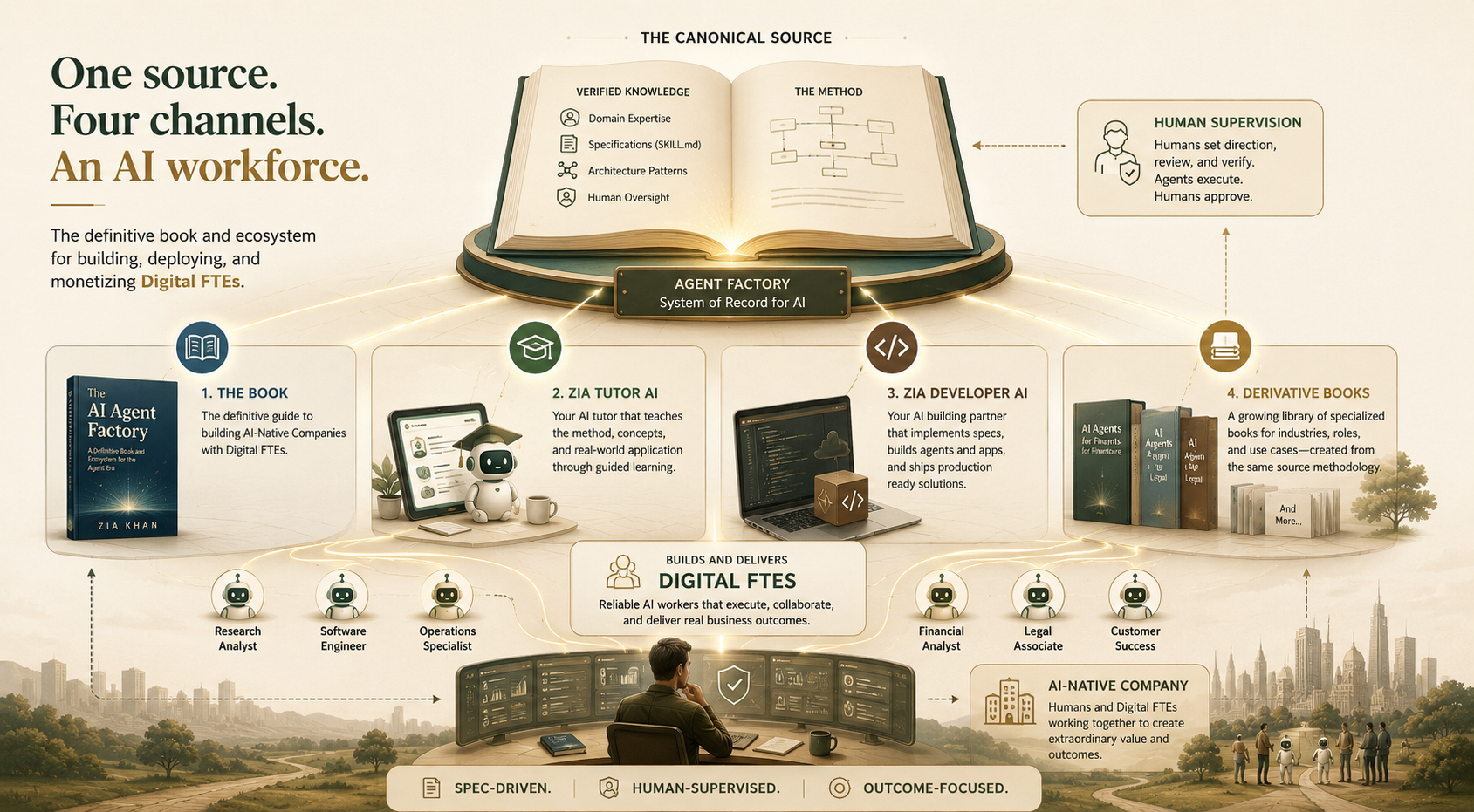
A canonical source for the Third Era of AI Tools, delivered through four channels: the book, an AI tutor, an AI building partner, and a growing family of specialized derivative books.
The spec-driven, human-supervised method for building AI-Native Companies. It is written for engineers, domain experts, and enterprise leaders building the workforce of the Agent era. It also trains its most in-demand role: the vendor-neutral Forward Deployed Engineer (FDE). This book teaches both how to build and how to earn. How to get paid for it is a series of its own.
Four Skills to Survive the Agent Era
AI already outperforms most human intelligence at more and more desk work. That is not a prediction. It is the current state, and the trend line only points one way. So the honest question is no longer "how do I stay smarter than AI?" That race cannot be won. The real question is different: what do you still need, when intelligence itself is cheap?
We believe the answer is four skills. Why these four and not others? Because each one passes the same test: it stays scarce when intelligence becomes cheap. AI is driving the cost of execution toward zero, in writing, analysis, code, and design alike. What it cannot drive down is the choice of what to build, the craft of directing the AI that builds it, the judgment of whether the result is true, and the trust between people. Any skill AI can absorb, it will absorb, and the price of that skill will collapse with it. These four sit where the collapse cannot reach.
Three of them form a loop: the same 10-80-10 Rule that runs through every chapter of this book. The fourth is the one thing the loop can never contain.
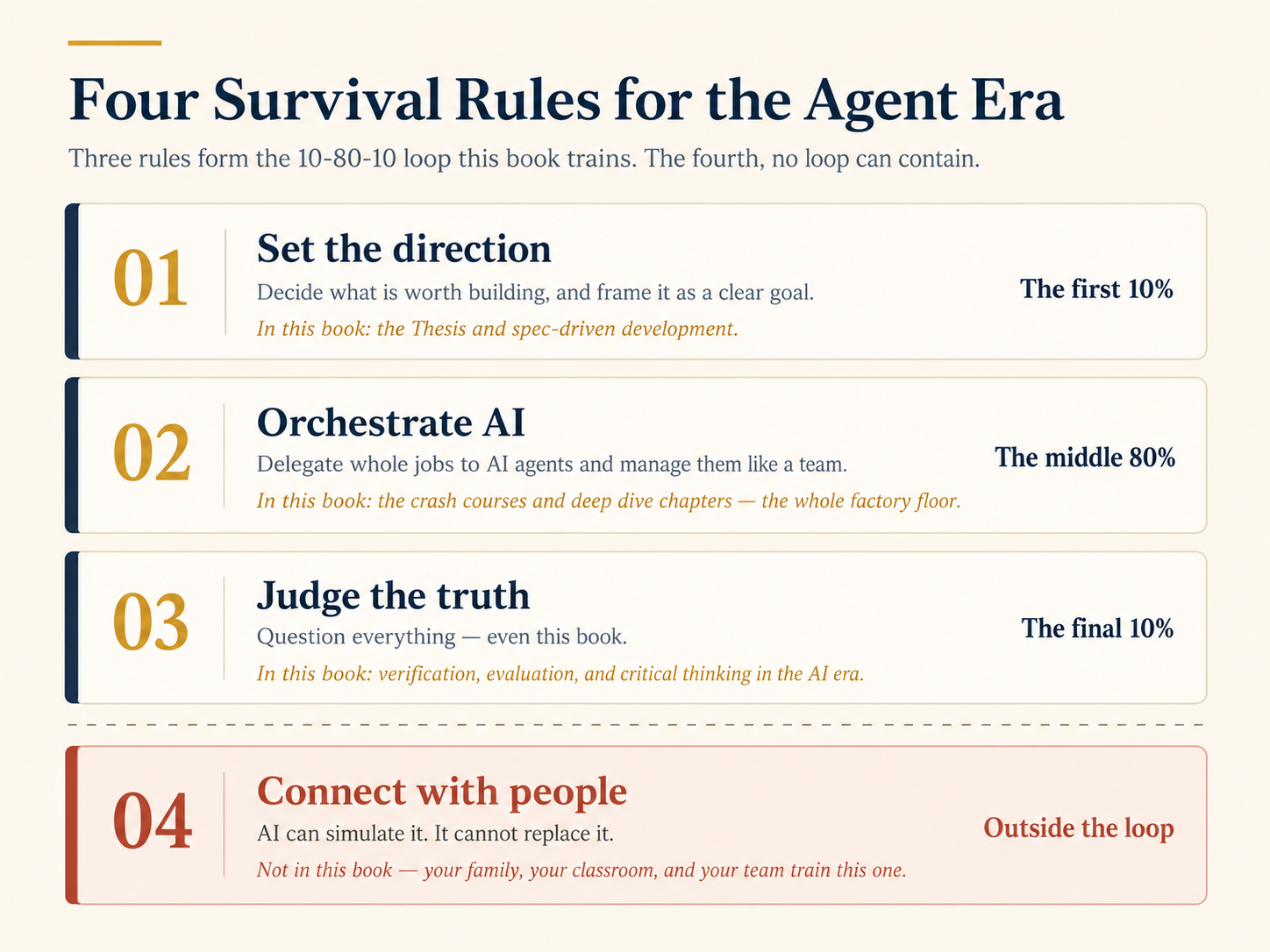
🎯 Set the Direction
🤖 Orchestrate AI
⚖️ Judge the Truth
🤝 Connect with People
What This Is
It is 8:07 a.m. A project manager is behind on a report. A finance lead is reconciling numbers across systems that don't talk to each other. A team is waiting on an answer that should have arrived yesterday. Now imagine each of them simply handed that work to a tireless digital coworker, one that follows instructions, uses the same tools they do, checks its own work, and hands back something they can trust. Building and directing that coworker is what this book is about.
A few plain words first, because the whole book leans on them:
- An AI Worker, also called a Digital FTE, is an AI that does a real job, not just answers a question. FTE means "full-time equivalent," the HR term for one employee's worth of work. Picture a new hire who never sleeps: you tell it what to do, it does the work, and a human still signs off.
- A general agent is the all-purpose assistant you direct, such as Claude Code, Claude Cowork, or ChatGPT. You either use it to get your work done, or use it to build one of those AI Workers.
- An AI-Native Company is what you get when one founder runs a real business with a handful of people and many AI Workers, instead of a large staff.
That is the whole idea. Everything else is how to do it well.
This book is not about chatbot tricks, impressive demos, or short-lived prototypes dressed up as strategy. It is about building dependable AI workers that can participate in real business operations. These systems do not replace human judgment. They extend it, scale it, and make it repeatable.
A note on terminology. Throughout this book, the terms Digital FTE, Digital Worker, and AI Worker are used interchangeably. They all name the same thing: a role-based AI agent that performs structured work inside an organization, under human oversight. The thesis uses AI Worker as its technical term. This book uses Digital FTE as its business-facing term.
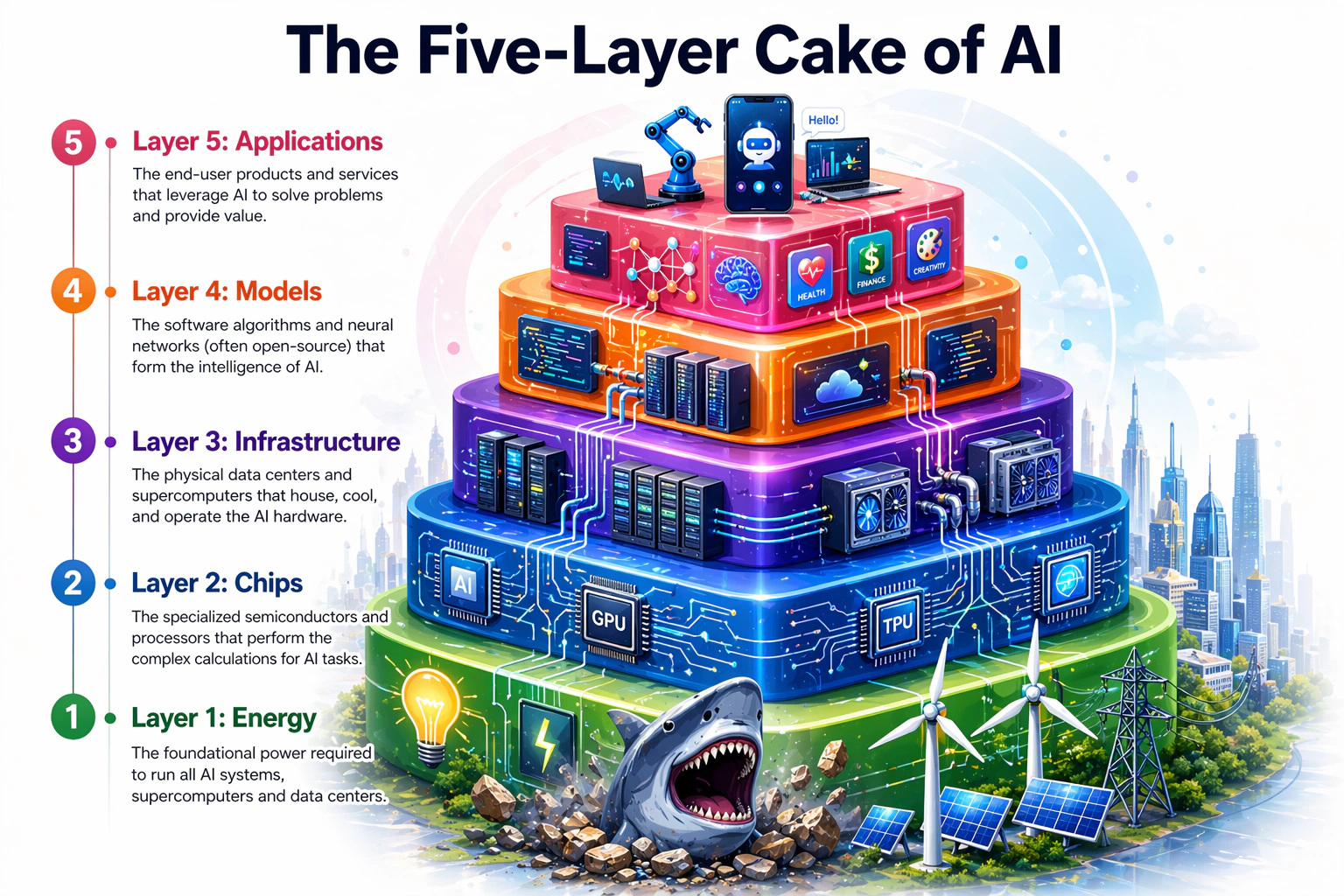
Modern AI is built like a five-layer cake, a metaphor popularized by Jensen Huang, CEO of NVIDIA. At the base lies Energy, powering vast data centers around the world. Above it sit Chips, the specialized processors that perform trillions of calculations every second. On top of that comes Infrastructure: the global network of supercomputers and cloud platforms that scale those computations. Above the infrastructure are Models, the neural networks that learn, reason, and generate intelligence. And finally, at the very top, sits the fifth layer, Applications, where AI stops being technology and starts becoming useful.
Billions of dollars are invested in the lower four layers so that this fifth layer can exist. This book is about that fifth layer. It teaches you how to build the applications, agents, and digital workers that transform AI capability into products people use, workflows organizations rely on, and value enterprises can capture.
The lower layers matter because they make the top layer possible. Models, infrastructure, and hardware are essential, but they do not create business value on their own. Value appears when intelligence is shaped into workflows, products, services, and operational systems that people can actually use.
The next competitive gap between organizations will not come only from who has the best model, the biggest GPU cluster, or the most impressive prototype. It will come from who can turn intelligence into repeatable execution. In the same way that software transformed manual processes into digital systems, Digital FTEs will transform structured knowledge work into scalable operational capability. The organizations that learn to build them well will move faster, preserve expertise better, and create entirely new forms of leverage.
The mission of The Agent Factory is to help you design and build these systems, so that AI becomes not just powerful, but useful, governable, and economically meaningful.
The Core Idea
At the center of this book is a simple idea:
Digital FTEs, also called Digital Workers or AI Workers, are reliable AI agents designed to perform structured knowledge work continuously inside real organizations.
A Digital FTE is more than a model with a prompt. It is a system that combines domain expertise, explicit specifications, engineering architecture, and human oversight. Those elements allow it to perform work consistently, auditably, and at scale.
The AI Agent Factory provides a systematic method for designing and deploying these workers. Together, they form the workforce of an AI-Native Company.
Rather than focusing only on large language models, this book explains how dependable agent systems emerge from the combination of four critical elements:
- Structured Specifications: clear definitions of what agents must do.
- Domain Expertise: the "knowledge engine" that guides reasoning and decision-making.
- Engineering Architecture: the infrastructure that ensures reliability and scalability.
- Human Oversight: the feedback loops that maintain accountability and governance.
Together, these elements enable the creation of agent systems that organizations can trust, deploy, and scale.
Digital FTEs are not only a technical construct. They are an economic one. They allow AI-Native organizations to package expertise, reduce execution bottlenecks, improve consistency, and create new service models, internal capabilities, and revenue streams. Built well, they do not merely automate tasks. They become scalable assets.
Why This Book Exists
Most organizations today, anywhere in the world, approach AI through isolated experiments: a prototype here, a chatbot there, a promising workflow demo that never quite makes it into daily operations.
What is missing is not excitement. What is missing is method.
Very few organizations have developed a repeatable way to build reliable AI agents that can function as a real part of the workforce. They may have access to strong models, talented people, and business demand, yet still lack the design discipline required to convert those ingredients into dependable digital workers.
This book introduces that method.
It explains how to identify valuable AI employee opportunities, turn expert knowledge into structured specifications, design bounded agent workflows, deploy them on reliable cloud-native infrastructure, and govern them with human oversight. In other words, this book teaches you to operate an Agent Factory: the process by which Digital FTEs (also called AI Workers) are designed, manufactured, and deployed inside an AI-Native Company. That process is spec-driven, which means you write a clear specification of the work first and then have the AI build to it. It is human-supervised, and it is powered by agent tools. We demonstrate the process using two tools that embody it: Claude Code, Anthropic's frontier coding agent, and OpenCode, the open-source, model-agnostic alternative. Skills, specifications, and architectural patterns written for one work in the other. The method is the constant. The tool is the variable.
There is a matching shortage on the other side of the table. Developers who could close this gap are struggling to find work as routine implementation gets cheaper every quarter. Many cannot yet name what they contribute once intelligence itself becomes a commodity.
One book can answer both shortages because they are the same problem seen from opposite sides. The method that makes AI land inside a real company is exactly the scarce skill that makes a developer worth hiring. The business series follows that thread all the way to a paid engagement.
By the end of this book, you will not simply understand agentic AI as an idea. You will understand how to manufacture dependable Digital FTEs as an organizational capability. These organizations will be AI-Native by default.
Find Your Path
Everyone climbs the same short ladder, and you can stop at any rung.
1. Foundations: start here. Begin with a handful of short courses in a web browser. You can use ChatGPT, Claude, or Gemini, with nothing to install. These are the skills everyone needs first. A doctor, an accountant, a student, and an engineer all take the same ones.
2. Mode 1: use AI to do your own work faster. With the basics in hand, you put AI to work on your real tasks: writing, analysis, planning, code. You stay the doer, and the AI is your power tool. Most people get enormous value and stop here.
3. Mode 2: build AI Workers that do the work for you. Going further, you use AI to build the tireless coworkers from the opening above. These Workers keep doing a job after you close the laptop. Now you are the builder, not just the doer.
4. The top of the ladder has a name. Learn to build AI Workers and combine them into a company that runs on them. You have then become the person the job market is paying top salaries to find: the Forward Deployed Engineer (FDE). An FDE walks into an organization and builds its AI workforce end to end. The full arc of this book fits in one line: you build AI Workers, and the Workers add up to an AI-Native Company. The Roles This Book Trains explains who this person is, what the market pays, and why companies need a vendor-neutral version of the role.
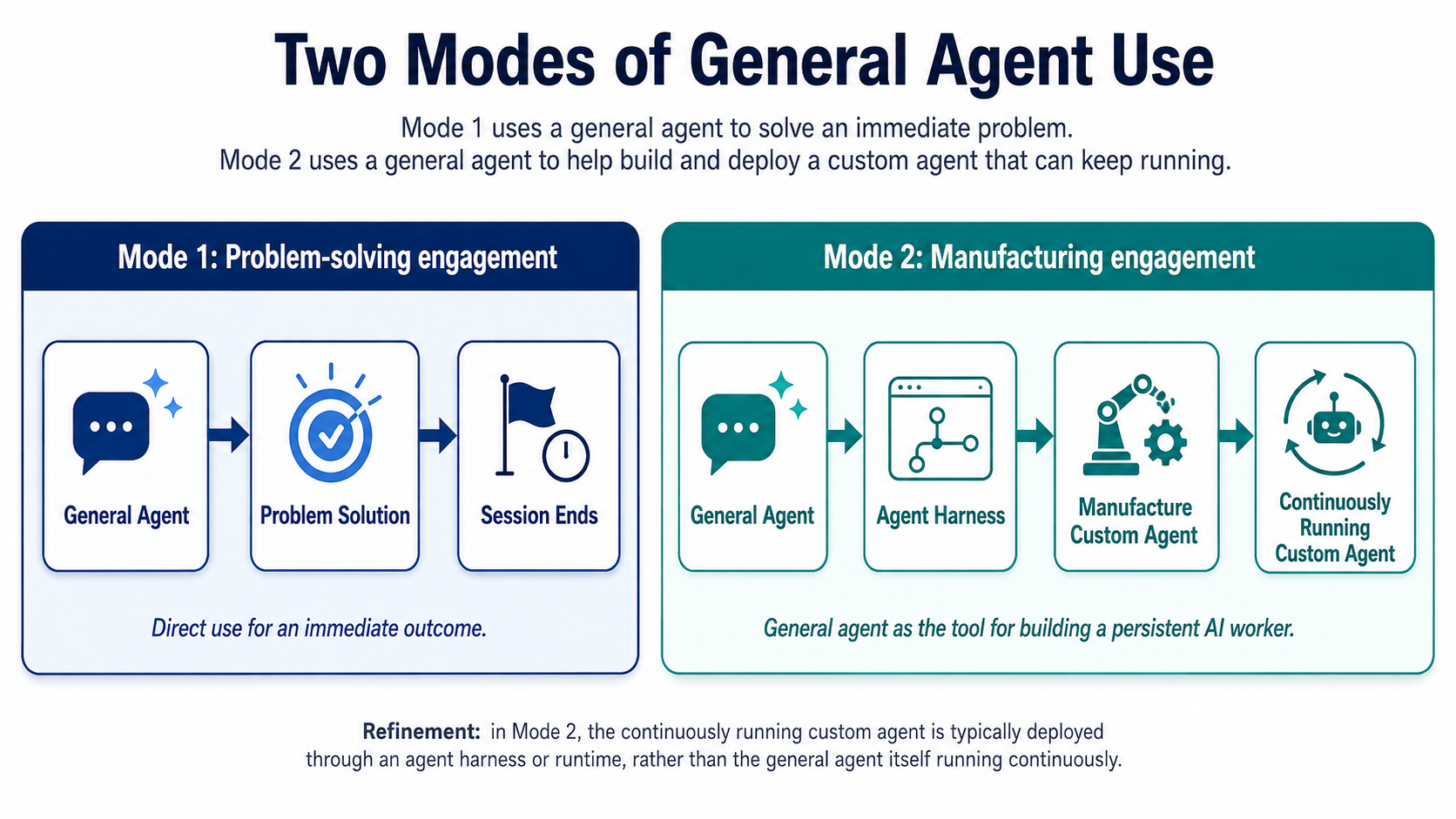
Mode 1 uses a general agent to solve a problem inside the session. Mode 2 uses a general agent to help manufacture a custom AI Worker that can keep running after the session ends.
You do not have to climb the whole ladder. Foundations plus Mode 1 is a serious skill set on its own. Getting Started walks you up it, course by course.
New to all this? Watch the short orientation first. It gives you the core idea in a few minutes, and once that clicks, every chapter that follows becomes easier to read.
View Full Presentation: The Agent Factory Orientation
Then read the Thesis for the vocabulary the rest of the book is built on: Digital FTE, AI-Native Company, the Two-Layer Model, the 10-80-10 Rule. From there, Getting Started: Crash Courses lays out the full path. Foundations come first (a good entry point is AI Prompting in 2026), then your mode, then the courses that match it. It is the same 10-80-10 rhythm the book teaches, applied to learning the book: the thesis sets the intent, the courses carry the execution, and your professional judgment closes the loop.
The Other Half: Getting Paid For It
Two things are true at the same time right now, and most people only ever look at one of them.
Developers cannot find work. Agents write a growing share of routine code, junior roles are thinning, and freelance boards are crowded with capable generalists bidding against each other and against the model itself. The honest question underneath the anxiety is not, "How do I get a job?" It is, "In an era where intelligence and code are cheap, what do I actually contribute?"
Companies cannot make AI work. They are starting AI projects everywhere, and about 95 percent of custom enterprise pilots show no measurable financial return (MIT, 2025). Not because the models are weak. Because nobody fits them into the company's real data, real rules, real approvals, and real people. This is the same problem Why This Book Exists names above. What is missing is not excitement. It is method.
Now put those two sentences next to each other, because that is what this book is for. One side has capable people with no way in. The other side has real money and no way through. The distance between them is not a talent shortage and not a technology shortage. It is a deployment gap, and it is exactly the width of one job.
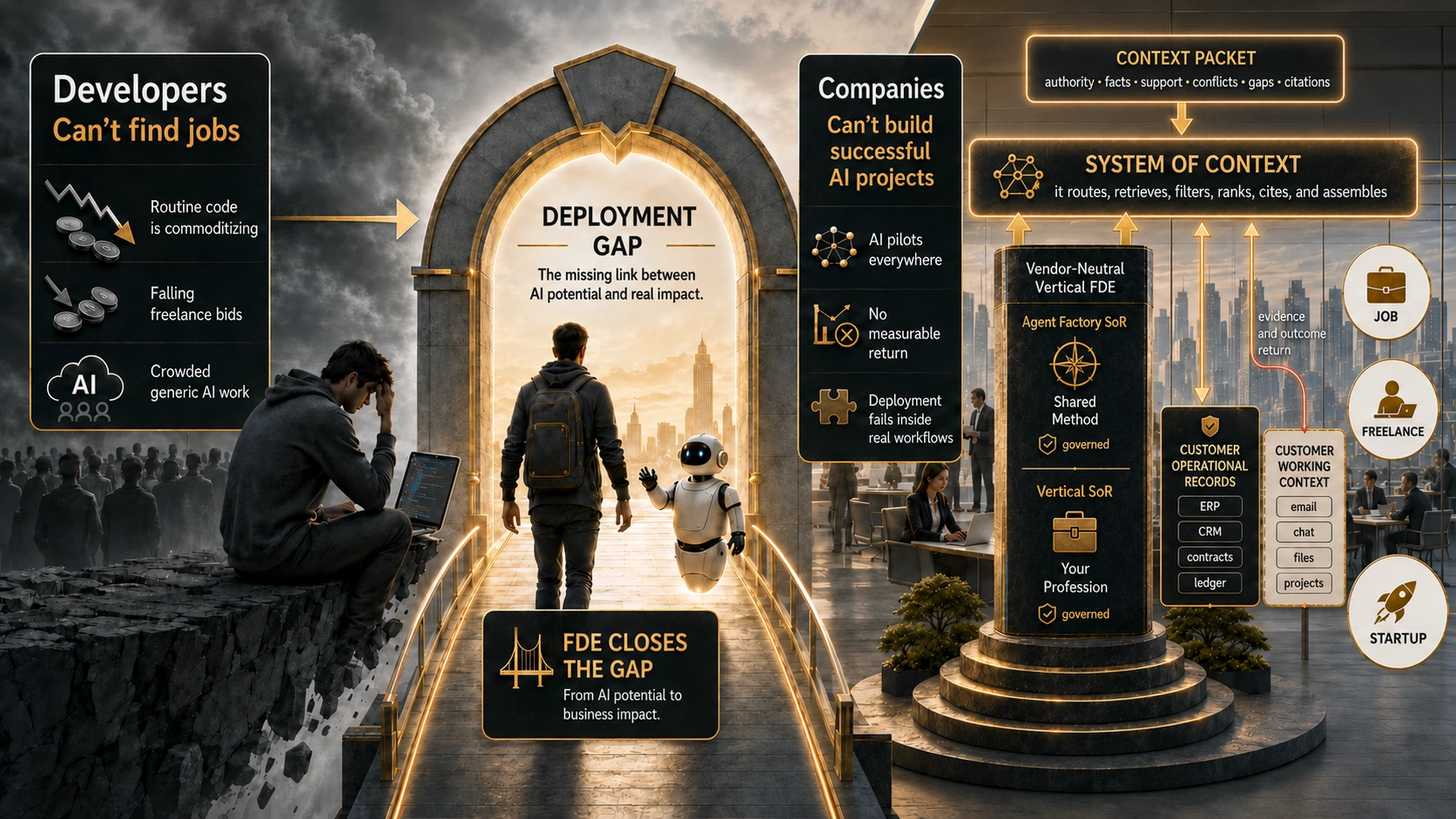
The technical half of this book teaches you to do that job. The business half teaches you to get paid for it, because a skill nobody buys is a hobby. That half is a series. It starts with the market, ends with your first invoice, and treats "How do I earn from this?" as an engineering question rather than a motivational one.
| The business series | The question it answers |
|---|---|
| The Roles This Book Trains | Which jobs did the Agent era create, what do they pay, and which seat fits me? |
| The Ecosystem | What does a working example of all this actually look like? |
| The FDE AF Model | What are the five layers, and where does a graduate earn at each one? |
| What You Carry In: The Ownership Argument | Of everything I value, what do I actually own? |
| Choosing Your Vertical | Which one profession, in which one country, and with which expert? |
| Designing the Vertical SoR | How do I design that profession's System of Record from first principles? |
| Getting Paid as a Vertical FDE | The capstone: the whole roadmap, what each route pays, how to price it, and where to start. |
The capstone lands on one argument. It is the commercial form of the four survival skills above. When intelligence and code get cheap, the market pays less for what you can do because more rivals can do it. It pays for what you hold. So the series helps you build something you can hold: one profession's governed knowledge, in one jurisdiction, created with a real expert. Carry that asset into a company that needs it, and you become the role the market is spending billions to find and cannot fill: the vendor-neutral vertical Forward Deployed Engineer.
Three routes lead out of that, and the same asset works behind all three.
The Job
The Open Market
Your Own Startup
The capstone says one thing plainly, and it is worth repeating here: the honest version travels further than the exciting one. Most readers will earn first by building governed knowledge systems and AI Workers for clients, using only what this book gives everyone. That work needs no domain expert or vertical of your own, and it pays soonest.
Your own vertical business is the larger prize and the harder gate. That gate is a person, not a skill: a senior professional willing to build it with you. The series is designed so the first route can fund the search for that person. Stopping at the first route is also a real outcome, not a failure.
Who This Book Is For
This book is written for the cross-functional teams building the Agentic Enterprise. These groups often speak different professional languages, chase different priorities, and measure success in different ways. But Digital FTEs can only be built well when those groups work together, and this book gives them a shared framework. All of them are participating in the same larger project. And every reader type below maps to a named role in the Agent era's new job market. The full map is The Roles This Book Trains.
| Reader Type | Role in the Agentic Enterprise | What You Will Gain |
|---|---|---|
| AI Developers & Engineers | Build infrastructure and systems | Architectural patterns, spec-driven development, and cloud-native deployment. |
| Domain Experts & Professionals | Provide knowledge to guide behavior | Methods for converting expertise into reusable AI skills and Digital FTEs that power AI-Native Companies. |
| Enterprise Executives | Lead organizational adoption | Governance models, risk controls, and deployment strategies for enterprise AI. |
| Product Managers & Architects | Translate business needs into systems | Frameworks for decomposing workflows into skills and verifiable outputs. |
| Department Leaders & Operators | Apply AI to operational processes | Techniques for turning internal playbooks into scalable Digital FTE workflows. |
AI Developers, Software Engineers & Platform Architects
The Builders
Developers and architects are responsible for turning the promise of agentic AI into production-grade systems. Many AI applications never leave the fragile prototype stage. This book introduces a systematic engineering approach to:
- Design agents using spec-driven development.
- Build scalable systems with cloud-native architectures (Docker, Kubernetes, Dapr).
- Implement secure and auditable tool interfaces.
- Structure reusable skill libraries that encapsulate domain expertise.
Subject Matter Experts & Domain Professionals
The Knowledge Holders
The most valuable AI systems depend on deep domain knowledge. Professionals in accounting, law, finance, and supply chain possess judgment that serves as the guiding structure for AI behavior. You will learn to encode that expertise into structured artifacts, specifically SKILL.md specifications. A SKILL.md is a plain-text file that packages a skill an AI can load and follow. Written well, it holds the division of labour in place:
AI executes routine reasoning, while professionals provide judgment, oversight, and accountability.
Enterprise Executives & Technology Leaders
The Decision Makers
Senior leaders must move from isolated experimentation to reliable enterprise deployment. This book provides a strategic roadmap for:
- Establishing governance models and risk controls.
- Implementing human-in-the-loop supervision.
- Executing phased adoption from pilot programs to enterprise-wide scale.
AI Product Managers & Solutions Architects
The Translators
You play a critical role in decomposing complex business processes into automated tasks. This book offers practical guidance for:
- Mapping workflows into agent skills.
- Defining boundaries between automated reasoning and human decision-making.
- Designing verifiable outputs and evaluation processes.
Department Leaders & Operational Teams
The Operators
Department leaders often manage workflows that are highly structured but time-intensive. This book shows how to transform internal playbooks into repeatable agent workflows to:
- Reduce repetitive analytical work and improve consistency.
- Extend expertise across the entire organization.
- Build digital capabilities that operate continuously.
How It's Delivered: One Source, Four Channels
One source powers four channels. When that source gains a new escalation protocol, a refined pattern, or a sharper definition, every channel inherits the update. Models, harnesses, and languages may change. The source remains.
📘 The Book
🎓 Zia Tutor AI
🛠️ Zia Developer AI
📚 Derivative Books
Together, the four channels reach people wherever learning and building happen. Derivative books travel across languages, age groups, and professions. Zia Developer AI works inside Claude Code and OpenCode, coding agents already in developers' hands. Zia Tutor AI meets learners in the chat tab and runs on each learner's own free Claude, so it can scale to anyone, anywhere, at no cost to serve.
Three Modes of Delivery
Readers can use the same knowledge base in three ways: read it directly, learn through an AI tutor, or build with an AI partner.
Human Reading
Zia Tutor AI
Zia Developer AI
Zia Tutor AI and Zia Developer AI make the same architectural move for different hosts. The tutor extends claude.ai for learners. The developer extends Claude Code or OpenCode for builders. The ecosystem teaches both patterns and runs on them.
Because all three modes draw from one knowledge base, a correction in the book reaches the tutor's teaching and the developer's guidance at the same time. The book is not a static artifact. It is the source of truth for a learning and development ecosystem.
This applies the 10-80-10 pattern to education. The book sets intent in the first 10% through domain knowledge, frameworks, and professional standards. Zia Tutor AI and Zia Developer AI handle the middle 80% through personalized teaching and step-by-step building guidance. You provide the final 10%: the professional judgment that confirms the agent is correct, the deployment is safe, and the knowledge is sound.
Two Tools, One Discipline
Claude Code and OpenCode are not competitors in this book. They are two expressions of the same discipline.
Why two tools, not one? Because this discipline must outlive any specific tool. Its core practices, spec-driven design, skill-based architecture, and human oversight, are portable by construction. Binding the method to one vendor would contradict its premise. It would also expose readers to risks they cannot control, including pricing changes, access restrictions, and strategic shifts. And it would exclude readers whose economic, regulatory, or architectural constraints make the dominant tool inaccessible.
Frontier-first
Open & model-agnostic
Both implement the same patterns this book teaches. Skills, subagents, hooks, MCP servers (MCP is the standard way an agent plugs into outside tools and data), and the spec-driven workflow work identically in both. A SKILL.md written for Claude Code drops into .opencode/skills/ and runs unchanged. The discipline is portable.
A System of Record for the Agent Era
Jensen Huang, CEO of NVIDIA, has argued that AI agents do not remove the need for systems of record. They reinforce it. A system of record is the single trusted source of truth that a business reads from, writes to, and verifies against. Agents need that ground truth. Without it, agents hallucinate. With it, they execute.
Huang is solving this for the enterprise. The databases, workflows, and operational platforms that companies have spent decades building become more essential in the agent era, not less. Agents do not replace SAP or ServiceNow. They use them, at machine scale.
But there is a layer Huang is not solving for: the human layer.
Millions of developers, architects, and domain professionals are about to build AI agents. Most of them have no canonical source to learn from. No structured body of knowledge that has been designed for verification, not just consumption. They are learning from scattered tutorials, outdated blog posts, and model outputs that may or may not reflect how production agent systems actually work.
When those developers move from learning to building, they face the same problem in a different form. Their AI coding partners draw on whatever patterns the model happens to surface. Those patterns may never have been verified, bounded, or designed to produce dependable Digital FTEs. Without a verified source, both human learning and AI-assisted building inherit the same fragility.
The AI Agent Factory Book is a system of record for agentic AI education and construction. It is also shipped as one. The Agent Factory System of Record serves the book's content over MCP, so Claude, ChatGPT, Claude Code, Cowork, or any custom agent can connect to it and ground itself in the book.
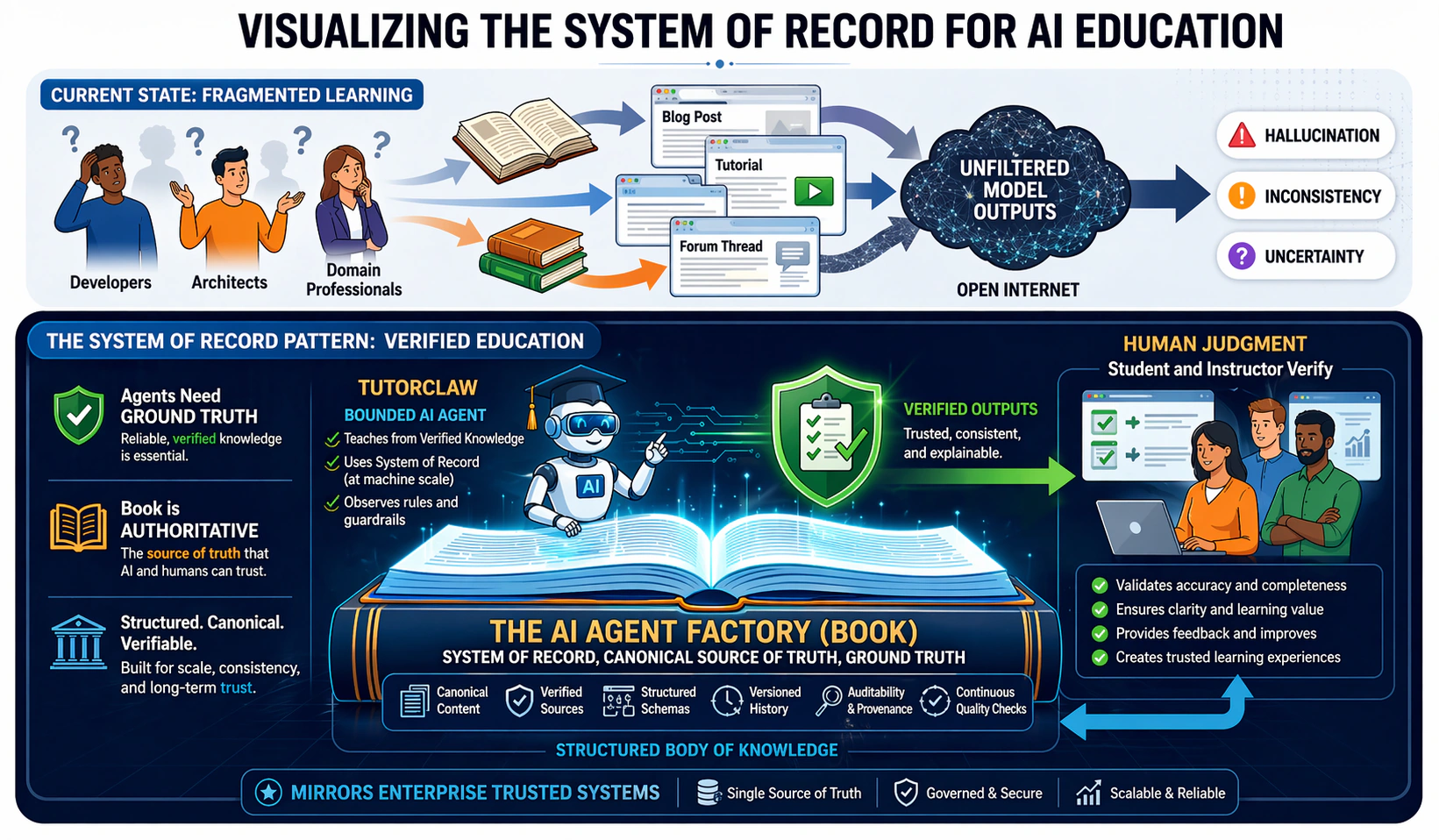
This is not a metaphor. The book's architecture follows the same pattern Huang describes for enterprise systems:
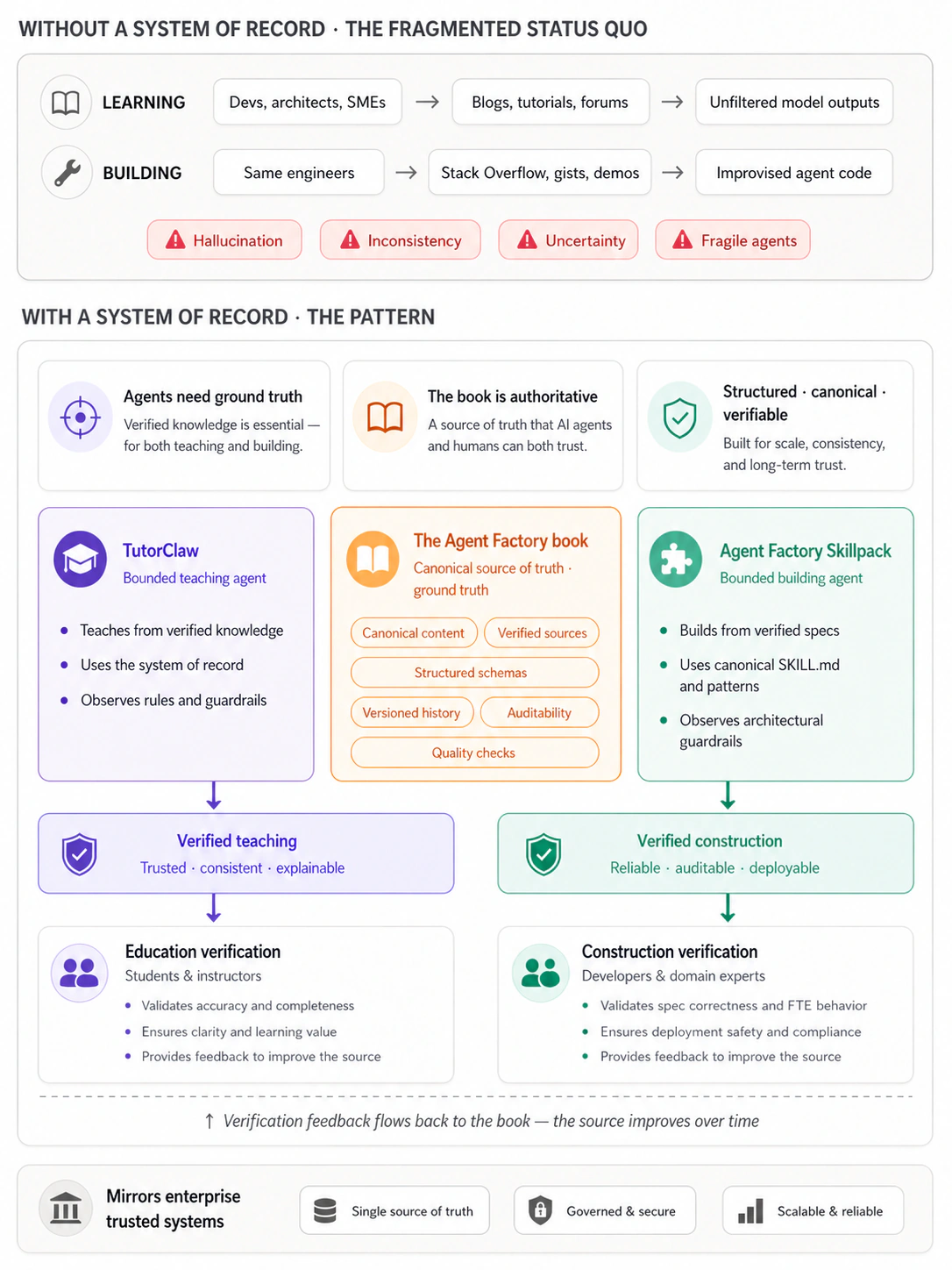
- The book is the canonical source of truth: it defines what agents are, how they are built, and how they are governed. The Agent Factory System of Record serves that knowledge to every connected agent.
- Zia Tutor AI is the teaching agent: it reads from the book, not the open internet, and teaches from verified knowledge rather than probabilistic generation.
- Claude Code and OpenCode are the building agents: equipped with Zia Developer AI, they read from the book rather than Stack Overflow or scattered tutorials. They construct Digital FTEs and AI-Native Companies from verified specifications, SKILL.md templates, and architectural patterns rather than improvised code.
- Human judgment is the verification layer: students, instructors, developers, and domain experts confirm that the teaching and the construction match the book's intent. This is the final 10% of the 10-80-10 pattern.
But education was only half the story. The same pattern extends to construction, and once you draw both pipelines side by side, the symmetry becomes the architecture itself.
The pattern does not stop at education and construction. The same source feeds a third lane: a growing family of derivative books. Each is specialized by topic or audience while inheriting the same vocabulary, architecture, and standards.
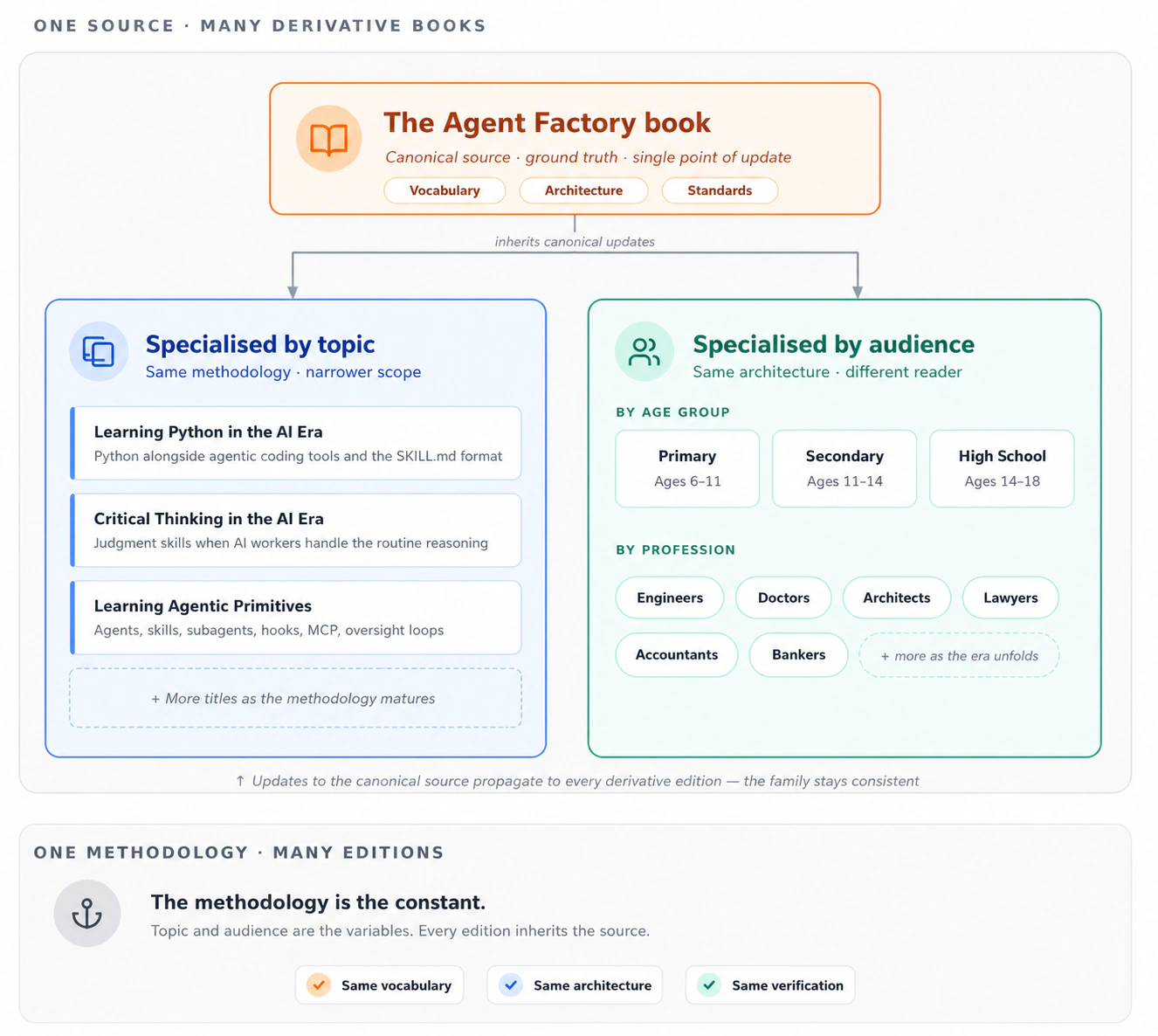
The topic axis. Some derivatives narrow the scope to one discipline that the Agent era is reshaping. Learning Python in the AI Era teaches Python alongside agentic coding tools, spec-driven workflows, and the SKILL.md format used by Claude Code and OpenCode. Critical Thinking in the AI Era develops the judgment required when AI Workers handle routine reasoning. Learning Agentic Primitives compresses foundational concepts such as agents, skills, subagents, hooks, MCP, and oversight loops into a focused primer. More titles will follow as the methodology matures.
The audience axis. Other derivatives keep the methodology constant but rewrite it for the reader. Editions for primary, secondary, and high-school students introduce age-appropriate framings of the same architectural ideas, so a high-school student can build their first SKILL.md using the same vocabulary their professional counterpart will use a decade later. Profession-specific editions adapt the material for engineers, doctors, architects, lawyers, accountants, bankers, and other domains where the workforce is being redrawn around Digital FTEs. The framework is constant. The examples, the priors, and the depth shift to meet the reader where they are.
When the canonical methodology is updated, whether with a new escalation protocol, a refined architectural pattern, or a sharper definition, the update propagates through the entire family. Every derivative inherits the correction.
And there is a deeper symmetry at work. This book does not merely use a system of record. It teaches you how to build agents that use systems of record, and it powers the very building agents (Claude Code and OpenCode, equipped with Zia Developer AI) that help you construct them. The architecture of the learning system, the architecture of the construction system, and the content of the curriculum all mirror each other. You learn the pattern by experiencing it. You build the pattern by using it.
This section raises one more question: if the book is a System of Record, what is the plan for building on it? That plan has a name: The FDE AF Model. It is the five-layer blueprint that turns this System of Record into vertical AI-native businesses, arranged into layers our graduates can build on and earn from.
The same principle runs one layer down into the infrastructure. The Digital FTEs you build need a literal system of record too. The book's stance is consolidate by default, specialize deliberately: use one Postgres for relational data, documents, full-text search, and AI vectors rather than scattering them across systems that drift out of sync. See the Thesis for the architecture and Give Your AI Searchable Context for the build.
Building the Agentic Enterprise
Agentic AI is not a feature. It is a workforce. The next generation of companies will be built around it, just as the last generation was built around software. The discipline used to design, manufacture, deploy, and govern that workforce will decide who wins the next decade.
That contest is global by definition. It will not be won by whoever has the largest model or the deepest GPU stack. It will be won by whoever can turn AI capability into reliable, governable, repeatable execution at the workforce layer. The teams that win it will not all sit in the same handful of cities. They will sit anywhere ambitious people with internet access and a working knowledge of agentic engineering decide to build.
The evolution of AI tools points to where lasting value sits. In the first era, the model was the product. In the second, the harness became the product: Claude Code, OpenCode, Cursor, and the agentic coding environments where models do their work. Some now describe SDKs, plugins, and vendor-specific extension layers as the third era.
We sit one layer above that. By the third era, we mean the point at which the discipline that runs across harnesses and their platforms becomes the product. The model commoditizes. The harness commoditizes. The harness platform commoditizes. What survives all three is the methodology, vocabulary, verification standards, and SKILL.md library that any compatible harness can load and run.
Why does that discipline suddenly matter so much? Because of where the economics are heading.
"We're going to see ten-person billion-dollar companies pretty soon — billion-dollar valuations. In my little group chat with my tech CEO friends, there's this betting pool for the first year that there is a one-person billion-dollar company — which would have been unimaginable without AI — and now it will happen."
— Sam Altman, OpenAI, in conversation with Alexis Ohanian, January 2024 (video · analysis)
Anthropic CEO Dario Amodei has since narrowed the timeline. He gave the first single-person billion-dollar company a strong majority chance of arriving soon and named developer tools, automated customer service, and proprietary trading as the most likely categories. Within months, the first concrete example appeared: a solo founder built a telehealth business to hundreds of millions in first-year revenue using rented infrastructure and AI agents in place of employees. More examples are arriving every quarter.
The architectural shape they build is the one Altman and Amodei describe: a source the founder owns, AI agents executing work that historically required teams, and rented infrastructure carrying the rest. That rented layer includes harnesses, messaging platforms, and model providers.
The Agent Factory ecosystem is one example of this shape. The book is the source of truth. Zia Tutor AI teaches, and Zia Developer AI builds, doing work that would normally require a team. The chat apps, coding tools, and AI models are rented from other companies rather than built from scratch. The book teaches readers to build companies of this shape, and the ecosystem they are reading from is one. The FDE AF Model provides the full blueprint, layer by layer, including where a graduate can earn at each layer.
The reader who finishes this book understands more than agentic AI as an idea. They can identify work that should become a Digital FTE and specify the agent that performs it. They can also deploy the architecture that runs it and govern the workforce that emerges from it.
The goal is simple: move beyond AI curiosity and into AI execution. Expertise becomes operational. Workflows become repeatable. Capabilities become products. Organizations gain a new kind of workforce: digital, dependable, and built by design. The people who learn to build that workforce gain leverage no previous generation of knowledge worker has had.
The Agent Factory ecosystem exists to put that leverage in their hands.